
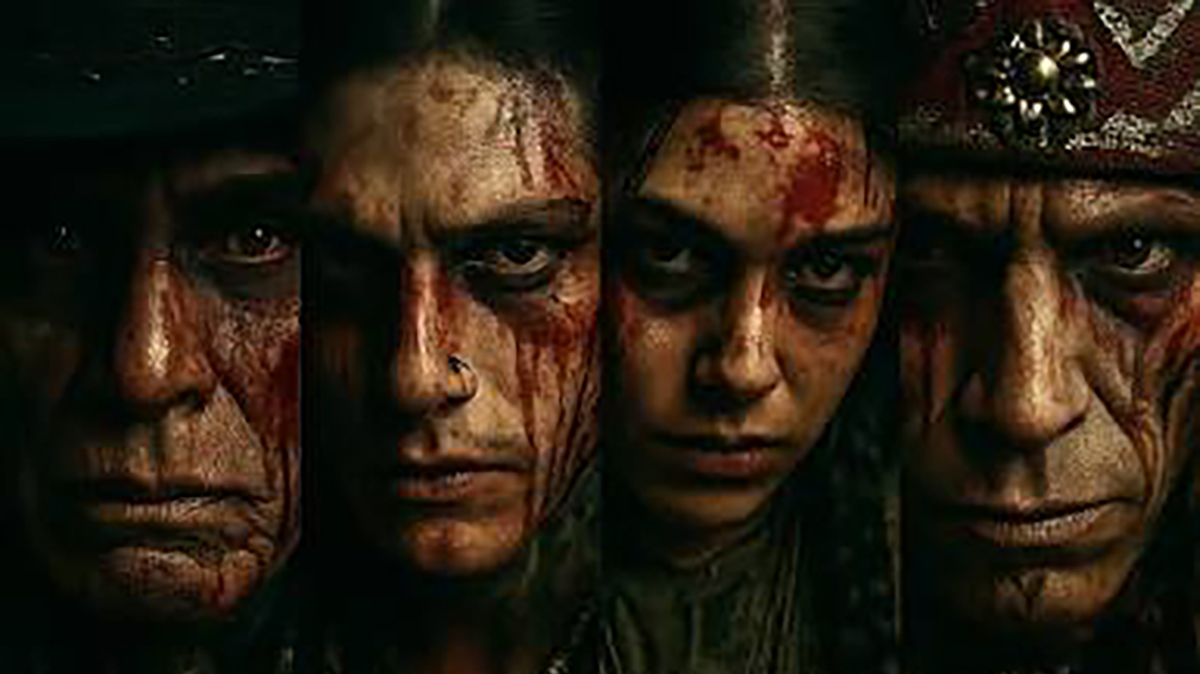
Independent filmmaker John Kalning brings vampires back to the Old West, inspiring a look at more than six decades of movies that have combined gunslingers with the supernatural.
The mysterious stranger riding into town is one of the most enduring images of the American Western. Sometimes he’s a hero, sometimes an outlaw and, every now and then, a vampire. It’s a combination of genres that filmmakers have been exploring since the 1950s, with everyone from Universal Pictures to directors Kathryn Bigelow, Robert Rodriguez and John Carpenter finding different ways to bring the undead to the American frontier.
The tradition continues with independent filmmaker John Kalning’s The Good, the Bad and the Bloodthirsty: The Four Horsemen, a short film that brings something different to the vampire Western, both in terms of its subject matter and the technology used to create it.
1. ‘The Good, the Bad and the Bloodthirsty: The Four Horsemen’ (2025)
Four Native American vampires arrive in an Old West town with unfinished business. Unlike the mysterious gunslingers of so many traditional Westerns, these riders are motivated by a desire to reclaim their heritage. Written, directed and edited by John Kalning through his independent filmmaking studio Neural Punks, the six-minute short was brought to the screen using AI-assisted filmmaking. As reported by Bloody Flicks, the film has already earned festival recognition, receiving an award at the 2025 Malibu Film Festival and taking Silver in the Best AI Short category at the Bali International AI Film Festival. It was also screened at the Detroit International Festival of Darkness.
Kalning comes to independent filmmaking with considerable experience in traditional Hollywood production, having held executive positions at companies including Lionsgate and Entertainment One.
An element that really stands out about his project is the opportunity to explore the mythology of the vampire Western from the perspective of Indigenous characters. The traditional Western has often told its stories from the viewpoint of settlers, lawmen and outlaws, with Native Americans relegated to supporting roles. Here, they occupy the center of the narrative.
There’s also the technological dimension. Period horror, particularly a production involving supernatural creatures and elaborate Western settings, presents considerable financial challenges for independent filmmakers. Emerging AI tools offer another means of approaching those challenges.
Kalning’s film joins a small but remarkably varied collection of vampire Westerns stretching back more than six decades. Some take place on the frontier itself, while others transplant the familiar conventions of the Western into contemporary America. What follows is a guide to 10 other films that have explored this unusual combination of genres.
2. ‘Curse of the Undead’ (1959)

One of Hollywood’s earliest vampire Westerns came courtesy of Universal Pictures, the studio that had helped define the screen vampire with Bela Lugosi’s Dracula nearly three decades earlier. Michael Pate stars as Drake Robey, a mysterious gunslinger whose arrival in a Western town coincides with a series of deaths. Eric Fleming, who would become familiar to television viewers as Gil Favor on Rawhide, plays a preacher who discovers that his adversary is considerably more dangerous than an ordinary hired gun.
3. ‘Billy the Kid Versus Dracula’ (1966)

Subtlety was clearly not a consideration when director William Beaudine brought together two of the most recognizable names in outlaw and supernatural folklore. John Carradine, who had previously portrayed Dracula in Universal’s House of Frankenstein and House of Dracula, returns to the role. Chuck Courtney plays Billy the Kid, who finds himself protecting his fiancée from the Count. The film was released on a double bill with another wonderfully improbable horror Western, Jesse James Meets Frankenstein’s Daughter.
4. ‘Near Dark’ (1987)

Director Kathryn Bigelow dispensed with the traditional Gothic trappings of the vampire movie with Near Dark, instead presenting her bloodsuckers as a nomadic band of outlaws roaming the contemporary American Southwest. Adrian Pasdar plays a young man drawn into their world after an encounter with a mysterious woman played by Jenny Wright. Lance Henriksen, Bill Paxton and Jenette Goldstein portray members of the vampire clan. Released the same year as The Lost Boys, the film offered a considerably grittier take on youthful encounters with the undead.
5. ‘Sundown: The Vampire in Retreat’ (1989)
Director Anthony Hickox takes a more comedic approach to the vampire Western with this story of an isolated desert community populated by vampires attempting to abandon their dependence on human blood. David Carradine leads the community as Count Mardulak, while Bruce Campbell plays a descendant of the legendary vampire hunter Van Helsing. Naturally, not everyone is enthusiastic about the prospect of peaceful coexistence, leading to a conflict that owes as much to traditional Westerns as it does to vampire mythology.
6. ‘From Dusk Till Dawn’ (1996)
Written by Quentin Tarantino and directed by Robert Rodriguez, the film begins as a crime thriller about two fugitive brothers, played by George Clooney and Tarantino, making their way across the Mexican border. Their destination turns out to be a remote bar populated by vampires, among them Salma Hayek’s memorable Santanico Pandemonium. The resulting battle for survival draws on the familiar Western premise of a group of people trapped in an isolated location and forced to confront a seemingly overwhelming threat.
7. ‘John Carpenter’s Vampires’ (1998)
Given John Carpenter’s lifelong admiration for Westerns, particularly the films of Howard Hawks, it seemed almost inevitable that his interpretation of the vampire would incorporate elements of the genre. Based on John Steakley’s novel Vampire$, the film stars James Woods as Jack Crow, the leader of a vampire-hunting team operating in the American Southwest. Carpenter approaches the material with the sensibility of a modern Western, replacing traditional lawmen and outlaws with professional vampire hunters and their supernatural adversaries.
8. ‘From Dusk Till Dawn 3: The Hangman’s Daughter’ (1999)
While the original From Dusk Till Dawn incorporated elements of the contemporary Western, this prequel takes the franchise back to the early 20th century. Directed by P.J. Pesce, the film follows an escaped outlaw, the daughter of his would-be executioner and American writer Ambrose Bierce, played by Michael Parks. Their paths converge at an establishment harboring a familiar supernatural threat. The film also explores the origins of Santanico Pandemonium, connecting its period setting to the events of the original movie.
9. ‘BloodRayne 2: Deliverance’ (2007)
More than 40 years after Billy the Kid battled Dracula, the legendary outlaw found himself on the other side of the vampire equation. In director Uwe Boll’s sequel to BloodRayne, Natassia Malthe assumes the role of Rayne, the half-human, half-vampire heroine introduced in the video game franchise. Arriving in the Old West, she confronts a vampiric Billy the Kid, played by Zack Ward, who has ambitions of establishing his own supernatural army.
10. ‘Death Rider in the House of Vampires’ (2021)
Musician and filmmaker Glenn Danzig combines his affection for European horror and spaghetti Westerns in this story of a mysterious rider seeking entry to a sanctuary populated by vampires. Devon Sawa stars as Death Rider, with a supporting cast that includes Julian Sands, Kim Director, Danny Trejo and Danzig himself. The film embraces the eccentric possibilities of the vampire Western, creating a frontier populated by supernatural variations on the genre’s familiar characters.
11. ‘Sinners’ (2025)
Although set in Mississippi in 1932 rather than the traditional Old West, writer-director Ryan Coogler’s Sinners draws considerably on the storytelling traditions of the Western. Michael B. Jordan plays twin brothers who return home and establish a juke joint, only to find their community threatened by vampires. Coogler combines the supernatural with the history of the American South, racial oppression, cultural identity and the power of blues music. Its central confrontation also recalls the classic Western siege film, in which a group of people must defend an isolated building against an encroaching enemy.
It’s a reminder of how much room there remains for filmmakers to reinvent the vampire Western, a tradition that continues with independent productions like The Four Horsemen.