
Listen to this artlce as read by Vampire & Slayers’ own Victoria
Nearly 40 years after Kathryn Bigelow sent a murderous family of vampires tearing across the American Southwest, Near Dark may be getting another chance at life. A24 is developing a television series based on Bigelow’s 1987 cult classic, according to Dread Central, although “developing” remains the key word. There’s no writer, showrunner, director or cast attached publicly, nor has a network or streaming service been announced.
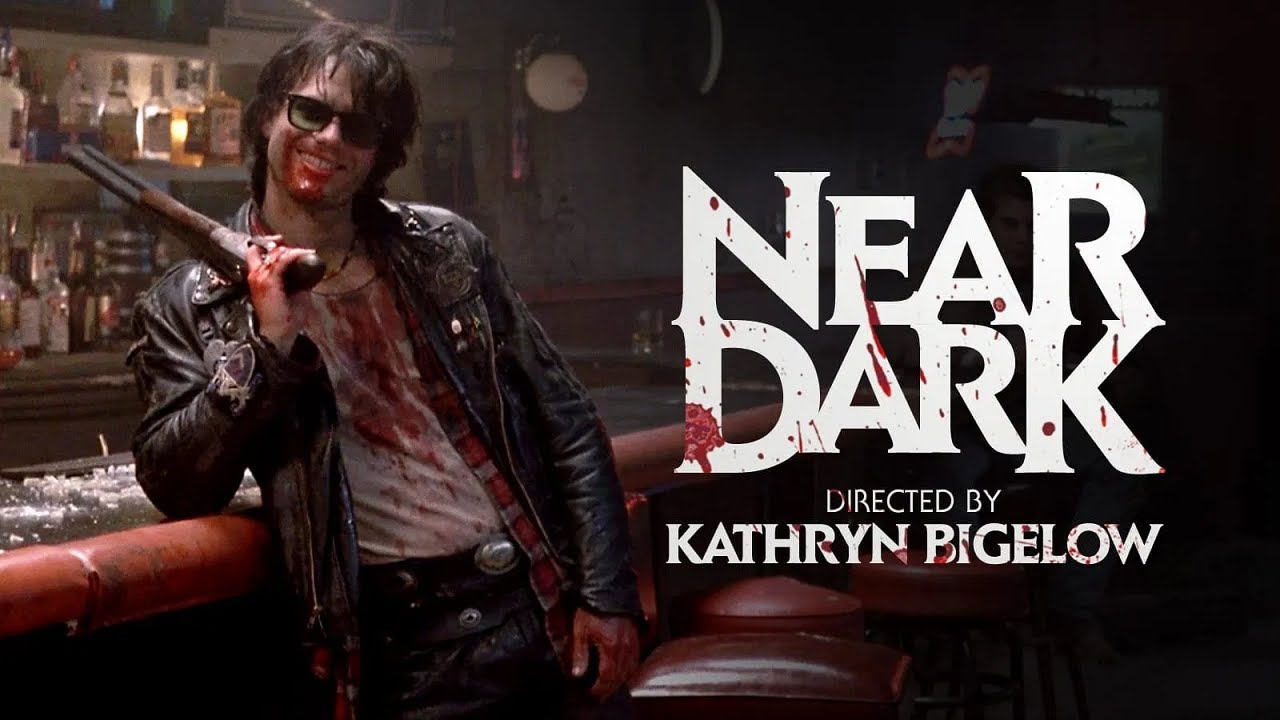
Even so, Near Dark is an intriguing property to resurrect. Starring Adrian Pasdar as Caleb Colton, the film follows a young man whose encounter with the mysterious Mae (Jenny Wright) results in him being unwillingly drawn into a nomadic family of vampires. The group is led by Lance Henriksen’s Jesse Hooker and also includes Diamondback (Jenette Goldstein), the gleefully psychotic Severen (Bill Paxton) and the eternally young Homer (Joshua John Miller).
Bigelow and co-writer Eric Red took vampires out of their traditional gothic surroundings and dropped them onto the highways and back roads of contemporary America. There were no castles or capes, and virtually none of the familiar Dracula iconography. Instead, these vampires traveled in stolen vehicles, hid out in cheap motel rooms and hunted in roadside bars, creating a bloody collision between the vampire film and the American Western.
Near Dark wasn’t a hit when it opened in 1987, but over the decades its reputation has grown enormously. While we wait to discover what A24 intends to do with it, here are nine things you may have forgotten — or never knew — about the original film.
1. Kathryn Bigelow Really Wanted to Make a Western
The Western influence in Near Dark wasn’t accidental. Bigelow and Red were interested in making a Western at a time when Hollywood had little appetite for the genre, which made getting one financed extremely difficult. Their solution was to combine the Western with something producers were considerably more interested in: horror.
Once they made that decision, the two genres proved surprisingly compatible. Jesse and his clan aren’t aristocratic immortals hiding away in a European castle; they’re essentially an outlaw gang riding across America. Their world consists of highways, isolated towns, guns, bars, cheap lodging and wide-open landscapes, and they can never remain in one place long enough for civilization to catch up with them.
Bigelow has subsequently described Near Dark in terms of that hybridization, and it’s one of the reasons the film remains so distinctive. Strip away the supernatural elements and Caleb’s story isn’t far removed from the classic Western tale of an ordinary young man falling in with a band of dangerous outlaws and discovering that joining them is considerably easier than escaping.
2. Nobody Ever Calls Them Vampires
Despite Near Dark becoming one of the most celebrated vampire movies of the 1980s, the film never actually uses the word “vampire.” That’s consistent with Bigelow and Red’s decision to remove much of the traditional mythology and ask a more practical question: if vampires actually existed in modern America, how would they survive without being discovered?
That meant leaving behind most of the familiar Dracula baggage. There are no coffins, bats, crosses, garlic or wooden stakes. Instead, Bigelow and Red concentrated on the fundamentals that mattered to their story. These creatures need blood, possess extraordinary strength, don’t appear to age and cannot survive exposure to sunlight.
Red reasoned that creatures like that would have to remain mobile. If bodies started piling up in one town, eventually someone would notice, so Jesse’s clan travels constantly, feeding and then disappearing before authorities can connect the crimes. That simple bit of logic helped transform Near Dark‘s vampires into supernatural highway outlaws and gave the movie its unusual sense of realism.
3. Three Aliens Survivors Became Vampires — With a Little Help From James Cameron
Anyone who saw James Cameron’s Aliens before Near Dark probably experienced a strong sense of déjà vu. Lance Henriksen, Bill Paxton and Jenette Goldstein went almost directly from battling xenomorphs as Bishop, Hudson and Vasquez to playing Jesse, Severen and Diamondback.
Their reunion wasn’t entirely coincidental. Cameron and Bigelow were close at the time, and Cameron reportedly encouraged her to consider members of his Aliens ensemble. Goldstein has recalled discovering over dinner with Henriksen and Paxton that all three of them had received the same strange screenplay involving vampires and a Western. Initially they weren’t certain accepting it was a particularly wise career move, but as they talked, each gradually admitted to the others that they actually thought the script was pretty good.
The fact that the three actors already knew one another ended up benefiting Near Dark. Jesse’s clan needed to feel like people who had been living, fighting and killing together for years, and Henriksen, Paxton and Goldstein arrived with a camaraderie already established. When Caleb enters their world, Adrian Pasdar’s outsider status becomes even more obvious because the audience can sense a history among the others that existed long before he arrived.
4. Michael Biehn Could Have Made It an Even Bigger Aliens Reunion
The connection between Aliens and Near Dark could have been even stronger. Michael Biehn, who played Corporal Hicks in Cameron’s film, was originally offered the role of Jesse Hooker. Had he accepted, four prominent members of the Aliens cast would have been reunited in Bigelow’s vampire film.
Biehn turned the role down, something he would later acknowledge as a mistake. He has explained that he had difficulty making sense of the screenplay when he first read it and simply didn’t connect with the material. The part instead went to Henriksen, whose weathered appearance and restrained performance created a very different kind of vampire patriarch.
It’s difficult now to imagine anyone else as Jesse. Henriksen plays him as someone who doesn’t need to demonstrate his authority because everyone around him already understands it. Even the flamboyantly violent Severen knows who’s in charge. Henriksen’s performance also creates the impression that Jesse really could have spent more than a century moving through America, watching generations of human beings appear and disappear while his makeshift family endured.
5. The Actors Invented Histories for Their Vampire Family
One reason Jesse’s clan feels as though it existed long before the events depicted in Near Dark is that the actors didn’t simply show up with costumes and fangs. They developed histories for their characters, imagining when each had originally been human and carrying elements of those periods into their performances.
Jesse was associated with the Civil War era, while Severen emerged from the Old West. Paxton reportedly incorporated some Jim Morrison into his conception of the character, which certainly fits Severen’s swaggering, performative personality. Goldstein envisioned Diamondback as a Depression-era woman, while Homer was connected to 1950s America.
Those backgrounds add another dimension to the clan. They’re not merely five monsters traveling together; they’re people pulled from different eras who have gradually become a surrogate family because human society is something they can observe but can no longer truly join. Caleb’s arrival threatens that equilibrium because he’s still emotionally connected to the human world — and, unlike the others, desperately wants to return to it.
6. Kathryn Bigelow Essentially Bet Her Directing Career on One Sequence
It’s easy to look back at Near Dark knowing that Bigelow would eventually become the first woman to win the Academy Award for Best Director, but in the mid-1980s she didn’t possess anything resembling that kind of industry power. In fact, getting to direct the screenplay she’d co-written required a considerable gamble.
Bigelow has recalled being badly in need of money when a producer offered to buy the screenplay from her. She refused because she wanted to direct it herself. Eventually she was offered an unusual compromise: she could make the movie, but the producers reserved the right to fire her after seeing the first day’s dailies if they weren’t satisfied with what she’d shot.
Rather than play it safe, Bigelow chose the motel shootout as her test. It’s one of the film’s most technically complicated sequences, with police surrounding the building while bullets rip through the walls and send deadly shafts of sunlight into the darkened room where the vampires are trapped. Bigelow got the footage she needed, the producers liked what they saw and she remained behind the camera.
Considering where her career eventually went, it was a fairly consequential first day.
7. Bill Paxton Turned Severen Into the Vampire You Couldn’t Stop Watching
Near Dark has an unusually strong ensemble, but Bill Paxton’s Severen has become the character most closely associated with the film. Where Caleb recoils from killing and Mae retains an emotional connection to humanity, Severen doesn’t seem remotely conflicted about being a vampire. He enjoys it.
That makes him dangerous in a different way from Jesse. Jesse kills because that’s how the clan survives; Severen frequently seems to kill because he’s having a wonderful time. Paxton mixes menace, sexuality, swagger and black comedy into the performance, culminating in the movie’s celebrated bar sequence, where Severen and the others torment their victims before slaughtering them.
Eric Red has identified Severen as his favorite of the vampires he created, explaining that the character allowed him considerable freedom as a writer. Paxton took that freedom even further. His Severen bears almost no resemblance to the elegant, seductive vampire archetype descended from Dracula, yet he’s every bit as charismatic. The performance helped establish the anarchic screen persona Paxton would continue to explore throughout his career.
8. Near Dark and The Lost Boys Reinvented Vampires in the Same Year — but Only One Was a Hit
Looking back, 1987 seems like a remarkable year for vampire movies. Joel Schumacher’s The Lost Boys arrived in July, followed by Near Dark in October. Both films dragged vampires firmly into contemporary America, yet their approaches could hardly have been more different.
The Lost Boys embraced MTV-era style, pop music, comedy, teenage sexuality and a highly marketable young cast. Near Dark was darker, grimier and considerably less interested in making its vampires glamorous. Where Santa Carla’s undead could hang out in a spectacular underground lair, Jesse’s family slept wherever they could completely block out the sun.
At the box office, there wasn’t much competition. The Lost Boys became a commercial success and quickly entered mainstream pop culture, while Near Dark earned only about $3.4 million domestically against a reported production budget of roughly $5 million. Its reputation developed much more slowly through home video, cable television and critical reassessment.
Today the two movies make fascinating companion pieces. Both asked what the vampire could become after decades of Dracula-inspired imagery, and both arrived at radically different answers within months of each other.
9. Bill Paxton and Lance Henriksen Already Had a Prequel in Mind — Before Hollywood Tried a Remake
A24 isn’t the first to wonder whether there might be more life in Near Dark. According to Lance Henriksen, he and Bill Paxton were thinking about another movie before they had even finished making the first one. After shooting their final scene together, the two began discussing a prequel centered on Jesse and Severen and spent hours imagining what those characters might have experienced during their long history together.
Unfortunately, that version never happened. Hollywood eventually pursued a different route, with Platinum Dunes and Rogue Pictures developing a remake and music-video director Samuel Bayer attached to direct. Bayer would later helm the 2010 remake of A Nightmare on Elm Street.
Then, ironically, another vampire romance helped put Near Dark back in its coffin.
When Twilight became a phenomenon in 2008, producer Brad Fuller said the proposed Near Dark remake had been placed on hold. At the broadest level, both stories involved a human falling in love with a vampire and being drawn into an unfamiliar supernatural family, and the filmmakers feared their remake would be perceived as following Twilight. Bayer subsequently confirmed that several screenplay drafts had been written but that the project never progressed to casting; in retrospect, he has said he’s glad they didn’t remake a movie he believes Bigelow had already done extremely well.
Nearly two decades after Twilight helped derail one attempt to bring Near Dark back, A24 is trying again — only this time as a television series. Whether that means revisiting Caleb and Mae, exploring Jesse’s vampire family or simply using Bigelow and Red’s concept as the foundation for a new story remains unknown.
What is known is that a movie that struggled to attract an audience in 1987 has survived long enough for Hollywood to come knocking again nearly four decades later. For a film about creatures who refuse to stay dead, that somehow seems appropriate.