
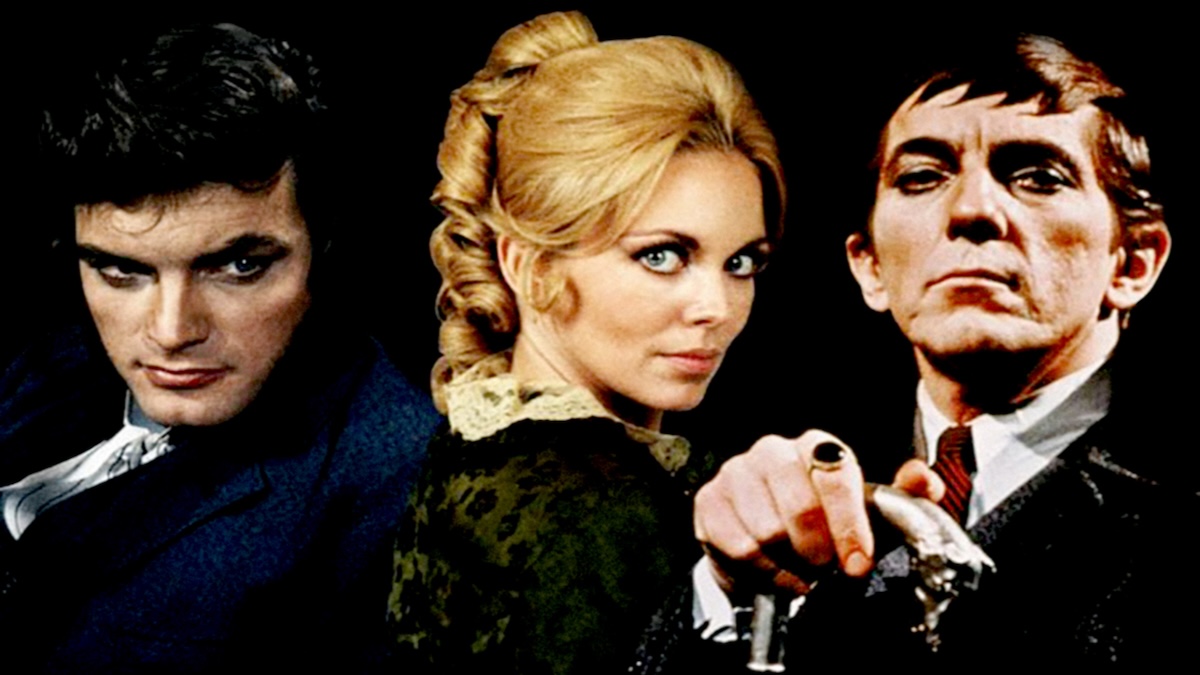
In an archival and never before published interview, Lara Parker reflects on the humanity she brought to the witch whose love for Barnabas Collins would ultimately prove her undoing.
Few characters in the history of Dark Shadows underwent as dramatic a transformation as Angelique Bouchard. Introduced in 1967 during the show’s journey back to 1795, the character, as played by Lara Parker, could easily have remained the villain of the piece, a woman whose obsession with Barnabas Collins set in motion the tragedy that would haunt generations of the Collins family. Instead, over the course of the next several years, Angelique emerged as one of the most complex and, at times, surprisingly sympathetic characters on the show.
Certainly there was no excusing many of the things she did, but what made Angelique so fascinating was that she was capable of experiencing the same pain she inflicted on others. There were moments when she seemed genuinely prepared to leave her past behind, only to discover that escaping it was considerably more difficult than she had imagined. And while her relationship with Barnabas remained at the heart of her story, there were occasions when her actions suggested that she was becoming someone quite different from the woman we first encountered in 1795.
Interestingly, some of that complexity came from Lara’s own reluctance to embrace the villainous nature of the character, as she explained to this writer during a 1985 interview.
LARA PARKER: “I misunderstood the character. I wanted to be the heroine. I wanted to be heartbroken, tragic—a princess. I remember one of the directors taking me aside and saying, ‘Honey, you’re not the heroine. You’re the villain.’ But I didn’t feel that. I wanted to play Angelique as someone wounded, someone who had been wronged. And strangely enough, that ended up working.”
“Jonathan Frid made a very deliberate choice with Barnabas. Instead of playing him as a traditional, macabre vampire, he played him as a tortured man—someone who felt guilt, who suffered. That gave his performance depth and texture. I was doing something similar, though not entirely by choice. If I had it to do over again, I might lean more fully into the evil. But because I resisted it—because part of me wanted to be Josette, to be the woman Barnabas truly loved—it gave Angelique another dimension. She felt cheated. She wanted to be the refined, delicate woman. So even when the directors told me, ‘Be cruel. Be evil. You want this person dead,’ there was always something inside me pushing in the opposite direction.”
What follows is a look at 10 turning points in Angelique’s journey, from the rejection that unleashed her fury to the heartbreaking moment when Barnabas finally spoke the words she had longed to hear.
WARNING: There are major spoilers ahead for the original Dark Shadows.
1. Barnabas Rejects Angelique in Favor of Josette

When Angelique arrives in Collinsport in 1795, accompanying the duPres family from Martinique, she does so with the knowledge that she and Barnabas Collins (Jonathan Frid) had previously been lovers. Whatever expectations she may have had regarding their future together are shattered by Barnabas, who makes it clear that his heart belongs to Josette (Kathryn Leigh Scott).
One of the more interesting aspects of their relationship is that Barnabas is hardly blameless. Whatever the depth of his feelings for Angelique in Martinique, he had given her reason to believe there was something between them. There’s also the matter of their respective social positions: Barnabas is the son of a wealthy businessman, while Angelique is a servant. Her rejection is both romantic and deeply personal. She might have accepted Barnabas’ decision and moved on with her life, but Angelique possesses something that most women in her circumstances do not: the power to change the situation. Unfortunately, she chooses to exercise that power, setting into motion a series of events that will destroy virtually everything she hopes to achieve.
For Lara, the transition from heartbroken woman to something far more dangerous was something she attempted to capture in her audition for the role, during which she performed an emotional scene opposite Jonathan Frid.
LARA PARKER: “I think what really got me the part was something I did at the end. I had always been told I had expressive eyes, and I knew the character had to have a kind of darkness. So at the end of the scene, I turned toward the camera and gave a look—a kind of moment of realization, of menace—thinking about what I would do to this man if he didn’t return my love. It was like one of Henry Kaplan’s [one of the show’s directors] ‘transitions’—that moment when something shifts internally. Jonathan Frid, who was reading with us, turned to me afterward and said, ‘I really hope you get this—you’d be very good.’”
2. Angelique Becomes Mrs. Barnabas Collins
There’s an element of tragedy in Angelique’s efforts to destroy the relationship between Barnabas and Josette. Using witchcraft, she brings Josette and Barnabas’ uncle Jeremiah (Anthony George) together, ultimately resulting in a duel between the two men and Jeremiah’s death. She subsequently uses the illness of Barnabas’ beloved younger sister, Sarah (Sharon Smyth), to help secure his agreement to marry her.
Under other circumstances, becoming Mrs. Barnabas Collins might have represented the culmination of Angelique’s dreams. Instead, it demonstrates how badly she misunderstands the nature of love in that she can manipulate circumstances, influence the emotions of others and eliminate the obstacles standing between herself and Barnabas, but she cannot manufacture the genuine affection she desires. In many ways, her marriage marks the point at which Angelique’s pursuit of happiness becomes almost indistinguishable from her desire for control. The more she attempts to secure Barnabas’ love through supernatural means, the further she pushes him away. For Lara, finding the emotions necessary to convey that degree of obsession represented something of an acting challenge.
LARA PARKER: I was always trying to pretend that I was Angelique. I would think, If I were really Angelique, how would I feel? But that didn’t always work—because I didn’t have the emotional experiences to draw from. I had never really felt jealousy, for example. I didn’t know what that felt like. Jonathan helped me a great deal with that. He used to say, ‘There’s evil in all of us.’ And I would say, ‘No, there isn’t any evil in me. I’ve never done anything mean to anyone.’ And he would insist, ‘It’s there. You just have to find it.'”
3. She Creates the Vampire Barnabas Collins

It’s arguably the single most important moment in the history of Dark Shadows. Having discovered the truth about Angelique and her involvement in the suffering of his family, Barnabas shoots her. Believing herself to be dying, Angelique retaliates by placing the curse on him that will transform him into a vampire and bring death to those who love him.
What’s particularly revealing about Angelique is that she subsequently attempts to undo what she has done. She discovers, however, that there are consequences to her actions that even she cannot reverse. Had Angelique simply wanted Barnabas dead, their story might have ended in 1795. Instead, her curse ensures that their relationship will continue across centuries, with both of them repeatedly confronting the consequences of what happened between them. For all her claims of loving Barnabas, she has condemned him to an existence in which love itself becomes a source of terror. And in doing so, she has effectively sentenced herself to an equally destructive emotional existence.
During our conversation, the suggestion was made to Lara that Angelique was essentially a woman scorned who was reacting in a way that many women might if they possessed her supernatural abilities.
LARA PARKER: “I think that’s partly what was written, and when you play what’s written, that comes across. But for me, there was always a reluctance. Strangely enough, I always felt guilty. Yes—even when I was sticking pins in dolls or burning people up. That didn’t really come across on screen, but it flavored the performance. It’s not something you can point to directly, but it keeps the character from becoming a cliché.”
4. Angelique Reinvents Herself as Cassandra Collins
Considering everything that transpired in 1795, one might reasonably assume that Angelique would have learned something from the experience. Her reappearance in 1968 suggests otherwise. Now sporting dark hair and calling herself Cassandra Blair, she becomes the wife of Roger Collins (Louis Edmonds), giving her access to Collinwood and its inhabitants. Barnabas, who has been freed from his vampirism, recognizes her, and Angelique sets about attempting to restore the curse, most notably through the Dream Curse storyline.
It’s an interesting development for the character in that it demonstrates that the passage of nearly two centuries has done little to diminish her obsession. One wonders how much of her identity at this point is actually tied to Barnabas. What would Angelique do with herself if she were to finally walk away from him? Her association with the warlock Nicholas Blair (Humbert Allen Astredo), who presents himself as her brother, also reveals something about Angelique’s place in the supernatural world. As powerful as she may be, there are forces to which even she must answer.
While Angelique’s association with Nicholas would ultimately prove disastrous for the character, Lara’s association with Humbert proved considerably more rewarding, allowing her to finally begin embracing some of the possibilities inherent in playing a villain.
LARA PARKER: “If I had it to do over again, I probably would have had more fun with it. I didn’t really start to enjoy it until Humbert Allen Astredo came on the show playing the devil. He talked to me a lot about technique—how to approach things technically—and he was able to explain it in a way I could understand. He became a good friend, and working with him helped me begin to see how much fun it could be to play evil. Jonathan had been telling me that from the beginning. He said, “You have a much better part than all those little heroines—you’re lucky.” And Dan Curtis used to call us “the big guns.” Whenever the ratings dropped, they would bring Barnabas and Angelique back, because our characters really drove the show. Audiences loved watching her be evil.”
5. Angelique Becomes the Monster She Created

There’s something almost Shakespearean about Nicholas Blair bringing Angelique back as a vampire, forcing her to experience the very existence to which she had condemned Barnabas. The woman responsible for so much of his suffering now finds herself experiencing the unnatural hunger that had plagued him. Additionally, someone accustomed to manipulating others finds herself subject to the authority of Nicholas, whose own ambitions are considerably greater than hers.
Initially, Angelique preys upon Joe Haskell (Joel Crothers), before eventually turning her attention back to Barnabas. The reversal in their relationship is fascinating: Barnabas, who has spent so much of his existence attempting to escape from Angelique, now experiences the supernatural compulsion of a vampire’s victim. Admittedly, the experience does not immediately transform Angelique into a more compassionate individual. She continues to use whatever power is available to her to get what she wants. But for the audience, it adds another dimension to the character. Angelique can be victimized, humiliated and made to suffer just as she has victimized, humiliated and caused suffering in others.
The introduction of Nicholas also demonstrates that Angelique is not necessarily the most evil character inhabiting the world of Dark Shadows. In contrast to Nicholas, whose ambitions extend far beyond the lives of any one individual or family, Angelique’s actions are frequently driven by recognizable, if horribly distorted, human emotions.
6. Quentin Collins Enters Her Life

With the show’s journey back to 1897, Angelique finds herself drawn to another member of the Collins family: Quentin Collins (David Selby). While her relationship with Barnabas remains the defining one of her existence, her interest in Quentin represents an intriguing departure for the character. Here is someone with whom she does not share centuries of emotional baggage, someone whose relationship with her is not predicated on the events that took place in Martinique or Collinsport in 1795.
Of course, Quentin comes with considerable baggage of his own, and he and Angelique are hardly destined for domestic bliss. Her willingness to resort to manipulation in her pursuit of him also demonstrates that some habits are difficult to break. Nonetheless, there is something significant about Angelique developing an interest in another man. It suggests that her emotional life need not begin and end with Barnabas Collins, though, of course, whether or not she is capable of fully embracing that possibility is another matter entirely.
There’s also something interesting about the pairing of Angelique and Quentin in that both characters have inflicted considerable suffering on others, yet both have the capacity to elicit sympathy from the audience. Neither is easily categorized as simply a hero or a villain, which makes their interactions all the more compelling.
7. Angelique Joins the Fight Against Count Petofi
One of the advantages of introducing a character as powerful and dangerous as Count Andreas Petofi (Thayer David) during the 1897 storyline is that it forces some of the show’s established characters to reassess their relationships with one another. Among them is Angelique, who finds herself opposing Petofi, whose supernatural abilities make him a threat to both Barnabas and Quentin. Suddenly, the powers that have made her such a formidable adversary for the Collins family are among the weapons available in its defense. It’s not a complete moral transformation. Angelique still has her personal interests, and her decision to oppose Petofi does not necessarily reflect an entirely selfless desire to protect others. Yet it’s an important development in the audience’s perception of her.
For much of her existence on Dark Shadows, Angelique has been the supernatural threat that others have had to overcome. Now she’s helping them overcome one. It opens up dramatic possibilities for the character that would have been difficult to imagine during the original 1795 storyline. In retrospect, it’s also an important step toward the woman Angelique will eventually become. Her supernatural abilities are not inherently evil; it’s what she chooses to do with them that makes the difference. And increasingly, we’re seeing her make choices that the Angelique of 1795 would have been unlikely to make.
8. She Walks Away From Witchcraft and Marries Sky Rumson
Perhaps one of the most genuinely surprising developments in Angelique’s story comes during the Leviathan storyline, when it’s revealed that she has married wealthy businessman Schuyler “Sky” Rumson (Geoffrey Scott) and has attempted to put witchcraft behind her. Think about the significance of that decision. Magic has been Angelique’s means of getting what she wants, protecting herself and retaliating against those who have wronged her. It has also been the source of virtually every great tragedy in her life.
For her to voluntarily abandon its use suggests that she has begun to recognize the destructive pattern of her existence. She’s attempting to find happiness through something other than supernatural manipulation, and, perhaps even more significantly, without Barnabas. Unfortunately, Sky’s involvement with the Leviathans destroys that dream. Once again, Angelique finds herself betrayed and drawn back toward the world she had attempted to leave behind. Her response is not always admirable, but there’s something genuinely sad about the fact that one of her most sincere attempts to change her life ends in disappointment.
It’s also worth considering how different this situation is from the one we encountered in 1795. Back then, Angelique attempted to use her powers to create the illusion of a happy marriage. With Sky, she has tried to achieve that happiness without them, only to discover that the man she loves has been keeping a terrible secret of his own. For someone who has spent so much of her existence deceiving others, it’s a particularly bitter irony.
9. Angelique Frees Barnabas From His Curse
During the 1840 storyline, Angelique, now going by the name Valerie Collins, is confronted with the opportunity to undo the defining act of her existence as she removes the vampire curse she had placed on Barnabas.
There’s a complication here that comes with the show’s frequent manipulation of time: this Angelique has not personally experienced the events of 1897 or the 20th century that the audience has witnessed. She’s an earlier incarnation of the character, although the emotional weight of what she does is no less considerable for those of us who have followed her story. What makes the moment particularly powerful is the contrast with 1795. Back then, Angelique attempted to reverse the curse almost immediately after casting it, horrified by what she had done. Now she actually succeeds in freeing Barnabas from the condition responsible for so much of his suffering.
For once, Angelique is giving Barnabas something rather than attempting to take something from him. It’s a distinction that speaks volumes about the changes taking place within her. It’s also a remarkable development from a storytelling perspective. The vampire curse had been the foundation upon which the relationship between Barnabas and Angelique had been built for years. Removing it raises the possibility that these two characters might finally be able to relate to one another as something other than enemies forever bound together by an act of vengeance.
10. Angelique Loses Her Power and Finally Wins Barnabas’ Love
During the final stages of the 1840 storyline, Angelique confronts Judah Zachery (Michael McGuire), the warlock with whom she shares a history stretching back to her existence as Miranda DuVal in 1692. Her actions help bring about his defeat and save Quentin Collins (the 1840 character also played by David Selby) from execution. In the process, Angelique loses her supernatural powers. The woman who has relied on witchcraft for so much of her existence is now mortal and vulnerable.
Tragically, she’s shot by Lamar Trask (Jerry Lacy), and Barnabas comes to recognize the depth of his feelings for her. His declaration of love comes too late for Angelique to hear it, a particularly cruel twist considering everything she has endured in pursuit of those very words.
Whether one believes that Barnabas truly loved Angelique all along, that he came to love her because of what she had become or that his declaration is born out of the enormity of the moment is certainly open to interpretation. But there’s something undeniably moving about the fact that Angelique finally achieves what she has always wanted precisely when she’s no longer attempting to force it to happen. Although Dark Shadows would continue for several more weeks with its Wuthering Heights-inspired 1841 Parallel Time storyline, this marked the conclusion of the original Barnabas and Angelique’s story. Jonathan Frid and Lara Parker would once again be romantically paired, but as Bramwell Collins and Catherine Harridge Collins.
When discussing the Shakespearean nature of Barnabas and Angelique’s tragic relationship, Lara was characteristically pragmatic about the circumstances surrounding its conclusion, while acknowledging the literary influences that had helped shape the series.
LARA PARKER: “I think they were simply trying to wrap things up. But we had very good writers—very literate writers. We worked through almost every major plot that’s ever been written. Elements of Shakespeare, Emily Brontë—classic literature—were all woven into the Dark Shadows storylines. Horror is a powerful genre, and many great writers used it. We drew from those traditions.”
Ultimately, though, perhaps the greatest contribution Lara made to Angelique was her unwillingness to see the character exclusively in terms of the terrible things she did. What began as an actress’ desire to play the romantic heroine helped give a seemingly irredeemable villain the emotional complexity necessary to make her eventual fate so affecting.
LARA PARKER: “I think sometimes, in spite of ourselves, we make choices that work. And in a way, that became part of the secret of Dark Shadows. There was always something going on beneath the surface—something beyond what was written.”
From the Vampire Bookshelf
A VAMPIRES & SLAYERS RECOMMENDATION
Return to Collinwood with Lara Parker
The actress who brought Angelique to life on Dark Shadows continued exploring the supernatural world of the Collins family through four original novels. Discover her literary contributions to the Gothic saga.
As an Amazon Associate I earn from qualifying purchases.


