
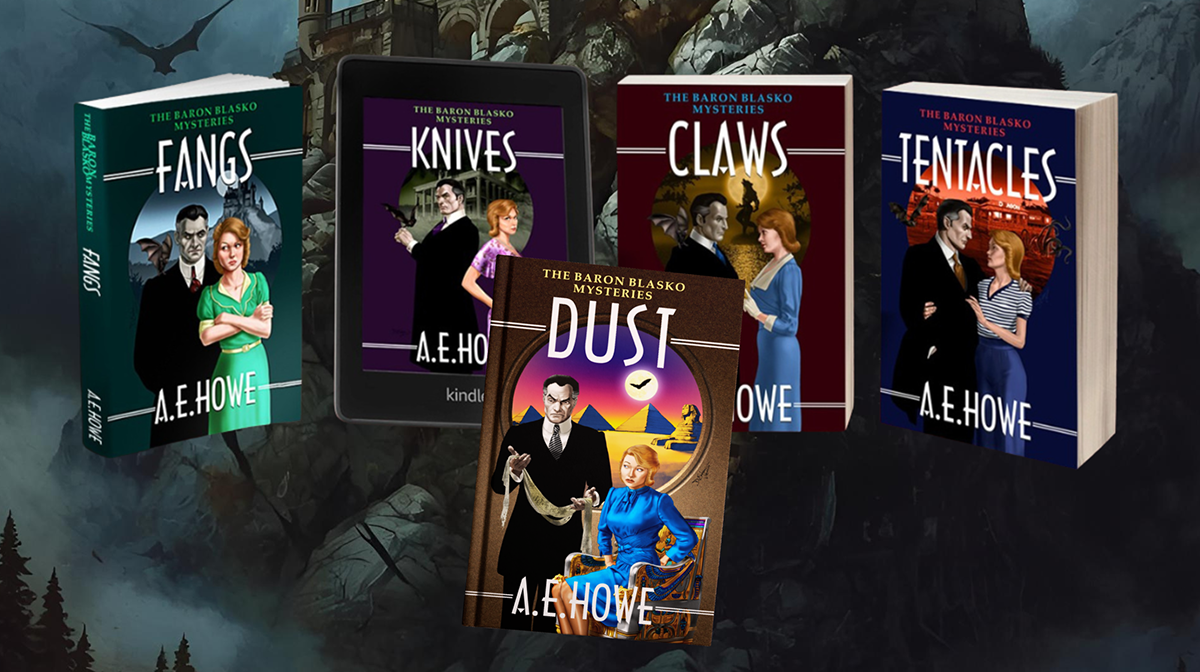
From Jonathan Frid’s Barnabas Collins and Bela Lugosi’s Dracula to the classic Universal monsters, author A.E. Howe and his wife and content editor, Melanie, explore the origins of their supernatural world.
When asked what his “love at first bite” was — his introduction to the world of vampires — author A.E. Howe doesn’t hesitate for a second: “Barnabas.”
Like so many children growing up in the late 1960s, Howe would hurry home from elementary school to watch Dark Shadows, the Gothic daytime soap opera that had been transformed into a television phenomenon with the arrival of Jonathan Frid as vampire Barnabas Collins. Little could he have imagined that decades later, those afternoons spent in the company of the Collins family would contribute to the creation of a vampire of his own: Baron Blasko.

“It really does all go back to being an elementary school student and hurrying home to catch Dark Shadows on TV,” Howe reflects in an exclusive interview with Vampires & Slayers. “Looking back, that seems kind of weird that an eight-year-old was hurrying home to watch a soap opera, but that was certainly my first introduction. And then I can remember reading Dracula probably when I was nine or 10.”
As to what it was about Dark Shadows that captured his imagination, Howe immediately replies, “Jonathan Frid, I think you have to credit him. You watch those early episodes and it is Gothic. I mean, it’s just like the old Gothic books, and that’s kind of what they designed it around. But Jonathan Frid took it to a whole different level with his character. Like a lot of actors — you can name Morgan Freeman, you could watch him reading a phone book and it’s interesting — Frid just was that kind of actor that when he was on screen, he just pulled the viewer in.”
The Monster Inside All of Us

For Howe, part of the appeal of Barnabas was that he represented something quite different from the vampires he had encountered in classic horror films. As Dark Shadows evolved, so did its central vampire, gradually revealing a humanity that made him increasingly sympathetic to the audience. “I’d also watched the Universal classics, and you see Dracula and there’s really nothing sympathetic about Bela Lugosi’s Dracula,” he observes. “But Jonathan Frid had a little more of the Wolf Man thing, where he seems like a reluctant vampire.”
Interestingly, Howe has a theory as to why so many children found themselves identifying with a centuries-old vampire who was struggling against his own nature. “We all feel like monsters when we’re children and we feel like we need to become a better person. Hopefully kids feel that way. You want to please your parents, you want to do the right thing, but you feel that monster inside of you. And so maybe we identified with Barnabas Collins for that reason.”
That appreciation for a monster who is capable of being something more would eventually find its way into the Baron Blasko mysteries, a series that combines elements of Gothic horror, detective fiction, humor and the supernatural imaginings of H.P. Lovecraft, all against the unlikely backdrop of Depression-era Alabama.

By the time Howe turned his attention to Baron Blasko, he was already well established as a mystery writer, notably through his Larry Macklin series of contemporary police procedurals. As of this conversation, that series had grown to encompass 22 novels and four novellas. “It came from my love of the classic monsters and Lovecraft,” he explains. “My most successful series is the Larry Macklin series, which is a police procedural that takes place in the present day. And I was just to the point where I wanted to get away from cell phones, I wanted to get away from DNA, do something where I could just let my imagination go completely wild. I didn’t have to feel restrained by anything in particular. I do set it in 1930s Alabama, so I have to fit it into that time period and that place. But other than that, once you have vampires, you can pretty much do anything. I had some of my Larry Macklin readers who said, ‘I don’t do vampires.'”
For Howe, however, it was an opportunity to return to the kinds of stories that had captured his imagination in the first place. “It goes back to the first things I read, Edgar Allan Poe, Dracula, watching Dark Shadows. So that was in me, and I wanted to contribute to the genre.”
The result was a series that, beginning with Fangs, would gradually incorporate many of the monsters Howe had grown up loving. Vampires, werewolves, a mummy and creatures that would be right at home in the world of Creature From the Black Lagoon have all found their way into the books.
A Tribute to Bela Lugosi

While Barnabas Collins helped shape Howe’s appreciation of the sympathetic vampire, another iconic figure in vampire history contributed directly to the creation of Baron Blasko. “I love Bela Lugosi,” he enthuses. “My character’s name is Baron Blasko — Blasko was Bela Lugosi’s actual name, so that was my little tribute to Bela. And the character is kind of as I would imagine Bela Lugosi, if he was a real vampire, would act. A little arrogant, but could get excited about things and maybe even overly enthusiastic sometimes. I’m taking a little bit of this from the Ed Wood film and how Martin Landau portrayed Bela Lugosi.”
The origins of the Blasko series, as it turns out, actually predate the books themselves. Howe had previously written a screenplay titled Josephine and the Vampire, which introduced the concept of bringing together two individuals who, under virtually any other circumstances, would have had absolutely nothing to do with each other.
“And so that was a kernel of the idea of taking this somewhat proper 1930s Alabama Southern woman and tying her to this vampire that was this Bela Lugosi-ish vampire, and having them be forced to live together and work together,” he says.

Josephine is a wealthy, unmarried woman in her 30s who, following the death of her father, finds herself in the unusual position of being the majority shareholder of a bank in a small Alabama town during the Great Depression. In accordance with her father’s dying wishes, she travels to Romania to return her grandfather’s ashes to his ancestral village in the Carpathian Mountains. It’s there that she encounters Baron Blasko and, in the course of a confrontation, consumes some of his blood.
Although she doesn’t become a vampire, Josephine discovers that she and Blasko are now bonded to one another and cannot be separated. As she has absolutely no intention of remaining in Romania, the vampire finds himself relocating to Alabama, where he takes up residence in her basement.
“It’s the odd couple concept of having to accommodate each other,” Howe laughs. “I wanted humor. All my books have humor in them.”
“They all have a little bit of dry humor in them,” clarifies Melanie, Howe’s wife and content editor, turning to her husband. “It’s part of your shtick.”
Beyond providing Josephine with the financial means to accommodate a vampire in her home, her position in the community serves an important storytelling function. “By having her be the bank owner, my idea was that way she could interact with the sheriff and have some power in the town,” Howe explains. “It just helps move the story along.”

The detective element of the series comes into play when Blasko, having developed an enthusiasm for the adventures of Sherlock Holmes, decides to try his hand at solving a murder that has taken place across the street. In the process, the foundation is laid for a partnership that will evolve considerably over the course of the books.
“They start out as an odd couple,” Howe says. “She’s unhappy with the situation, he’s unhappy with the situation. But over time, of course, they develop this working relationship as detectives. In no way would this be considered a romance, but there’s certainly romantic tension between the two characters.”
“That does develop and grow as it goes along,” Melanie points out. “It’s not the focus.”
At this point in our conversation, it’s suggested that what they had essentially created was Moonlighting with fangs, a reference to the 1980s television series starring Bruce Willis and Cybill Shepherd as private detectives thrown together by circumstances whose romantic tension was as much a part of the appeal as the mysteries themselves.
“That’s pretty good,” Howe laughs. “I may use that in advertising.”
Reinventing the Rules of Vampirism

As much as Howe considers himself a traditionalist when it comes to vampires, creating a vampire detective who has to function in the world of ordinary human beings necessitated a certain amount of tinkering with the established mythology. “I realized that I had to let some of the traditional rules of vampirism go or it was going to be really difficult to write the book I wanted to write,” he admits.
One particularly interesting example involves the traditional belief that vampires cast no reflection in mirrors. Rather than dispensing with the concept entirely, Howe came up with a variation that gives the vampire’s aversion to mirrors a very different meaning. When Blasko looks into a mirror, what he sees is a reflection of his true age. Others looking at his reflection, however, would not necessarily see the same thing.
Howe explains, “It’s trying to keep some of that tradition, but also you couldn’t have a vampire as a detective walking around in the real world, and somebody would notice that he wasn’t in a mirror. I had to drop some things. It was interesting having to work around some of that.”
And, for the record, there are no sparkling vampires in the world of Baron Blasko.
Given the influence of Dark Shadows on Howe, the inevitable question is how Baron Blasko compares to Barnabas Collins. His response is somewhat surprising. “He is better than Barnabas,” he offers, railing to recognize that them be fighting words, “in the sense that his motives are more pure than Barnabas’. There’s a selfish side to Barnabas and while Blasko’s egotistical, he has a moral compass.”
“A sense of honor,” adds Melanie.
“Very much so,” Howe agrees.
Much of that comes from the period in which Blasko originally became a vampire, during the medieval era and the Turkish invasion, when his ideas of knighthood and chivalry helped define who he was. Becoming a vampire didn’t necessarily change that. “He still managed to maintain his sense of wanting to protect the people in his area, his fiefdom,” Melanie explains. “So he kind of acted as an overlord and a keeper and a protector of the peasants, for lack of a better word, under his domain. And he kept that up for a long time until eventually he just kind of retreated to his castle.”
“He sees his power as a way of accomplishing that, protecting his people at that period,” Howe adds.
The question of what remains of the human being following the transformation into a vampire is one that has been explored in everything from Dark Shadows to Buffy the Vampire Slayer and Angel. It’s also one that Howe will be addressing more directly in the forthcoming sixth Baron Blasko book. “This last book explores that idea of does he have a soul?” he reveals. “Is he damned or not? Or is it something else?”
The Creative Partnership Behind Baron Blasko

One of the pleasures of speaking with Howe and Melanie is watching the dynamic between the two of them, particularly when the discussion turns to the details of the individual books. When asked to go through each of the five published installments and explain what they accomplish in terms of the larger story, Howe immediately deferred to his wife.
“That’s why I have her sitting here, because honestly, my method is pretty much to write the first draft, go through it, make changes, and then I almost never read the book again.”
Melanie proceeded to guide me through the five books, recalling characters, plot developments and the various threads that connect the novels, sometimes to the apparent surprise of the man who had written them.
“You see how much more she knows about the books,” Howe laughs at one point.
As Melanie explains, theirs is very much a team effort, with each bringing a different set of skills to the books. “He is the creative one,” she says. “All of the characters, all of the plots, all of the dialogue comes through him, but I clean everything up. I make sure the continuity stays there.”
“When I use the same character name 15 times, she corrects it,” Howe interjects.
Despite her intimate knowledge of the worlds her husband creates, Melanie is continually amazed by his ability to come up with new ones. “I used to think that I was a writer, and what I learned is I’m a good technical writer,” she reflects. “I can clean stuff up, but I don’t have the creativity. What he can do with his mind, where these ideas just keep coming, I am always in awe of. I couldn’t do it.”
The Future of Baron Blasko
With five books currently available — Fangs, Knives, Claws, Tentacles and Dust — the Baron Blasko mysteries are approaching something of a turning point. A sixth book has been written and is being edited, and will bring the overarching storyline that has developed throughout the series to a conclusion. “It will be a ‘completed series’ with the sixth book,” Howe says, although he’s quick to add that he’s leaving the door open to further adventures.
“It completes the storyline,” Melanie clarifies.
Among other things, the sixth installment will resolve the relationship between Josephine and Blasko, although neither Howe nor Melanie is about to reveal precisely what form that resolution will take.
“Good, bad or indifferent, I’m not going to say anything,” Howe insists. “It resolves the issue. That’s the big arc.”
In the meantime, Howe is also working on a novella that will delve into Blasko’s past during the Napoleonic era and establish a connection to an entirely new fantasy series, The Dark Springs Chronicles, which will see him expand his supernatural universe considerably.
Not bad for a kid who used to hurry home from elementary school to watch a vampire on television.
Coming up at Vampires & Slayers: A.E. Howe and Melanie take us through each of the Baron Blasko mysteries, exploring the evolution of the characters, the introduction of the classic monsters and the storylines that will come together in the forthcoming sixth book.