
There’s something wonderfully appropriate about a vampire saga that refuses to follow the rules, particularly when its creator discovered that the character she had originally envisioned as the villain was actually the one whose story she most wanted to tell.
For Welsh author Margarita Felices, that character is Rachel, the vampire at the center of her four-book Judgement of Souls series, a sweeping supernatural saga that combines romance, religious conflict, ancient mysteries and more than 300 years of history. What began as a single novel eventually expanded into something considerably more ambitious, with Felices discovering that in order to move her story forward, she first had to travel backward through the centuries.
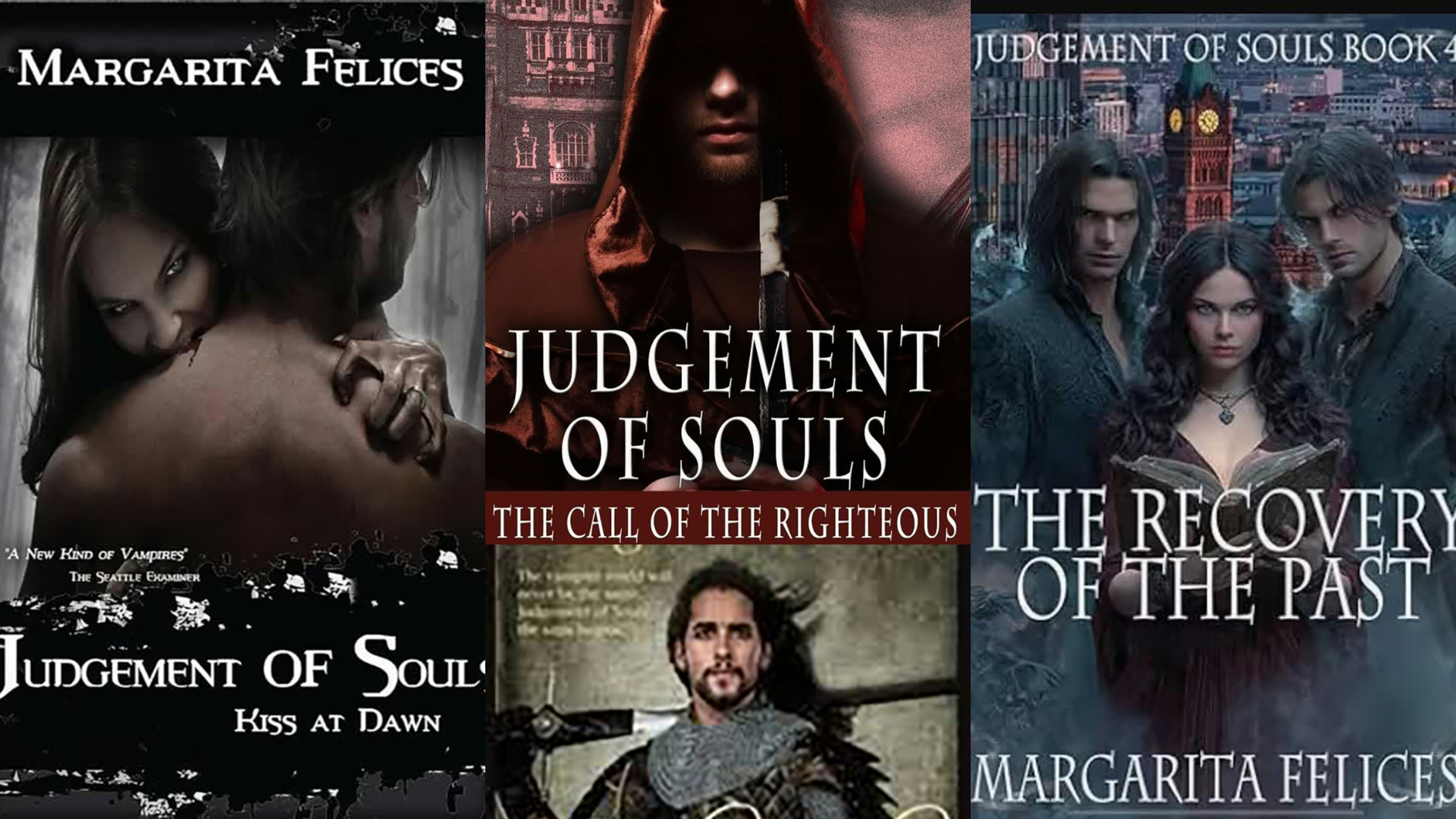
The result is a series that begins in the modern world with Kiss at Dawn, then explores the events that shaped its characters through Call of the Righteous and Origin, before returning to the present with The Recovery of the Past. Along the way, readers encounter a secret organization of vampire hunters known as the Righteous, the French Revolution, the Crusades and mysterious artifacts whose origins stretch back into ancient history.

Felices herself brings an interesting background to the proceedings. Based in Cardiff, Wales, she spent much of her professional life working in television, beginning as a photographer before moving into news, arts programming, factual productions and drama. Her credits include involvement with Doctor Who and Torchwood, and she concluded her BBC career working with the BBC National Orchestra of Wales. When the opportunity for early retirement arrived in 2021, she embraced it.
Writing, however, had been part of her life long before television. As a student, she contributed to and eventually edited her school magazine, supported herself through college by writing short stories and later placed third in a BBC scriptwriting competition. Her literary interests extend beyond vampires to witchcraft, supernatural suspense and contemporary fiction, but Gothic culture has always held a special attraction.
A self-described Goth with a passion for Gothic architecture, fashion and music, Felices even drew inspiration for the nightclub featured in Kiss at Dawn from a real establishment she frequented. Her interest in historical authenticity has also taken her to many of the locations featured in the novels, researching the settings and events that form the backdrop to her vampires’ adventures.
In this exclusive interview with Vampires & Slayers, Margarita Felices discusses her introduction to vampire fiction, the unexpected evolution of Judgement of Souls, the challenges of blending supernatural mythology with real history and how Rachel, a character originally intended to be her antagonist, ultimately transformed the entire series.

VAMPIRES & SLAYERS: What was your introduction into the world of vampires, whatever medium it might have been?
My introduction to vampires was hardly love at first bite! I grew up watching the old Hammer-style Dracula films, and their vampires struck me as corny, predictable and full of clichés. They certainly didn’t make me imagine that one day I would write about vampires myself. I can’t pinpoint the first time the genre truly drew me in, but Bram Stoker’s Dracula was a turning point. For the first time, I saw a vampire as more than a monster, he was vulnerable, painfully human and caught in a story where horror and love were intertwined. I could understand his pain, and that changed how I saw the genre. I was also a massive fan of Anne Rice and had read her Vampire Chronicles, so watching the film adaptation of Interview with the Vampire deepened that fascination. The vampires who once bored me had become characters whose stories I wanted to explore.
V&S: What was it that you found creatively inspiring?
What inspired me was discovering the humanity beneath the horror. Once I could see vampires as vulnerable beings rather than simply monsters, they became far more interesting to me. Their pain mattered and so did their capacity for love. Bram Stoker’s Dracula brought those contradictions into focus, while Anne Rice’s Vampire Chronicles and Interview with the Vampire deepened my appreciation of them. Creatively, that opened a door, a vampire story didn’t have to rely on the familiar clichés that had bored me. It could be frightening and tender at the same time, and make you feel for someone you might otherwise fear. That tension was what captured my imagination and the possibility of looking beyond the monster and finding a story worth telling.
V&S: Let’s talk about the series itself. What was the impetus for the idea?
I wanted to write a different kind of vampire story and one that moved beyond neck-biting and the familiar image of the endlessly tortured soul. At the heart of that idea was Rachel, a naïve vampire on a quest to help her banished parents. The more I wrote about her, the more she fascinated me, and I couldn’t wait to discover where her story would lead. The series spans 300 years and introduces a faction within the Church whose sole purpose is to hunt down and kill all supernatural beings, especially vampires. Above all, I wanted to write the kind of story I would want to read myself and make it something different, with vampires portrayed in ways that would surprise me rather than simply repeat what I had seen before.

V&S: How did the idea evolve?
The biggest surprise was that at the beginning, my villain became the character I couldn’t bear to keep as a villain. Rachel began as the antagonist, and Max didn’t even exist in that first version — you’ll have to read the books to discover more about him! But the more I wrote about Rachel, the more I loved her. Eventually, I couldn’t bring myself to keep her in the role I had originally planned. I took the story apart and started again, only to realize that there was a whole backstory waiting to be told. Although Judgement of Souls was ready to go, it became the third part of the series, and I had to travel backwards in time to write the two books that would lead up to it. I wrote the story as a standalone book too, it’s up to the reader to see if they were interested in reading the backstories or not. Each book makes sense on its own.
Book 2 was where the research really began. I read extensively and even visited some of the places where I set my vampires’ stories. The greatest challenge was weaving together the lives of three vampires with 300 years of mortal vampire hunters, whose mission passed from father to son through the generations. Alongside that, I had to weave in human history, my vampires became caught up in the French Revolution, and I went back further still to the Crusades for Book 1. Those two earlier books demanded a great deal of reading and research, taking the story far beyond the one I had first imagined.
V&S: Please share whatever you’d like about each of the volumes.
I wrote the original three books backwards, so I’ll begin with the one that started it all for me!
Judgement of Souls: Kiss at Dawn was my first full-length novel. It brings Rachel into the mortal world, where she meets Daniel, a nightclub owner, and becomes caught between her feelings for him and the dangers surrounding her. Max brings violence into their lives, and Rachel has to decide how far she will go to protect the man she loves. The Gothic club atmosphere came from a real place, whose setting and clientele helped bring that part of the story to life.
Judgement of Souls: Call of the Righteous takes us back through 300 years of Rachel’s history as she searches for Max and the missing Book of Cain, determined to help her banished parents. Along the way, she forms friendships, encounters love and faces The Righteous, the vampire hunters whose mission passes through generations. The French Revolution becomes part of her journey, so this book allowed me to weave my vampires’ lives into human history on a much larger scale.

Judgement of Souls: Origin goes back further still. To the Crusades and the discovery of the Book of Cain. It explores Rachel’s parents, Phillippe and Arianne, their relationship and the beginnings of the world Rachel is born into. It also shows how the conflict between the Church and the vampires takes shape. This was the hardest of the original three books to write because of the historical research involved, but it gave the story its beginning and brought the backstory together.
Judgement of Souls: The Recovery of the Past moves the story forward again, picking up six months after Daniel’s transformation into a vampire. Rachel, Daniel and Arun face an unexpected situation: The Righteous need their help. The search for stolen artifacts, including the Book of Thoth, takes them from Paris to Egypt, where ancient mysteries and supernatural dangers force vampires and hunters to consider working together. Without giving too much away, the possibility of changing the past raises the stakes, and the uneasy alliance gives the series a new direction.
V&S: As you’ve written one book after the other, how would you say the series has evolved and did any elements of that evolution surprise you?
Across the four books, Judgement of Souls has grown into a much wider world than I originally imagined. I began with Kiss at Dawn and then worked backwards, discovering the history that had brought my characters to that point. What started as one story became an exploration of their lives and relationships across centuries, with generations of The Righteous hunting them and historical events shaping their journeys. That gave the series a depth I hadn’t anticipated, but the biggest surprise was Rachel herself. She began as my villain, yet the more I wrote about her, the more I loved her, until I could no longer keep her in that role. Changing her place in the story changed everything around her. For me, the evolution hasn’t simply been about expanding the history or the setting, it’s been about uncovering the humanity beneath the vampire mythology. I thought I knew the story I wanted to tell, but discovering what else it could become has been part of the pleasure of writing it.

V&S: How has the experience of writing these books evolved you as a writer?
Writing these books has taught me that starting again isn’t necessarily a failure — sometimes it’s how you find the story you really want to tell. After spending a year on the first version and scrapping it, I had to be willing to rethink my ideas rather than hold on to them simply because I’d already put so much work into them. Rachel taught me that lesson too. I had planned for her to be the villain, but the more I wrote about her, the less that role felt right. I learned to give my characters room to develop instead of forcing them to follow my original plan. The historical books challenged me in a different way and keeping three vampires’ lives consistent across generations of hunters, while weaving in real historical events, demanded patience, research and careful attention to detail. Above all, the experience has made me more open to change. I can begin with a plan, but I also need to recognize when the story is taking me somewhere more interesting.
Explore Margarita’s books and keep in touch
Browse her full back catalogue on Amazon.
Join the fan(g)s on the Judgement of Souls Facebook page!
Follow her on https://www.tiktok.com/@margaritafelices
Follow her on Instagram.