
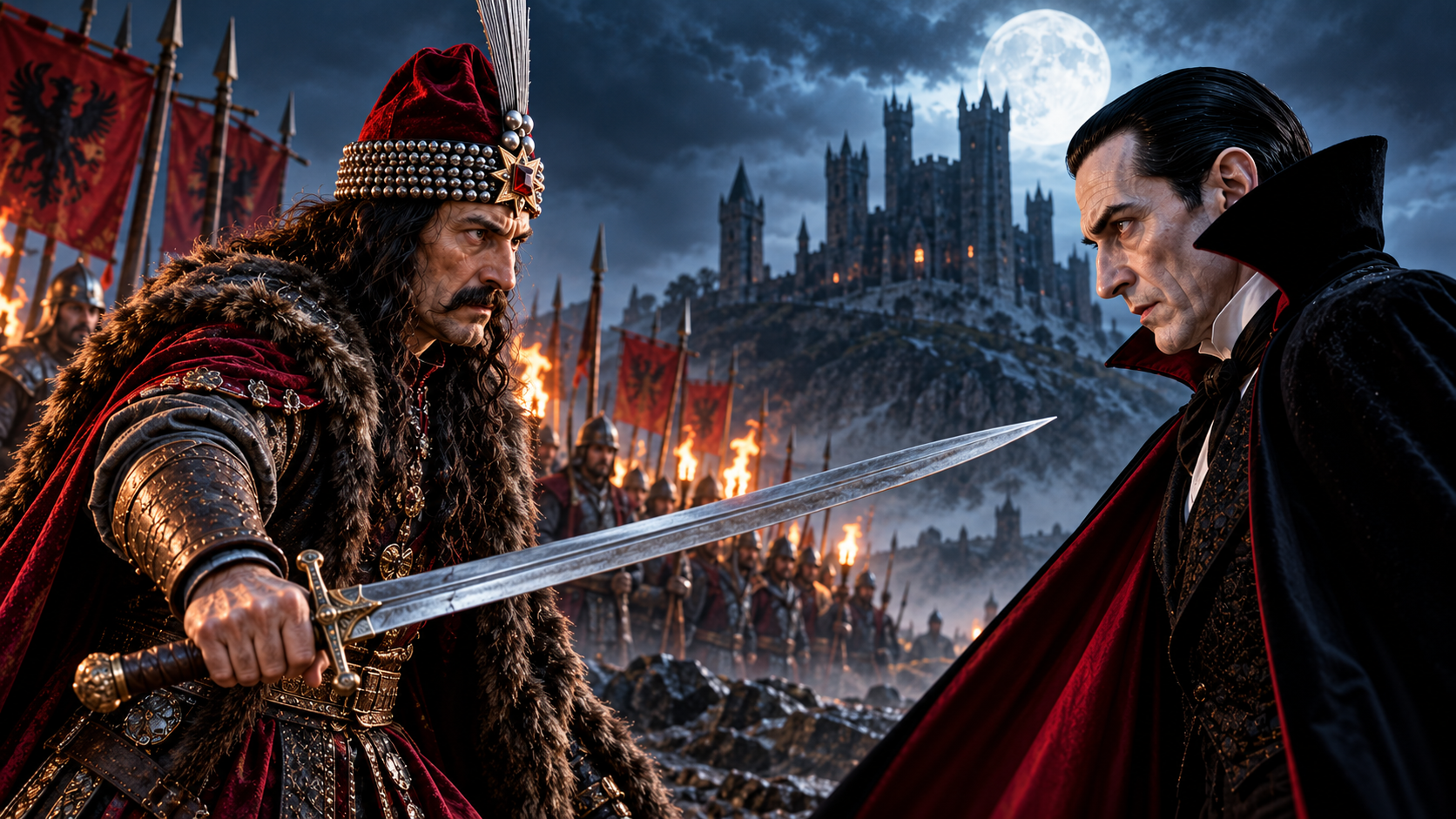
For generations, we’ve been told that Count Dracula was inspired by a bloodthirsty Romanian ruler. But the real origins of Bram Stoker’s immortal vampire may lie in a childhood haunted by death, a domineering theatrical legend and the darkest fears of Victorian England, all of which is explored in a new Mystik Manor video, “Why Dracula Was Never Vlad the Impaler (The Real-Life Origin)”
Ask almost anyone where Bram Stoker found the inspiration for Count Dracula, and chances are they’ll give you the same answer: Vlad the Impaler. It’s certainly a compelling story and an important part of vampire folklore. Vlad III, the 15th-century ruler of Wallachia, earned his fearsome reputation through his brutal treatment of enemies, particularly his use of impalement as a method of execution. His association with the name Dracula, combined with his bloody history, seems to make him the perfect historical inspiration for literature’s most famous vampire.
There’s just one problem. The surviving evidence suggests that Vlad’s influence on Stoker’s 1897 novel Dracula was considerably smaller than popular mythology would have us believe. In fact, when Stoker first began developing his vampire story, his central villain wasn’t even called Dracula. And the people, experiences and fears that may have shaped the character are arguably more fascinating than the familiar tale of a medieval prince.
Before Dracula, There Was Count Wampyr

One of the most revealing sources of information about the creation of Dracula is Stoker’s own research. The author’s surviving notes, now preserved at the Rosenbach in Philadelphia, provide a fascinating glimpse into the development of the novel. They reveal that Stoker spent years researching everything from Eastern European geography and vampire folklore to medical conditions and supernatural beliefs. But they also reveal something unexpected: during the early stages of writing, Stoker’s vampire was known as Count Wampyr.
It wasn’t until the summer of 1890, while vacationing in the English seaside town of Whitby, that Stoker encountered the name that would ultimately become synonymous with vampires. At the Whitby library, he consulted William Wilkinson’s An Account of the Principalities of Wallachia and Moldavia, published in 1820. The book contained references to a historical figure named Dracula and an explanation connecting the name with the word “devil.” Stoker copied that information into his notes and, apparently recognizing the dramatic possibilities of the name, eventually abandoned Count Wampyr in favor of Count Dracula.
What makes this discovery significant is how little information Stoker appears to have recorded about the historical Vlad. There is no substantial evidence in his surviving research notes that he conducted an extensive investigation into Vlad’s life, military campaigns or notorious methods of execution. That doesn’t mean Stoker knew nothing about the historical ruler, but the familiar claim that he simply transformed Vlad the Impaler into a supernatural vampire goes well beyond what the documentary evidence establishes.
Stoker borrowed a name with ominous historical associations. The creation of the character himself appears to have been a much more complicated process. And to understand that process, we need to travel from Transylvania to Ireland.
Bram Stoker’s Childhood Was Haunted by Death

Long before Bram Stoker imagined an undead aristocrat rising from his coffin, his mother had witnessed horrors that were all too real. Charlotte Thornley Stoker was a young girl living in Sligo, Ireland, when cholera devastated the town in 1832. The epidemic spread with terrifying speed. People who appeared healthy could become violently ill and die within hours. Fear and confusion swept through the community as residents struggled to understand a disease whose causes were not yet fully understood. With deaths mounting, the ordinary rituals surrounding burial began to collapse.
Charlotte later recorded her memories in an account titled Experiences of the Cholera in Ireland, describing the panic, suffering and disturbing stories that circulated during the outbreak. Among the most frightening were accounts of people being buried before they were actually dead. The fear of premature burial was particularly powerful during the 19th century, when medical knowledge offered fewer reliable ways of distinguishing death from certain forms of unconsciousness. Charlotte’s recollections included stories of apparent victims recovering after being mistaken for dead, along with descriptions of the chaos surrounding the disposal of bodies.
And Bram Stoker was particularly well positioned to absorb such nightmares. Born in Dublin in 1847, he suffered from an unidentified childhood illness that left him bedridden for much of his early life. Accounts of his childhood suggest that he did not walk normally until around the age of seven. During those years, his mother entertained him with stories, including accounts of the cholera epidemic she had survived.
Imagine the effect on a sickly child of hearing about people buried alive, bodies mistaken for corpses and death seemingly lurking everywhere. Decades later, Stoker would create a monster whose victims existed in a horrifying state between life and death. In Dracula, the dead do not necessarily remain dead. Coffins become places of both burial and rebirth. Disease-like transformations spread from one victim to another, while loved ones confront the possibility that someone they have buried may return.
We cannot prove that Charlotte Stoker’s cholera stories directly produced Count Dracula, but the parallels are striking. The seeds of the vampire’s horror may have been planted in a Dublin bedroom long before Stoker ever encountered the name of a Wallachian prince.
Did Henry Irving Inspire Count Dracula?

If Stoker’s mother helped introduce him to the terror of death, another figure in his life may have influenced the personality of the monster himself. That man was Sir Henry Irving.
Today, Irving is largely remembered by theater historians, but during the late Victorian era he was one of Britain’s most celebrated actors. His commanding stage presence, distinctive physical appearance and extraordinary ability to captivate audiences made him a theatrical superstar. For Bram Stoker, Irving became much more than a professional acquaintance.
The two men met in 1876, after Stoker praised Irving’s performance in Hamlet. Their friendship eventually led Stoker to London, where he became Irving’s manager at the Lyceum Theatre in 1878. It was a demanding relationship. Stoker handled the complicated business of running the theater, organized tours, managed correspondence, dealt with financial matters and devoted enormous amounts of time to Irving’s career. The association continued for more than a quarter of a century.
Irving was charismatic, brilliant and accustomed to being the center of attention. Stoker, meanwhile, spent much of his professional life ensuring that the actor’s theatrical empire continued functioning. Some scholars and biographers have suggested that this relationship helped shape Stoker’s conception of Dracula.
Consider the count’s appearance in the novel. He is an imposing older aristocrat with an extraordinary ability to dominate those around him. His presence is hypnotic, his manner commanding and his expectations absolute. He possesses the power to make others serve his purposes, frequently without their fully understanding the nature of his control. Irving’s commanding personality and physical characteristics have invited comparisons with the fictional vampire.
There is also an intriguing parallel between Stoker’s professional existence and the predicament of Jonathan Harker. When Harker arrives at Dracula’s castle, he initially believes himself to be performing a straightforward legal assignment, but gradually discovers that he is a prisoner. The count demands information about England, its customs, property transactions and transportation systems. Harker finds himself using his professional skills in the service of a powerful master whose true intentions remain hidden.
Could Stoker have drawn upon his own experience of working for Irving when imagining this relationship? It’s an appealing interpretation, although not something that can be established as fact.
What is known is that Stoker hoped Irving might portray Dracula on stage. In May 1897, shortly before the novel’s publication, Stoker arranged a dramatic reading of the work at the Lyceum Theatre, largely to protect its theatrical copyright. Irving never took on the role. According to a frequently repeated account, his reaction to the dramatization was devastatingly brief: “Dreadful!”
Whether every detail of that anecdote is reliable remains open to question. Nevertheless, Irving’s refusal to play Dracula provides a fascinating footnote to their relationship. If the actor did contribute something to the vampire’s personality, he apparently had little interest in bringing that creation to life.
Dracula and Victorian England’s Fear of Contaminated Blood

Another important influence on Stoker’s novel was the society in which he lived. When Dracula appeared in 1897, Britain was experiencing enormous social, scientific and cultural changes. Advances in medicine had expanded understanding of disease, yet infectious illnesses remained a source of widespread anxiety. The possibility of contamination, particularly through blood and intimate contact, carried frightening implications.
Syphilis, for example, was a serious and potentially devastating disease for which no effective modern cure existed. It could progress over years, damaging the nervous system and other organs, and could be transmitted between sexual partners or from mother to child. Victorian readers were familiar with fears surrounding infection, physical degeneration and the possibility that apparently respectable individuals might conceal dangerous illnesses.
Seen in that context, Dracula’s method of attacking his victims becomes especially disturbing. He doesn’t simply murder them. He introduces something into their bodies that gradually changes them. His victims weaken, become pale and experience mysterious symptoms that conventional medical treatment cannot explain.
Lucy Westenra’s decline is particularly revealing. As Dracula repeatedly feeds upon her, she becomes increasingly fragile. Her friends and doctors struggle to understand what is happening, and attempts to save her include blood transfusions. Even the celebrated Professor Abraham Van Helsing must confront a condition that seems to defy established medical knowledge. Eventually, Lucy undergoes a transformation that is both physical and psychological.
The parallels between vampirism and fears of infectious disease have long attracted literary scholars. That doesn’t mean Dracula was intended as a literal representation of syphilis or any other specific illness. Rather, Stoker created a supernatural threat that could embody multiple contemporary anxieties about blood, infection, sexuality and the vulnerability of the human body. The result was a monster whose power extended far beyond his sharp teeth.
The Sexual Fears Hidden Inside Dracula

For Victorian readers, Dracula’s threat wasn’t confined to physical illness. He also challenged prevailing ideas about morality, particularly those surrounding women and sexuality.
Consider Lucy Westenra. When readers first meet her, Lucy is charming, affectionate and seemingly representative of the respectable young Victorian woman. She is also the object of romantic attention from three men, all of whom propose marriage. After Dracula begins preying upon her, however, Lucy’s transformation becomes increasingly unsettling.
Following her death, she returns as a vampire, luring children away at night and becoming known as the “Bloofer Lady.” The once gentle young woman becomes a predatory figure whose behavior violates nearly every expectation imposed upon respectable Victorian femininity.
Her eventual destruction is one of the novel’s most disturbing sequences. Arthur Holmwood, the man who loved her, drives a wooden stake through her heart as Van Helsing and the others assist in the ritual intended to release her from undeath. Literary critics have frequently interpreted the scene in terms of sexuality, repression and the restoration of patriarchal control.
Under that reading, Lucy’s transformation represents the terrifying possibility of female desire escaping the restrictions of conventional morality. Her destruction, in turn, becomes a violent attempt to restore the social order.
Similar tensions appear throughout the novel. The three vampire women encountered by Jonathan Harker are openly seductive and aggressive, reversing the traditional Victorian expectation that men should initiate romantic encounters. Dracula himself invades bedrooms, exercises intimate power over his victims and threatens the boundaries separating respectable society from forbidden desires.
These themes help explain why the novel remains so rich for interpretation. Its vampire is not simply a creature that drinks blood. He is an intruder capable of undermining the social, sexual and moral rules upon which Victorian civilization believed itself to depend.
Bram Stoker Never Saw Dracula Become a Cultural Phenomenon

When Dracula was published on May 26, 1897, it did not immediately become the enormous cultural sensation we know today. The novel received attention and a number of favorable reviews, but its initial success was relatively modest compared with its eventual reputation.
Stoker continued working for Irving, whose theatrical career remained central to his professional life. After Irving’s death in 1905, Stoker experienced declining health. He died in London on April 20, 1912, at the age of 64, never having lived to see his vampire become one of the most recognizable fictional characters in the world.
That transformation owed much to his widow, Florence Stoker. In 1922, German director F. W. Murnau released Nosferatu: A Symphony of Horror, an unauthorized adaptation of Dracula. The film changed the names and certain details of the story, transforming Count Dracula into Count Orlok, but the connection to Stoker’s novel was unmistakable.
Florence pursued legal action against the filmmakers and ultimately obtained a ruling ordering the destruction of the film. Fortunately for cinema history, surviving prints escaped destruction. The legal dispute became part of the complicated history of Dracula’s emergence as a screen character.
Meanwhile, authorized theatrical adaptations helped introduce the vampire to new audiences. The stage version eventually led to Universal Pictures’ 1931 Dracula, starring Bela Lugosi. With his hypnotic gaze, formal evening clothes and distinctive manner of speaking, Lugosi helped establish the popular image of the count for generations.
Later actors, including Christopher Lee, Frank Langella and Gary Oldman, would reinterpret the character in their own ways. And through those transformations, Dracula’s supposed connection to Vlad the Impaler would become an increasingly familiar part of popular culture.
So Who Really Inspired Dracula?

The most interesting answer may be that no single individual did. Vlad the Impaler contributed a historically resonant name and perhaps a sense of sinister Eastern European history. Stoker’s mother may have helped shape his fascination with death, disease and the terrifying possibility of the dead returning to life. Henry Irving may have contributed elements of Dracula’s commanding personality and his ability to dominate others.
Victorian fears about infection, sexuality, immigration, degeneration and the fragility of civilization provided an atmosphere in which such a monster could flourish. And behind all of those influences stood a writer who spent years combining research, folklore, personal experience and imagination into a remarkably enduring work of Gothic fiction.
That is ultimately what makes the origins of Count Dracula so fascinating. The familiar story of a novelist transforming a brutal Romanian ruler into a vampire is simple, memorable and appealing, but the available evidence points toward something far richer.
Dracula emerged from a world haunted by disease, death, forbidden desire and the fear that civilized society might be only a fragile defense against darker human impulses.