
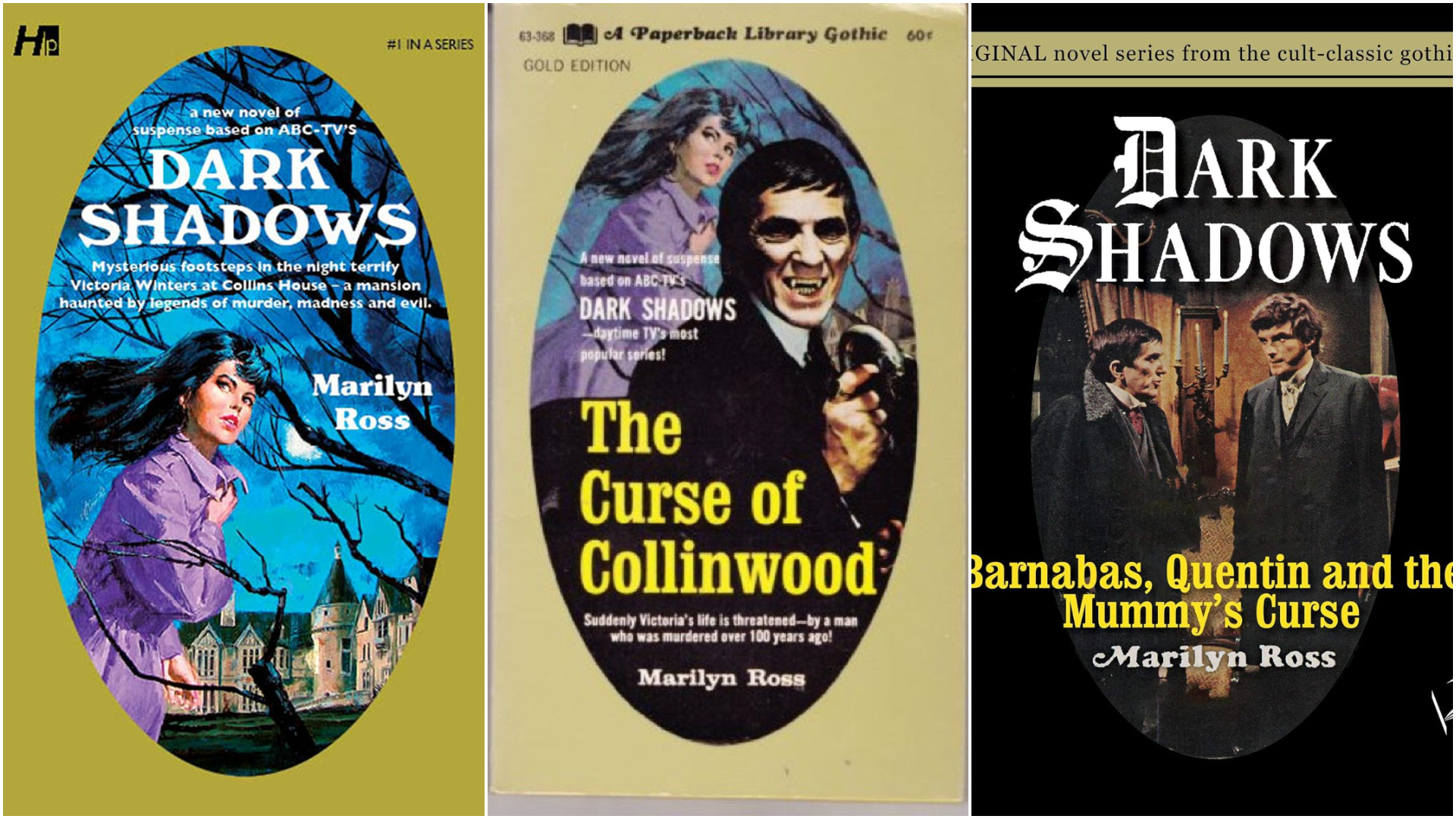
From Victoria Winters’ arrival at Collinwood to the adventures of Barnabas Collins and Quentin Collins, here’s how the original Dark Shadows paperback series began.
For fans of Dark Shadows, there was a time when spending time with the Collins family didn’t necessarily mean turning on the television. Sometimes it meant opening a paperback.
Beginning in December 1966, Paperback Library published a series of original Dark Shadows novels credited to Marilyn Ross, a name that would become familiar to countless fans of the daytime Gothic soap opera. In reality, the books were written by prolific Canadian author Dan Ross, who used his wife’s name as a pseudonym.
Over the next several years, Ross produced 32 original novels, along with a novelization of the 1970 feature film House of Dark Shadows. The books allowed readers to return to Collinwood whenever they wanted, offering new mysteries, romances and supernatural adventures featuring characters from the television series.
There was, however, a significant difference between the two versions of Dark Shadows. Although the novels featured familiar names and locations, they didn’t necessarily follow television continuity. Characters had different histories, relationships developed in unexpected ways, and events unfolded that had never happened on the show. The books essentially created their own Dark Shadows universe.
The earliest novels concentrated on Victoria Winters and the mysteries surrounding the Collins family. But as Barnabas Collins became the television show’s breakout character, the paperback series shifted its attention to the vampire. Quentin Collins eventually joined him, transforming the books into a succession of supernatural adventures that sometimes ventured even further into horror and fantasy than the television series itself.
Here is a look at the first 16 novels in publication order, with a guide to each story and what makes it particularly interesting for Dark Shadows fans.
The First 16 Dark Shadows Novels in Publication Order
1. Dark Shadows (December 1966)

What it’s about: Victoria Winters arrives in Collinsport to become governess to young David Collins, despite warnings about the mysterious family living at Collins House. She hopes the position might provide answers about her own unknown origins, but soon becomes the target of apparently deliberate attacks. Complicating matters is her growing attraction to Ernest Collins, a relative of the family who is mourning his wife. As Victoria’s feelings deepen, she begins questioning the circumstances surrounding Ernest’s widowhood and whether someone at the estate wants her dead.
What makes it interesting: Published just months after the television series premiered, the first novel reflects Dark Shadows in its original Gothic-mystery incarnation. Ernest Collins is an original character created for the books, rather than someone viewers would recognize from television. Barnabas Collins doesn’t appear in the story, although later editions featured Jonathan Frid on the cover, capitalizing on the vampire’s growing popularity.
2. Victoria Winters (March 1967)

What it’s about: Convinced that Collins House holds the key to her mysterious past, Victoria continues working as the Collins family’s governess despite the threats against her life. Her determination is tested when four mysterious strangers arrive at the estate, followed by a series of frightening attacks. A ghostly figure also begins stalking Victoria, leaving her increasingly unsure whom she can trust. What initially seemed like an opportunity to discover her identity has become a struggle to survive.
What makes it interesting: The second novel continues Victoria’s search for her origins, which was also one of the central mysteries of the television show’s earliest months. The arrival of four mysterious visitors and the suggestion of a supernatural presence reinforce the Gothic-romance formula that initially defined the paperback series. Like its predecessor, the story places Victoria firmly at the center of the action.
3. Strangers at Collins House (September 1967)

What it’s about: Victoria believes she may finally have discovered a clue to her identity when she meets Henry Collins, an elderly relative who gives her jewelry that once belonged to his lost love. The resemblance between Victoria and the woman raises intriguing questions about her ancestry. But the gift apparently places her in danger. A succession of suspicious accidents threatens her life, leaving Victoria wondering whether thieves are after the jewels or someone is determined to prevent her from uncovering the truth about her past.
What makes it interesting: Rather than relying entirely on supernatural threats, this installment builds its mystery around family history, valuable jewelry and Victoria’s uncertain parentage. The connection between Victoria and a woman from the Collins family’s past is particularly intriguing, given how frequently the television series would explore ancestral mysteries and striking resemblances between characters from different generations.
4. The Mystery of Collinwood (January 1968)

What it’s about: Victoria Winters encounters a sinister newcomer to Collinwood: Professor Mark Veno, a hypnotist whose influence threatens to become deadly. At one point, Victoria finds herself on a cliff overlooking the sea, struggling against his attempt to compel her to jump. The professor is actually Mark Collins, brother to Elizabeth and Roger, who wants his daughter Linda to marry Ernest Collins and regards Victoria as an obstacle. Meanwhile, sightings of the legendary Phantom Mariner add another frightening mystery to the estate.
What makes it interesting: Mark Collins, operating under the identity of Professor Veno, is another character unique to the paperback continuity. His sinister activities and the mysterious Phantom Mariner give the novel a particularly pulpy Gothic atmosphere. The story also demonstrates how freely Ross could expand the Collins family tree, introducing relatives and relationships that had no counterpart on television.
5. The Curse of Collinwood (May 1968)

What it’s about: Still grieving the death of Ernest Collins, Victoria Winters begins seeing strange figures that she initially believes are apparitions brought on by her troubled state of mind. But when the threats against her become real, she discovers something far more terrifying. The figures are Derek and Esther Collins, two members of the family who were murdered more than a century earlier. Somehow, a shaft of moonlight has released them from their coffins, condemning them to wander the earth as the living dead. Victoria must confront a supernatural threat that is anything but imaginary.
What makes it interesting: The novel represents a notable departure from the earlier books’ emphasis on Gothic mysteries. Its undead characters bring the paperback series closer to the supernatural territory that was making the television show increasingly popular. Barnabas appeared on the original cover but not in the story itself, making this the final novel before the vampire’s actual introduction to the paperback universe.
6. Barnabas Collins (November 1968)

What it’s about: On a fog-shrouded night in 1899, Barnabas Collins arrives at Collinwood, bringing with him a horrifying secret. Although he appears to be an aristocratic member of the Collins family, Barnabas is actually a vampire whose existence stretches back more than a century. His arrival introduces a new source of danger to the estate, as the novel explores the circumstances surrounding his presence and the terrible truth behind his seemingly respectable appearance.
What makes it interesting: This is Barnabas’ first appearance in the Marilyn Ross novels, and it establishes a separate continuity from the television series. Rather than having been imprisoned in his coffin until 1967, this version of Barnabas was active decades earlier. The novel also presents a considerably more frightening vampire than the increasingly sympathetic character Jonathan Frid was portraying on television.
7. The Secret of Barnabas Collins (January 1969)

What it’s about: Desperate to free himself from the vampire’s curse, Barnabas Collins searches for a woman who can take the place of his lost love, Josette. His quest leads him to Clare Duncan, a beautiful young noblewoman with whom he becomes romantically involved. Barnabas hopes that their relationship might finally end his supernatural torment, but the romance places Clare in terrible danger. As their feelings deepen, the secret of Barnabas’ existence threatens to destroy the woman he believes might save him.
What makes it interesting: Set in 1870, the novel develops a central element of the Barnabas mythology: his obsession with finding a replacement for Josette. Unlike the television series’ established chronology, the paperback continuity allows him to pursue that obsession during the nineteenth century. The story also continues the darker characterization established in the preceding novel.
8. The Demon of Barnabas Collins (April 1969)

What it’s about: When a motion-picture company arrives at Collinwood, Barnabas meets and falls in love with Rita Glenn, a beautiful actress who may offer him a way out of his supernatural existence. Rita introduces him to the mysterious Dr. Moreno, who claims to possess a cure for the vampire’s curse. Barnabas undergoes the treatment and initially celebrates his apparent recovery. But his happiness is short-lived. Another vampire threatens Rita’s life, forcing Barnabas to confront a terrible choice: remain free of his curse or become one of the living dead again to save the woman he loves.
What makes it interesting: This is an especially significant installment because Barnabas takes on a more heroic role. Rather than simply representing a threat to others, he faces the possibility of sacrificing his own freedom to protect someone he loves. The arrival of a film crew also brings an unusual show-business element into the Gothic world of Collinwood.
9. The Foe of Barnabas Collins (July 1969)

What it’s about: Barnabas befriends Paula Jennings, a wealthy young woman who has recently married the mysterious Christopher Jennings. Suspecting that Christopher is the werewolf responsible for terrorizing the surrounding countryside, Barnabas becomes increasingly concerned for Paula’s safety. His fears intensify when Christopher joins forces with Melissa Henry, a woman who is actually the reincarnation of Angelique. Barnabas now faces two formidable supernatural enemies, and protecting Paula means confronting both the werewolf and the witch whose evil powers may rival his own.
What makes it interesting: The novel brings together three familiar elements of Dark Shadows mythology: Barnabas, the werewolf curse and Angelique. However, Chris Jennings is presented as a villain rather than the sympathetic character viewers knew from television, while Angelique assumes the identity of Melissa Henry. It’s another example of Ross taking recognizable characters in dramatically different directions.
10. The Phantom and Barnabas Collins (September 1969)

What it’s about: Maggie Evans visits the Collins family cemetery and unexpectedly finds herself transported back to 1880. Awakening with amnesia in an unfamiliar version of Collinwood, she gradually discovers that she has fallen into the clutches of Dr. Giles Collins, a sinister physician conducting experiments involving human blood. Several people have already died as a result of his activities, and Maggie may be his next victim. Although others warn her that Barnabas Collins is a vampire, she turns to him for protection. Unfortunately, Barnabas himself is also threatened by the doctor’s murderous schemes.
What makes it interesting: Maggie takes center stage in a story involving time travel, amnesia and a mad scientist. It’s an intriguing combination of familiar television concepts and Ross’s own Gothic plotting, with Barnabas positioned as Maggie’s potential rescuer rather than her principal tormentor. The nineteenth-century setting also demonstrates the novels’ willingness to explore periods outside the television show’s established chronology.
11. Barnabas Collins vs. the Warlock (October 1969)

What it’s about: Strange occurrences at Collinwood threaten Maggie Evans and the two children in her care, David Collins and Amy Jennings. An evil supernatural presence appears to exert an influence over the children, drawing them into frightening and increasingly dangerous behavior. The mysteries surrounding a nearby swamp and cemetery add to the atmosphere of menace, while Maggie’s growing attachment to Barnabas Collins complicates matters. As the danger increases, she must determine what is influencing the children and whether Barnabas can help protect them.
What makes it interesting: The novel draws upon elements of Henry James’s The Turn of the Screw, particularly the idea of children threatened by supernatural influence. It also brings together several familiar television characters, including Maggie, David, Amy, Elizabeth, Roger and Carolyn, giving the story a stronger connection to the show’s established ensemble.
12. The Peril of Barnabas Collins (November 1969)

What it’s about: Barnabas falls in love with Diana Hastings, a beautiful heiress, and once again becomes determined to find a cure for his vampirism. He brings the mysterious scientist Dr. Rudolf Padrel to Collinwood, hoping that the doctor’s experimental serum will restore his humanity. But when graves are desecrated and a young girl is murdered, suspicion falls on Barnabas. Angry villagers threaten to storm the estate, while Barnabas begins to suspect that Padrel is responsible for the crimes. His dilemma is agonizing: expose the scientist and risk losing his only chance of becoming human, or remain silent as the danger grows.
What makes it interesting: Ross returns to Barnabas’ recurring desire to escape his curse, this time placing him in a conflict between self-preservation and protecting others. The story also reportedly uses an unusual framing device in which Maggie and Carolyn discover Diana Hastings’ diaries, allowing the earlier events to be recounted through her experiences.
13. Barnabas Collins and the Mysterious Ghost (January 1970)

What it’s about: When a ballet company arrives at Collinwood to entertain summer visitors, its presence is accompanied by a series of disturbing incidents. Barnabas Collins becomes romantically involved with Diana Samson, a beautiful member of the troupe who finds herself repeatedly threatened by an apparently invisible attacker. Matters take a deadly turn when the company’s leading dancer is murdered, casting suspicion on everyone, including Barnabas and Diana. The discovery of several disturbed graves revives an old legend about an invisible ghost haunting Collinwood. Barnabas must discover whether Diana is being stalked by a human murderer or a supernatural enemy before she becomes the next victim.
What makes it interesting: The introduction of a visiting ballet company gives this installment an unusual setting for its Gothic mystery. It also continues Ross’s increasingly sympathetic portrayal of Barnabas, who finds himself trying to protect a woman he loves while facing suspicion of murder. The story’s contemporary setting is another reminder that the books could move freely between different periods.
14. Barnabas Collins and Quentin’s Demon (February 1970)

What it’s about: In 1895, Quentin Collins invites Lara Balfour to Collinwood after becoming fascinated by a haunting waltz composed by her father. A romance begins to develop between them, but Lara soon learns that Quentin’s first wife was savagely murdered by a wolflike creature that was never captured. Other young women have suffered similar deaths, and the attacks appear to coincide with Quentin’s mysterious disappearances during the full moon. Lara begins to suspect that the man pursuing her may be a werewolf. Although frightened, she is reluctant to leave Collinwood because she has also developed feelings for Barnabas Collins. Whether Barnabas can protect her from the danger remains uncertain.
What makes it interesting: This is Quentin Collins’ first appearance in the Marilyn Ross novels, introducing the werewolf mythology that had become so popular on television. The romantic triangle involving Quentin, Lara and Barnabas also gives the story a particularly strong Gothic-romance element, while establishing a relationship between the two Collins men that would become increasingly important to the paperback series.
15. Barnabas Collins and the Gypsy Witch (March 1970)

What it’s about: Roxanna Collins receives a terrifying warning from a gypsy witch who predicts that violent death will surround her. Seeking protection, Roxanna turns to her distant cousin Barnabas Collins, but the situation quickly becomes more complicated. When her father and brother are murdered, suspicion falls on Barnabas himself. Roxanna, who believes she may be under the influence of a mysterious spell, begins to question whether she can trust the man she has come to love. With the police investigating and Roxanna potentially the next victim, Barnabas must establish his innocence while uncovering the truth behind the murders and the sinister forces threatening Collinwood.
What makes it interesting: Set during the 1890s, the novel combines witchcraft, murder and romantic suspicion. Once again, Ross places Barnabas in the position of a possible murderer who must prove his innocence, while the heroine struggles to determine whether the supernatural danger comes from someone she loves.
16. Barnabas, Quentin and the Mummy’s Curse (April 1970)

What it’s about: Professor Anthony Collins arrives at Collinwood to catalog his collection of ancient Egyptian artifacts, bringing with him the mummy of King Rehotip, a ruler who supposedly died more than 2,000 years earlier. But the professor knows that the king is actually in a state of suspended animation, and he succeeds in bringing him back to life. Soon afterward, a young woman is murdered, and the police suspect Quentin Collins. Maggie Evans believes the resurrected mummy is responsible, but when she attempts to reveal her suspicions, Professor Collins threatens to implicate Barnabas instead. Terrified that she may become the creature’s next victim, Maggie must decide whether to remain silent or risk the consequences.
What makes it interesting: The sixteenth novel is the first to feature both Barnabas and Quentin in its title, establishing the pairing that would dominate the remaining books. It also introduces an Egyptian mummy into the Dark Shadows universe, a classic horror creature that never became part of the original television series’ storylines. For fans who wondered what a mummy adventure at Collinwood might have looked like, Ross provided an answer.
An Alternate Dark Shadows Universe
Looking back at these first 16 novels, it’s fascinating to see how the paperback series evolved alongside the television show. The first five books reflect the early emphasis on Victoria Winters and the mysteries of Collinwood, while the sixth introduces Barnabas Collins and begins shifting the focus toward supernatural horror. By the fourteenth novel, Quentin has arrived, setting the stage for the partnership that would dominate the remainder of the series.
Yet the books were never simply adaptations of television storylines. Ross created his own version of the Collins family, sometimes introducing entirely new relatives, altering established histories and placing familiar characters in situations that viewers never witnessed. Barnabas could be a sinister vampire in one adventure and a romantic hero in another, while Quentin’s personality and motivations could change dramatically from book to book.
That freedom was both a strength and a source of occasional frustration for fans expecting the novels to follow the television series. But viewed as an alternate continuity, the books offer something rather wonderful: 32 additional visits to Collinwood, filled with mysteries, romance, murder and supernatural creatures.
For readers who grew up collecting the original paperbacks, the novels remain a nostalgic reminder of the years when Dark Shadows was everywhere. For newer fans, they provide an opportunity to discover a different interpretation of characters who have remained popular for six decades.
And we’ve only reached the halfway point.
Coming soon: The remaining 16 Marilyn Ross novels, including more adventures of Barnabas and Quentin, encounters with sinister scientists and supernatural enemies, and some of the strangest stories ever to unfold at Collinwood. We’ll also look at Ross’s novelization of House of Dark Shadows, which stands apart from the original paperback continuity.
