
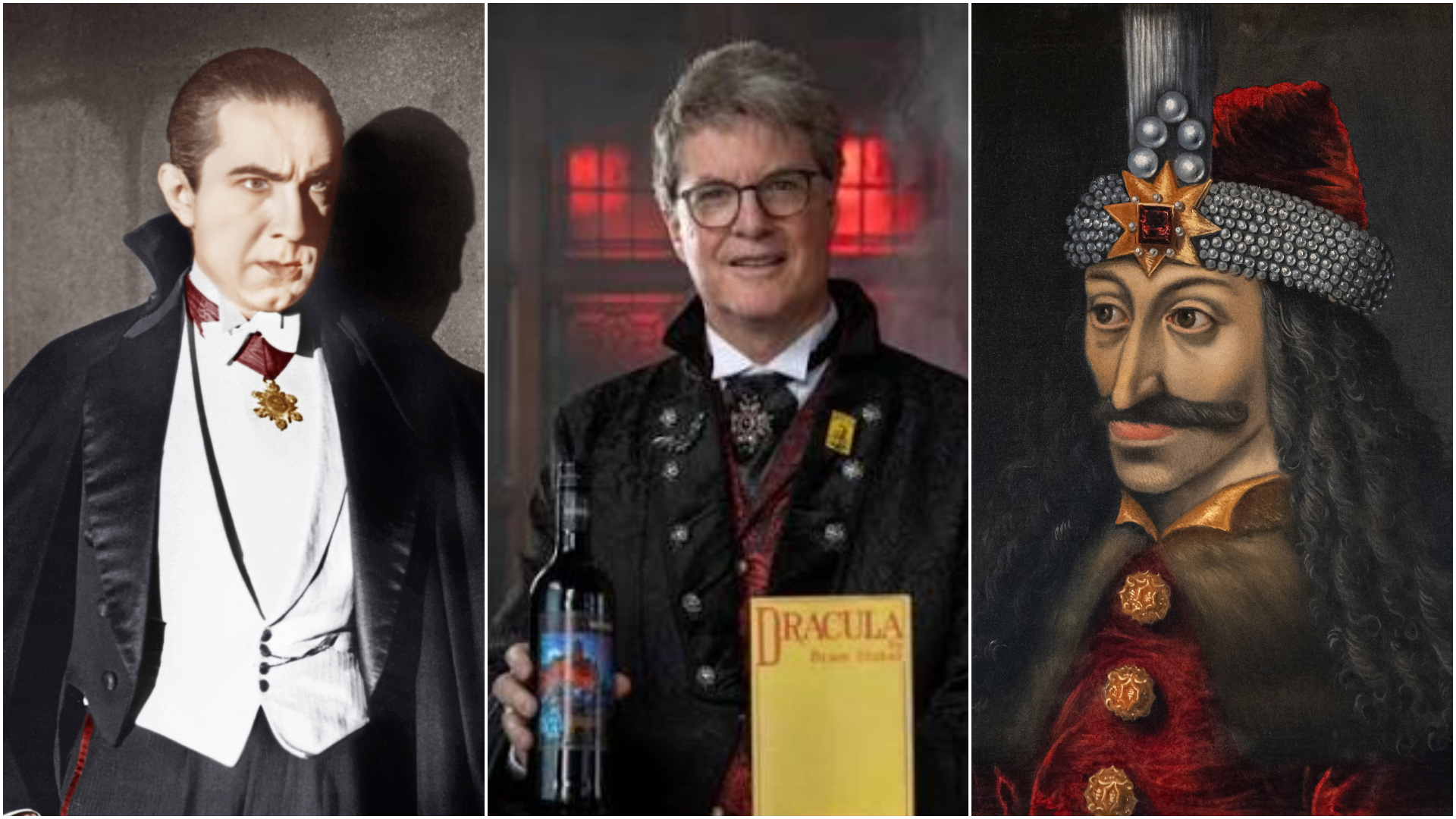
Bram Stoker’s descendant has spent years investigating the origins of Dracula, and his discoveries suggest the legendary vampire’s connection to Vlad the Impaler may be much stronger than scholars once believed.
For generations, the connection between Bram Stoker’s Dracula and the real-life Vlad the Impaler has been treated as something close to historical fact. Vlad III, the 15th-century ruler of Wallachia notorious for his brutal methods of dealing with enemies, was the inspiration for literature’s most famous vampire. Or so the story goes.
Except that Dracula scholars have spent decades arguing otherwise. While Stoker undoubtedly borrowed the name Dracula from historical accounts, the prevailing scholarly interpretation has been that he knew little about Vlad himself. The novelist, according to this argument, wasn’t particularly interested in the Wallachian ruler’s bloody history. He simply encountered a name that suited the monstrous character he was creating. But what if that interpretation is wrong? Or, at the very least, incomplete?
That’s the question being raised by Dacre Stoker, Bram’s great-grandnephew, an author, researcher and longtime investigator of the history behind Dracula. During an exclusive conversation with Vampires & Slayers, Dacre explained how his own research has led him to challenge the conventional wisdom about Vlad’s influence on his famous ancestor. And unlike the countless theories circulating online, his argument is rooted in the actual books Bram Stoker consulted while writing his 1897 novel.
The Dracula Connection That Scholars Thought They Had Settled
For years, one of the central pieces of evidence in the debate has been a book by William Wilkinson, An Account of the Principalities of Wallachia and Moldavia, published in 1820. Bram encountered it while visiting Whitby, England, in 1890, and made notes about the name Dracula and its supposed meaning. Dacre explains that two respected Dracula scholars, Elizabeth Miller and Robert Eighteen-Bisang, were among those who helped establish the distinction between the fictional Count and the historical Vlad.
DACRE STOKER: “I was very good friends with Dr. Elizabeth Miller and Robert Eighteen-Bisang. I wrote two books with them. They’re high-end scholars. We joke about them and call them the Dracula Police because they love to correct people when they say, and so many people did, Bram Stoker knew nothing about Vlad the Impaler. All he saw was one book by William Wilkinson that he found in the Whitby Library that says, ‘Dracula in the Wallachian language means devil. It was given to anyone who displayed courage, cruel action, or cunning.’ End of story. That is correct in the one book.”
The Wilkinson reference was significant because it established where Bram encountered the name Dracula. What it didn’t necessarily establish was whether he knew anything more about the historical figure associated with it. And that’s where Dacre’s investigation took an unexpected turn.
A Discovery Hidden Just Four Pages Away

Bram Stoker was a meticulous researcher. His surviving notes for Dracula, preserved at the Rosenbach Museum and Library in Philadelphia, contain references to books, historical accounts and folklore that helped shape the novel. Among those references was a book by Samuelson, with a notation directing the writer to page 179. For Dacre, that seemingly ordinary citation became the starting point for a discovery.
DACRE STOKER: “I’m the guy that followed up, even though the two of them transcribed the Dracula notes in the Rosenbach Museum, and in the back of those notes, Bram listed all his books. And in one of the pages he said, ‘See Samuelson, page 179.’ And it was all about the Dacians in Romania, the early native people, these mystical Dacians.
“So of course, when I go over to London, when they discover these books and they see all these marks in the pages, I say, ‘Hey, you got anything by this guy, Samuelson?’ ‘Yeah, it’s listed in the books. Here it is.’ I open it up. I immediately go to page 179, and I see nothing about Vlad the Impaler, but I see four pages earlier, a whole page on John Hunyadi and Vlad the Impaler being called the devil by their enemies and their countrymen because of the atrocities that they did, and this whole page goes into great detail.
“Vlad the Impaler nailing the turbans into the heads of these visiting envoys, doing all these things. So I was able to debunk this fact that Bram Stoker knew nothing about Vlad the Impaler. I don’t exactly know what he knew and he didn’t write it in his notebook like he wrote Dracula in the Wallachian language means devil, but I found a second book that mentions Dracula being known as the devil. And then, yes, all these other things about him impaling and so on.”

The distinction is fascinating. Bram’s notes don’t specifically say he read the passage about Vlad, but they establish that he was consulting the same book and had directed himself to material only a few pages away. For Dacre, the likelihood that his ancestor would have read those surrounding pages is difficult to dismiss. As he put it later in our conversation, “It’s not like Bram didn’t read the whole damn book. That’s what he does.”
That observation doesn’t constitute definitive proof of Vlad’s influence, but it does challenge the assumption that Bram’s knowledge of the historical Dracula began and ended with Wilkinson, and Dacre believes the evidence goes considerably further.
Was Dracula’s Own History Borrowed from the Past?
One of the most revealing passages in Dracula occurs in Chapter Two, when Jonathan Harker listens to the Count discuss his ancestry and the turbulent history of his people. Dracula speaks of battles, conquerors and the fierce warriors who preceded him. It’s a curious moment because the Count is offering something approaching a historical biography, albeit one wrapped in the supernatural mythology of the novel. Dacre believes the Samuelson book helps explain where some of that material originated.
DACRE STOKER: “So I read more of the book and then I go to Dracula because I’m working with Eighteen-Bisang on an annotated Dracula. And I say, ‘Well, in Chapter Two, when Harker asks him, asks Count Dracula all about his history and who he was, where the heck do you think he gets all this stuff about his backstory and the berserkers from Iceland and Attila the Hun and all this stuff?’ It’s all from this Samuelson book. That’s where the backstory is. So it makes total sense to me that Bram sees two sources, two different sources of Vlad or Dracula being named as the devil, and he needs to create a devil incarnate with a real backstory. And the real backstory is that of Vlad the Impaler. Yes, he never mentions the word Vlad in the whole novel Dracula, never mentions impalement. That’s not what he needed. What he needed was a devil and somebody who was known as a devil.”
This is an important distinction in Dacre’s argument. He’s not suggesting that Bram intended to write a historical novel about Vlad III or that the fictional Dracula was meant to be a faithful representation of the Wallachian ruler. Instead, he believes Bram borrowed elements of history to make his supernatural creation feel authentic. And there was another influence, one much closer to the novelist’s everyday life.
Henry Irving, Mephistopheles and the Making of a Monster

Bram Stoker spent much of his professional life working as the business manager of the celebrated Victorian actor Henry Irving at London’s Lyceum Theatre. Their relationship placed Bram at the center of the theatrical world, where he witnessed Irving’s commanding performances and larger-than-life stage presence.
DACRE STOKER: “And the third piece of that is Henry Irving playing the role of Mephistopheles, the devil. And why do I know that? Because I’m one of the six people who saw the Dracula typescript, the one that’s owned by Paul Allen, the 480 pages, that has the passage in it that mentions Dracula as Mephistopheles all crossed out. So the things that were crossed out of the typescript never got published. But I’ve seen it and I know now, or I did when I saw it six years ago, that Bram was thinking Mephistopheles when he was creating his character. Who was Mephistopheles? The role of the devil’s assistant on Earth that Henry Irving played. So now you got three potential sources of the devil, Irving dressed as he does in this costume on stage, very dominating guy, and Vlad the Impaler.”
Even Dracula’s Castle May Have Been a Combination of Real Places

Dacre sees a similar creative process at work in the setting of Dracula, particularly the Count’s imposing Transylvanian castle. Today, Bran Castle in Romania is widely promoted as Dracula’s Castle, despite its limited historical association with Vlad the Impaler and the absence of evidence that Bram ever visited it. Yet Dacre believes there’s a legitimate literary connection between Bran Castle and the fictional fortress, although not necessarily the one tourists expect.
DACRE STOKER: “Now, I lead these trips to Romania and I tell people, we’re going to go see locations associated with Vlad the Impaler and the fictional Count Dracula. There is a nexus point, only one, and that’s Bran Castle. Bran Castle was never ruled by Vlad the Impaler. He may have been there in passing, but in my opinion, it is the castle that Bram Stoker described in the book because he saw not just two, but three sketches of that castle in three of those books in the London Library.
“And it’s the only sketches of any castles in any of those books that Bram listed in the London Library. So the external image of Bran Castle was what Bram described. The internal layout of the castle is exactly as Bram experienced in Slains Castle in Cruden Bay, Scotland. So he merged his castles, he merged Vlad the Impaler and Mephistopheles, Henry Irving. He did all this merger. The story is full of these sort of little fusions or mergers, whatever you want to say, to suit what he was trying to do.”
It’s a compelling interpretation of the way Bram approached his fiction, although the precise identification of Bran Castle as his visual inspiration remains Dacre’s interpretation rather than an established fact. He was trying to create a realistic feeling to his readers by having bits and pieces of realism, or as Miller used to say, create the willful suspension of disbelief by putting enough fact in it that you believe the fiction.”
The significance of getting the story right
Dacre’s interest in Vlad extends well beyond the question of whether the Wallachian ruler influenced Bram Stoker. Having traveled to Romania 16 times, he has developed a personal appreciation for the country’s history and the complicated place Vlad occupies within it. In popular culture, Vlad is frequently portrayed as a bloodthirsty monster. Within Romanian history, however, he is also remembered for resisting the expansion of the Ottoman Empire, even as his brutality remains an essential part of his historical reputation. Dacre recently participated as an expert in a History Channel UK production titled Evil Medieval, examining whether Vlad was exceptionally cruel or, in some respects, a product of his violent era.
DACRE STOKER: “There’s arguments both ways. And as we say, under the circumstances, what Vlad the Impaler was trying to do to protect Christian Europe from the threat of the invading Ottoman Empire, he was constantly changing his allegiances with the German Saxons, the Austrian-Hungarians to position himself to be effective. And that’s what they did in the time. When you’re a small man in a strategically placed country, you’ve got to make alliances every month.”
He also recognizes that the extraordinary popularity of Bram’s fictional Dracula has fundamentally changed the way the world thinks about Vlad.
DACRE STOKER: “I feel a little guilty when someone says, and I really love the country, ‘Oh, it’s your great-granduncle that has turned our guy into some Hollywood hero when he really was a hero fighting for Christianity.’ But he had three reigns totaling seven and a half years. He’s relatively insignificant. It’s my guy that made him real famous. That’s why we’re talking about him now, but let’s get the record straight.”
It’s part of what Dacre calls “responsible vampire tourism,” the idea that enjoying the mythology of Dracula shouldn’t come at the expense of understanding the actual history behind it.
DACRE STOKER: “I feel very strongly about if we’re going to get the facts straight, let’s just not look at the old facts. There’s new ones that have emerged. And unfortunately, my good friends Miller and Eighteen-Bisang hadn’t seen it. Now, Miller died before I could tell this, but Eighteen-Bisang hadn’t died and he completely agreed with me. We’re the two guys that actually did the annotated Dracula together for the 125th anniversary. So again, I feel like I have contributed to the whole argument and made some discoveries by putting the puzzles together.”