
Dr. Mystic reads the article that follows, which you can download to listen to later
In 1975, Stephen King’s second novel transformed a quiet Maine community into a breeding ground for the undead, establishing a vampire mythology he would revisit for decades.
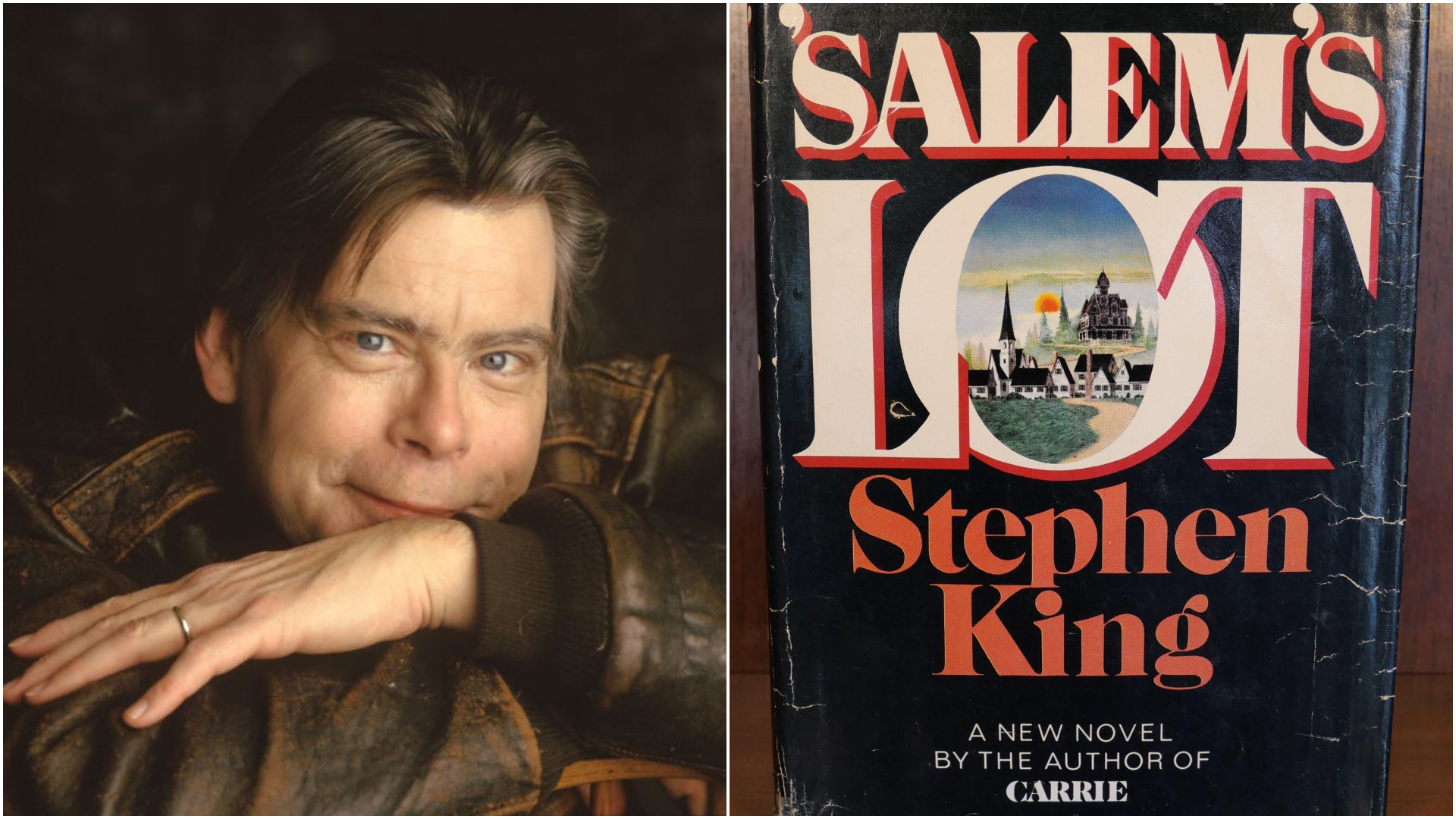
Long before Stephen King introduced readers to the psychic vampires of Doctor Sleep, the sinister nurses of The Little Sisters of Eluria or the bloodthirsty aviator of The Night Flier, he unleashed a very different kind of horror upon the fictional Maine town of Jerusalem’s Lot. Published on October 17, 1975, ‘Salem’s Lot was King’s second novel, following the success of Carrie the previous year. Its premise was straightforward enough: What would happen if a vampire like Bram Stoker’s Dracula came to modern America? But rather than place the Count in a bustling metropolis, King imagined him settling into an isolated community where people knew one another, secrets were plentiful and disappearances might initially go unnoticed.
The result was a novel that helped redefine vampire fiction for a new generation, replacing the castles and villages of Gothic Europe with familiar American surroundings. More importantly, King understood that the real horror wasn’t simply the arrival of a monster. It was watching an entire community gradually surrender to him.
From Dracula to Jerusalem’s Lot

The inspiration for ‘Salem’s Lot emerged during King’s years as a high school English teacher in Maine. Among the books he taught in a fantasy and science fiction class was Stoker’s Dracula, and he was impressed by how enthusiastically his students responded to a novel first published in 1897. As King recalls on his official website, the idea developed during a dinner conversation with his wife, Tabitha. He wondered what would happen if Dracula returned in 20th-century America. Tabitha had a decidedly practical response: “He’d probably be run over by a Yellow Cab on Park Avenue and killed.”
The remark was funny, but it also suggested a problem. Perhaps an ancient European vampire wouldn’t fare particularly well in modern New York City. But what about rural Maine? King began imagining the Count arriving in a sleepy little town, far removed from the distractions and scrutiny of urban life. There, an outsider might establish himself without attracting too much attention, at least until it was too late. That became the foundation for ‘Salem’s Lot, although the novel initially carried the title Second Coming.
King wrote the book while living with his family in North Windham, Maine, where he worked in a small room in the garage of a rented house. His mother was seriously ill, his career as a novelist was just beginning and the enormous success that would eventually make him one of the world’s bestselling authors still lay ahead.
The manuscript subsequently bore the title Jerusalem’s Lot, but that presented a marketing concern. According to King’s original Doubleday editor, Bill Thompson, the publisher’s sales department worried that readers might mistake it for a religious novel. In a 2018 interview with Suntup Editions, Thompson credited Tabitha with suggesting the abbreviated title ‘Salem’s Lot, believing it would suggest witchcraft rather than a biblical setting. It was an inspired choice, giving the novel a title that sounded both familiar and vaguely sinister.
A Town Already Haunted

The story begins with novelist Ben Mears returning to Jerusalem’s Lot, a small Maine community where he spent part of his childhood. His principal interest is the Marsten House, an abandoned mansion overlooking the town. As a boy, Ben experienced something terrifying inside the house, and he hopes that returning to confront those memories will provide material for a new book. But the house has attracted another interested party.
A mysterious European businessman named Kurt Barlow has purchased the property, with his associate Richard Straker arriving to establish an antiques business in town. Soon afterward, children begin disappearing, residents fall mysteriously ill and the dead refuse to remain in their graves. As Ben and a small group of allies begin investigating, they discover that Barlow is an ancient vampire who is systematically transforming Jerusalem’s Lot into a community of the undead.
Among those drawn into the struggle are schoolteacher Matt Burke, young Mark Petrie, Ben’s romantic interest Susan Norton and Father Donald Callahan, a Catholic priest whose troubled faith will be tested in ways he could never have anticipated. King gives these characters their own histories, relationships and personal difficulties before allowing the supernatural horror to overtake them. It’s an approach makes the town feel like a functioning community rather than simply a backdrop for a monster story. And it makes the gradual disappearance of its inhabitants all the more disturbing.
The Vampire Isn’t the Only Monster

One of the novel’s most effective elements is King’s suggestion that Jerusalem’s Lot was troubled long before Kurt Barlow arrived. The Marsten House carries a history of murder and violence, while the town itself conceals domestic abuse, cruelty, prejudice and other forms of ordinary human ugliness. Barlow doesn’t create all the darkness in Jerusalem’s Lot, but instead exploits what is already there.
King also takes his time revealing the extent of the vampire’s influence. Rather than immediately unleashing a supernatural catastrophe, he follows the daily lives of the townspeople as seemingly unrelated incidents begin accumulating. A child vanishes, someone becomes ill, a familiar face appears outside a bedroom window after dark. And by the time the characters understand what’s happening, the infection has spread far beyond their ability to contain it.
Barlow himself remains largely in the background during the early portions of the novel. His presence is felt through the actions of others and the increasingly ominous changes overtaking the community. The result is a vampire story in which the setting becomes nearly as important as the monster.
Stephen King on Letting the Vampires Win

King has acknowledged that part of his attraction to the story was the possibility of allowing the vampires to triumph. In his introduction to a 1999 edition of ‘Salem’s Lot, he discussed the appeal of imagining an entire town taken over by the undead, its inhabitants continuing their ordinary routines while concealing their new appetites. There was a darkly comic element to the idea: vampires operating local businesses, driving cars and essentially carrying on with small-town life, except for their dietary requirements. But King also discovered that his protagonist wasn’t necessarily willing to surrender.
Ben Mears emerged as someone determined to fight back, even when the odds seemed hopeless. That tension between the author’s fascination with a doomed community and his protagonist’s determination to resist gives the novel much of its emotional power. The book is not simply about the spread of vampirism, but the possibility of courage in a place where nearly everyone has become either a victim or an accomplice.
A Different Kind of Dracula

Although Barlow is unmistakably descended from Stoker’s Count Dracula, King adapts the character to fit his American setting. Barlow is ancient, intelligent and capable of manipulating the people around him. But he is also practical enough to rely on a human associate, establish a commercial presence and exploit the vulnerabilities of an isolated community. His arrival isn’t announced by a supernatural spectacle, but disguised as a business transaction. The vampire’s victims, meanwhile, retain enough of their former identities to make encounters with them particularly painful. A child returning to a bedroom window or a loved one appearing after death is more emotionally unsettling than an anonymous monster emerging from the darkness.
King draws upon traditional vampire mythology, including crosses, stakes, invitations and the power of faith, but places those elements in a world of automobiles, television sets, schoolteachers and ordinary working families. The supernatural becomes frightening precisely because it intrudes upon such recognizable surroundings.
The Novel That Almost Had Another Life

Although ‘Salem’s Lot is now considered one of King’s signature novels, its original publication came at a time when his career was still developing. Even his editor wasn’t entirely convinced that a vampire novel was the ideal follow-up to Carrie. In the Suntup interview, Thompson recalled that vampires weren’t especially fashionable at the time and that he initially considered the manuscript a relatively conventional example of the genre. Nevertheless, he acknowledged the effectiveness of transplanting the familiar Dracula story into an American small-town setting.
The novel’s subsequent popularity helped establish King as an author capable of moving beyond the premise of his debut, while demonstrating that familiar horror traditions could be reinvented through contemporary characters and settings. In 2005, Doubleday published an illustrated edition containing approximately 50 pages of material deleted from the original manuscript, a new introduction by King and two related short stories, Jerusalem’s Lot and One for the Road. Those additions offered readers an opportunity to explore both the development of the novel and the larger mythology surrounding its fictional community.
The Vampires Would Return
The influence of ‘Salem’s Lot extended well beyond its original publication. King returned to the town in One for the Road, a short story that revealed the vampire infestation had not been entirely eradicated. He also explored an earlier chapter in the region’s sinister history through Jerusalem’s Lot, a Gothic tale with strong Lovecraftian influences.
Decades later, Father Callahan would reappear in Wolves of the Calla, bringing his experiences with Barlow into the mythology of The Dark Tower. His return effectively connected King’s early vampire novel to the elaborate fictional universe that would become central to his career.
And then there were the adaptations. Tobe Hooper directed the celebrated 1979 television miniseries, followed by Larry Cohen’s unconventional 1987 sequel, A Return to Salem’s Lot. A new television adaptation appeared in 2004, and another feature version arrived in 2024. Each production offered a different interpretation of King’s material, particularly the character of Kurt Barlow.
But the original novel remains the foundation. More than half a century after its publication, ‘Salem’s Lot continues to demonstrate how effective the vampire can be when removed from the familiar trappings of Gothic horror and placed somewhere seemingly ordinary. King didn’t need a Transylvanian castle or an isolated European village, just a small Maine town, a house overlooking the community and a stranger who arrived with plans to stay. And by the time the residents realized what had moved into their neighborhood, it was already too late.