
While not really equating the two, there is nonetheless an element of Ray Bradbury’s Something Wicked This Way Comes suggested by the new film Vampire Carnival, available as video on demand beginning October 30. That’s particularly true in the form of its unique take on the undead, drawing people in through their despair and offering up a possible alternative future path for them.
The official synopsis offers, “Vampire Carnival follows a grieving young woman who is drawn to a mysterious traveling carnival that appears without warning in her small town. Seduced by its eerie spectacle and promises of escape, she soon discovers that the carnival is a gateway to a hidden world where vampires feed not on blood, but on human despair. As she becomes ensnared in its seductive illusions, she must confront the trauma she’s been running from or risk becoming the carnival’s next permanent attraction.”
The film is directed by Justin Powell and David Charbonier, who are the first to admit that the title is a little off-putting and conveys a cheesier product than viewers actually get.

JUSTIN POWELL: “Let’s just get this out of the way: the title is not what it was named when David and I signed onto this project. It was originally called Carnival Gothic and then Crave, which everyone loved. That’s what it was going to be, but then the execs decided, ‘Let’s go on some weird Sharknado-clowns-from-outer-space direction with the title, even though that’s not what the movie is.”
Surprisingly, Powell and Charbonier weren’t involved in the early development of Vampire Carnival, instead being brought on board relatively late in the process to replace a director who had previously been attached.
DAVID CHARBONIER: “Justin and I got brought on pretty last minute to direct this movie, so I’m not sure how it came about in terms of development. That’s something Justin and I have been curious about, but they don’t tell us anything; they try to keep us in the dark about all this stuff. But the project was interesting to us for a few different reasons, including the fact that we love vampires and the genre, so we dove in and here we are.”
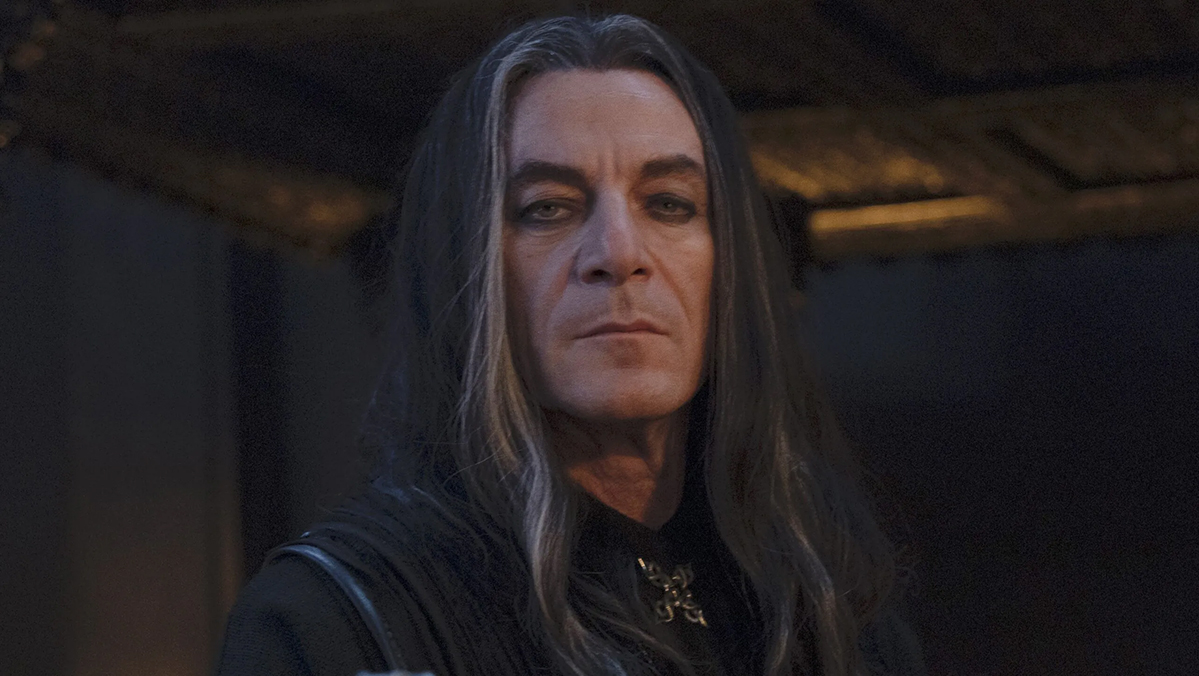
Intriguing about Vampire Carnival is that these members of the undead aren’t interested in indiscriminately slaughtering humans. Instead, they’ve established their own rules and society, seemingly determined to coexist with humanity rather than simply prey upon it. Powell credits actor Jason Isaacs, who stars as the clan’s leader, Toussaint, with helping the filmmakers find a way to understand these creatures.
JUSTIN POWELL: “I feel like the reason that this stands out is because these vampires have a real code and a real system, where they, aside from Eric [Kieron Moore], aren’t on a mission to kill or really harm humans. They want to co-exist and obviously they have their needs where they need to feed. But Jason Isaacs actually came to us with a really interesting perspective that shaped how we feel about the movie. And that is that these are vegan vampires in a way. It’s just a really fascinating concept to us in general, and an approach we really latched onto and a lens that we saw it through while we were shooting.”
Needless to say, the idea of vampire choosing not to kill humans isn’t entirely new, but what’s interesting here is the notion of an entire community attempting to live by a shared code. That makes the rebellious character of Eric particularly significant. Unlike the others, he doesn’t seem interested in suppressing his darker impulses or apologizing for what he has become. And the conflict between those opposing philosophies ultimately becomes central to the movie, particularly when Eric finds himself confronting Toussaint. That confrontation, it should be noted, almost looked very different from what we ended up with.
Spoiler warning: what follows discusses a major scene late in the film
One of the more effective elements of Vampire Carnival is the way it handles the physical struggle between the two characters of Eric and Toussaint. Ordinarily, when two superpowered vampires face off, you expect a spectacular battle where walls are demolished, bodies hurled across rooms and the combatants demonstrating just how far beyond human their abilities are. But that’s not quite what happens. In fact, the confrontation is surprisingly contained, emphasizing the emotional stakes (we weren’t even trying to be punny there) and the realization that Eric may have seriously misjudged his opponent.
JUSTIN POWELL: “It was a tough scene for us to shoot, because on the page, it always was supposed to be that Eric gets his ass kicked. That was always the case, but there was more scope with what was originally there. He was about to get punched through a wall and then that wall actually kind of breaks the veil and they end up landing out on the carnival grounds. And then Toussaint continues to kick Eric’s ass from there.”
“But there were so many time constraints with this production and just crazy things that happened that forced us to contain it. But there is something really intimate there that we were able to lay into. Kieron gives such a great, nuanced performance throughout that setting that really does help us.”
The more intimate staging meant that the focus remained on the characters and their relationship rather than the spectacle of their supernatural abilities and, as Powell explains, that ultimately played into one of the film’s central themes.

JUSTIN POWELL: “He really helped us make that setting work and just to really feel Eric’s pain. A lot of the themes of this movie is kind of vampirism serving a healing purpose in a way. And just getting to see a lot of the trauma that Eric has experienced and a lot of that coming out during this fight, and the connection he has to Toussaint as this new father figure. Kieron really helped us make that setting work, because we were bummed about it at the time. But maybe the way it came out was a happy accident. We’ll roll with that.”
Toward the end of the conversation, the question arises of why vampires continue to captivate the imagination of audiences, the genre having experienced countless transformations, from gothic horror and romantic fantasy to action and supernatural thrillers. Yet no matter how often vampires seem to fall out of fashion, they inevitably return.
DAVID CHARBONIER: “Why do these stories endure? Why do we have so many of them? And they don’t ever really change the rules of what it means to be a vampire, what their desires are, how they operate, how they exist in the world. For me, maybe they’re real. That’s why they’re written about in such old literature and the stories are still so present and still being made. I don’t really know what I believe anymore in terms of what’s real and what isn’t. Maybe it’s because in so many ways they’re relatable. There’s a fantasy and escapist element to them as well.
JUSTIN POWELL: “As a species, were’ often drawn to danger and the forbidden, and vampires really represent that. That’s just always going to be intriguing to us, and in turn that makes vampires relevant.”