
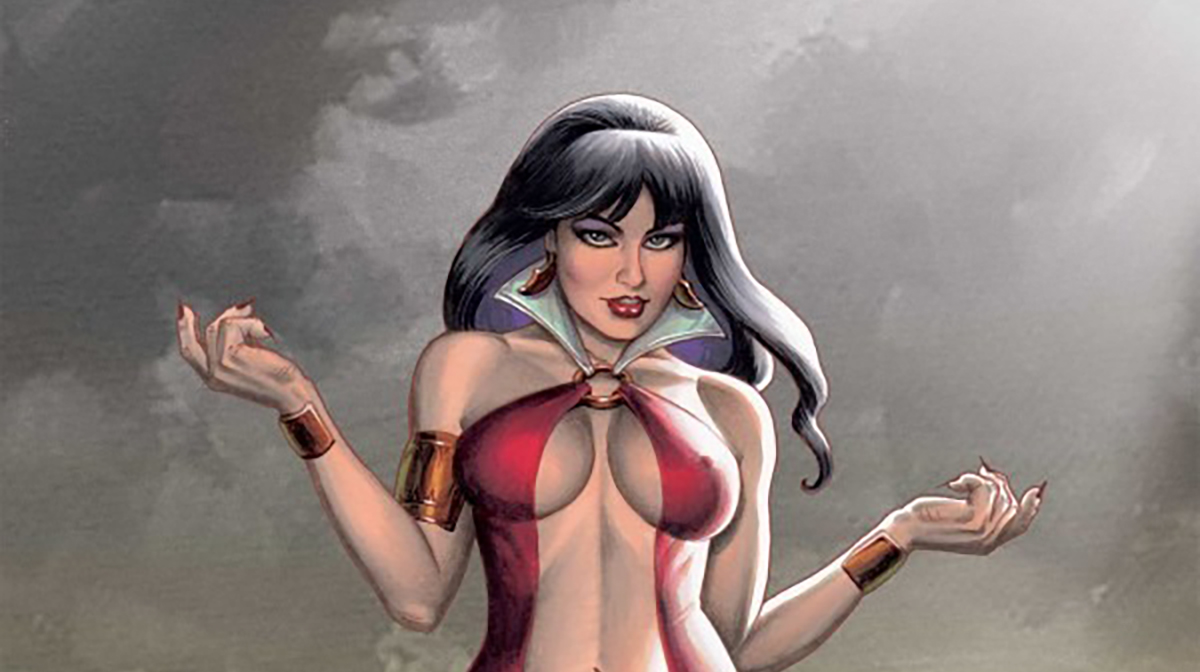
For nearly six decades, Vampirella has been one of the most recognizable figures in horror comics, thanks to her striking appearance, bloodthirsty adventures and a publishing history that has taken her from the pages of Warren Publishing’s black-and-white magazines to modern comic-book series. Yet despite her longevity, the character has made remarkably few appearances on screen. That may eventually change. In 2021, plans were announced for a new Vampirella movie, with subsequent developments pointing toward television and even animation. But as of October 2026, there’s no confirmed release date, cast or production schedule.
So who is Vampirella, and what has kept her alive in popular culture since 1969? From her unusual origins to her forgotten 1996 movie, here are nine facts about the vampire heroine whose story is still being written.
1. Vampirella made her debut in 1969 — with a little help from a science fiction legend
Vampirella first appeared in September 1969, when Warren Publishing launched Vampirella #1 as a companion to its popular horror magazines Creepy and Eerie. The character was conceived by Forrest J Ackerman, the legendary editor of Famous Monsters of Filmland, with comic-book artist Trina Robbins responsible for designing her now-famous costume.
The first issue featured a memorable painted cover by Frank Frazetta, whose fantasy and horror artwork was already becoming legendary. Inside, Vampirella was introduced as the hostess of a horror anthology, much like Uncle Creepy and Cousin Eerie, but unlike those grotesque narrators, Vampirella was a glamorous, mysterious woman with a story of her own waiting to be told.
Her debut coincided with a period when horror comics were finding new audiences outside the traditional color-comic format. Warren’s black-and-white magazines could explore subjects and imagery that mainstream comics publishers often avoided. Vampirella was perfectly suited to that environment, combining science fiction, gothic horror and a distinctly late-1960s sensibility.
2. Her original home was a planet where blood flowed like water
Vampirella’s earliest origin story was considerably stranger than the traditional tale of a vampire emerging from a Transylvanian castle. She came from Drakulon, a distant planet whose inhabitants survived by drinking blood that flowed naturally in rivers. When the planet’s supply began to disappear, Vampirella traveled to Earth, where blood was plentiful but generally belonged to living creatures.
This science-fiction explanation made her different from the vampires of folklore. Rather than being a human transformed by a supernatural curse, she was initially presented as an extraterrestrial whose biological needs happened to resemble those of Earth’s undead. Over the years, however, her origins underwent significant revisions. Later stories connected her to Lilith, the supernatural mother of vampires, while other interpretations explored alternate dimensions, demonic ancestry and competing versions of her history. The result is a character whose mythology can be as complicated as that of any long-running superhero.
3. She wasn’t originally intended to be the star of her own adventures

Vampirella began as a horror hostess, introducing the frightening stories appearing in her magazine. But that supporting role didn’t last long. Writer and editor Archie Goodwin helped transform her into a fully developed protagonist, giving her ongoing adventures, supporting characters and a mythology that extended beyond her original Drakulon background.
Among the important figures in her early stories were Adam Van Helsing, a descendant of the legendary vampire hunter, and the magician Pendragon, who became one of her closest allies. The character’s adventures increasingly involved confrontations with vampires, supernatural conspiracies and dangerous enemies, including Dracula himself.mArtist José González, who became closely associated with Vampirella during the Warren years, also played a major role in defining her appearance and visual personality. By the early 1970s, Vampirella had evolved from someone who merely introduced horror stories into the heroine at the center of them.
4. Vampirella is a vampire who often fights other vampires
One of the most appealing contradictions in Vampirella’s mythology is that she’s a blood-drinking creature who frequently battles other blood-drinking creatures. Although her precise abilities have varied depending on the writer and the era, Vampirella generally possesses enhanced strength, speed and resilience. She’s also been depicted as having powers of hypnosis, heightened senses and the ability to transform.
Unlike many traditional vampires, she has often been portrayed as immune to familiar weaknesses such as sunlight, garlic and religious symbols. Her relationship with human blood is more complicated. Vampirella must confront her own appetite while trying to protect the people who could potentially become her victims. That conflict gives the character something more substantial than her appearance might initially suggest. She’s a monster who doesn’t necessarily want to behave like one, and her greatest battles sometimes involve controlling her own nature.
5. Her famous costume has become both her trademark and a source of controversy
It’s impossible to discuss Vampirella without addressing the costume that made her instantly recognizable: a revealing red outfit with a high collar, gold accents and dramatic cutouts. Designed by Trina Robbins, it became one of the most enduring images in horror comics, reproduced and reinterpreted by generations of artists.
For publishers, the costume has been an unmistakable marketing advantage. Even readers unfamiliar with Vampirella’s adventures can often recognize the character immediately. But her appearance has also inspired decades of debate about the sexualization of female comic-book characters.
Some readers see Vampirella as an empowered heroine who uses her appearance and sexuality on her own terms. Others argue that her presentation reflects the male-oriented marketing traditions of horror and fantasy comics. The tension has followed her throughout her publishing history, although different writers and artists have approached the character in very different ways. Whatever one’s perspective, the costume remains central to Vampirella’s visual identity — and one reason she’s endured as a pop-culture icon.
6. Vampirella has survived three major publishing eras
The original Vampirella magazine ran for 112 issues, ending in 1983 as Warren Publishing’s fortunes declined. But the character didn’t remain buried. In the early 1990s, Harris Publications revived Vampirella in full-color comics, introducing her to a generation of readers accustomed to superhero storytelling and the booming comics market. The Harris era brought new interpretations of her mythology, new creative teams and a more contemporary approach to the character. It also helped establish Vampirella as a continuing comic-book property rather than simply a nostalgic reminder of the Warren magazines.
Dynamite Entertainment subsequently acquired the publishing rights, launching new series and reprinting classic material. Among the most notable modern contributors is writer Christopher Priest, whose work brought a psychologically complex and sometimes satirical perspective to Vampirella’s adventures.
Across all three eras, the character has undergone numerous transformations while retaining her basic identity as a vampire heroine caught between humanity and the supernatural world.
7. Vampirella already starred in a movie — and Roger Daltrey played the villain
Although recent interest has centered on a possible new adaptation, Vampirella actually made her live-action movie debut in 1996. Produced under Roger Corman’s Roger Corman Presents banner and directed by Jim Wynorski, Vampirella starred Talisa Soto as the title character. Soto was already familiar to genre audiences through her portrayal of Princess Kitana in the 1995 film Mortal Kombat. Her adversary was Vlad, played by Roger Daltrey, best known as the lead singer of The Who.
The film reworked elements of Vampirella’s extraterrestrial origin, with the heroine pursuing Vlad to Earth after he and his followers committed a terrible crime on Drakulon. Despite the character’s established comics following, the movie failed to establish a successful screen franchise. Its limited budget and production values left many fans disappointed, and the planned sequel never materialized. Nevertheless, the film remains a curiosity for Vampirella enthusiasts — and proof that bringing the character to the screen has been an ambition for decades.
8. A new Vampirella movie was announced in 2021, but the project evolved toward television
On March 2, 2021, Mike The Pike Productions announced that its subsidiary, Arowana Media Holdings, had acquired worldwide film, television and streaming rights to Vampirella from Dynamite Entertainment. The announcement raised hopes that the character might finally receive a major new screen adaptation. At the time, the company discussed plans for a feature film and additional productions based on Vampirella’s fictional universe.
Subsequent corporate materials, however, pointed in a different direction. Arowana reported a partnership with Canada’s Copperheart Productions to develop Vampirella for television. A 2023 regulatory filing went further, describing an agreement involving Dynamite and a Vancouver animation studio to develop an animated series based on the character’s universe. The company’s later promotional materials continued to identify Vampirella as a television project in development. What remains unclear is whether any of those plans are moving forward.
As of October 2026, no network, streaming service, cast, director or production start has been publicly confirmed in the sources reviewed for this article. Nor has a release date been announced. For now, the proposed adaptation remains a development project rather than a confirmed upcoming movie or series.
9. More than 55 years later, Vampirella is still going strong
Even without a new movie or television series, Vampirella remains an active presence in comics. Dynamite has continued producing new adventures, special editions and collected volumes, while frequently bringing the character into contact with other supernatural and fantasy properties. Among the titles appearing in late 2026 are Vampirella: Paradise, which continues the character’s supernatural adventures, and Pathfinder/Vampirella: Blade of Darkness, a crossover that transports her into the fantasy world of Pathfinder.
Her continued popularity also reflects a broader fascination with vampires, whose stories can accommodate everything from gothic tragedy and supernatural romance to action, satire and psychological horror. Vampirella has explored nearly all those possibilities during her long career. Whether she eventually returns to the screen remains an open question. But after surviving the collapse of her original publisher, decades of changing comic-book tastes and numerous revisions to her own mythology, the character has already demonstrated one very important quality.
Vampirella is remarkably difficult to kill.