
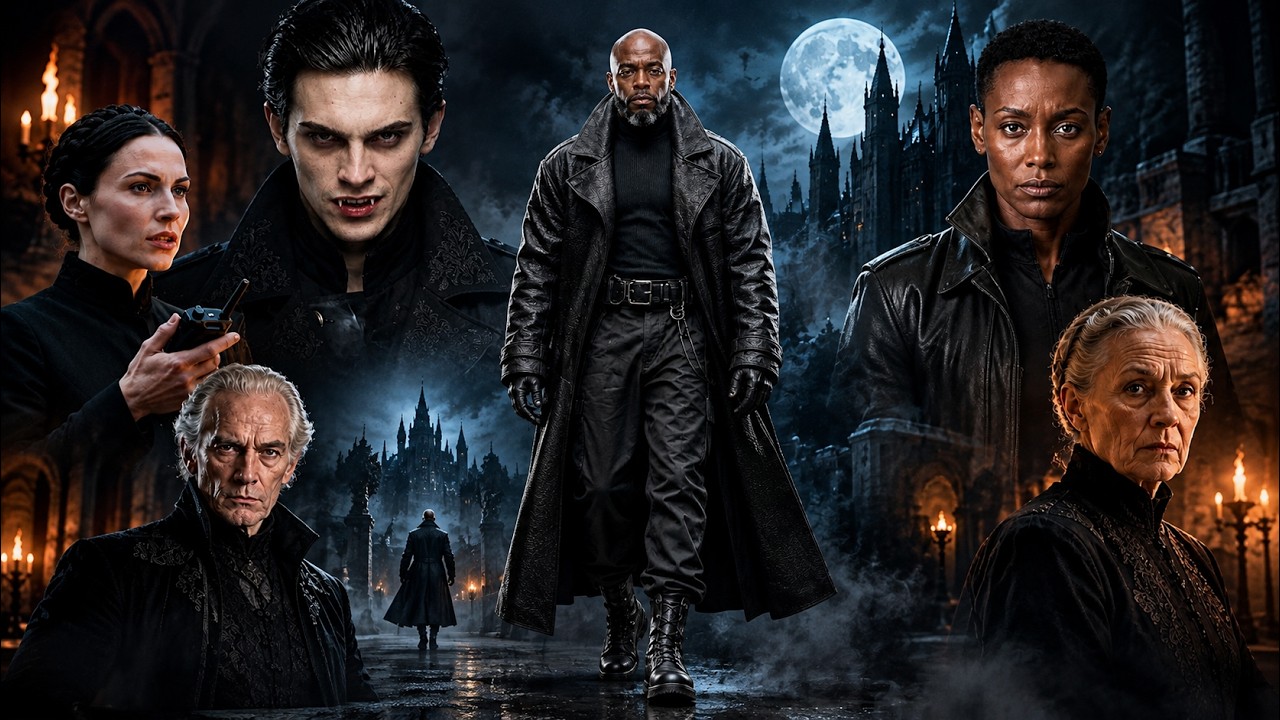
From futuristic bloodsuckers and supernatural action to vampire-werewolf romance, a new generation of filmmakers is experimenting with AI-generated horror.
Vampires have survived just about every transformation popular culture has thrown at them, from the aristocratic menace of Bela Lugosi’s Dracula to the romantic immortals of Twilight and the blood-soaked creatures of 30 Days of Night. Now they’re undergoing another transformation, and this time it isn’t happening on screen so much as behind the scenes. Artificial intelligence is becoming a tool for creating vampire movies and television series, allowing filmmakers to experiment with characters, locations and supernatural effects that might otherwise be beyond their budgets.
The results are already beginning to appear online, ranging from independently produced YouTube pilots to complete episodic dramas designed for mobile devices. Some creators are using AI to generate imagery while retaining conventional writing and editing techniques, while others are developing productions in which virtually everything viewers see and hear is synthesized. And although the technology remains controversial, particularly when it comes to the future of actors, artists and other creative professionals, there’s no denying that it is opening up new possibilities for people interested in telling genre stories.
For vampire fans, the more immediate question is whether any of these productions are worth watching. We’ve identified four projects that illustrate the different approaches being taken, from a science-fiction mystery about the origins of vampirism to a supernatural action adventure and a romantic fantasy involving warring vampires and werewolves.
NEØFERATU: What happens when humanity conquers death?
One of the more intriguing concepts comes from filmmaker Elena Savlokhova, whose 17-minute pilot Patient Zero introduces the world of NEØFERATU. Set in a near future where humanity has apparently succeeded in overcoming death, the story explores an unexpected consequence of that achievement: the emergence of vampires.
The pilot follows a woman named Jana as she awakens and begins confronting a past she has spent considerable time trying to avoid. Although the premise incorporates familiar elements of vampire mythology, its central idea moves the genre into science-fiction territory. Instead of treating vampirism exclusively as an ancient supernatural curse, NEØFERATU connects it to humanity’s efforts to manipulate mortality itself.
It’s an interesting premise because immortality has always been one of the vampire’s defining characteristics, and the desire to escape death has been explored repeatedly in both horror and science fiction. Here, those ideas come together in a world where the achievement of eternal life may have created something far more dangerous than anyone anticipated.
The project also demonstrates the increasingly complicated production methods available to independent AI filmmakers. Its listing on the AI-film discovery site AI MOVIE CTRL identifies a collection of tools used in its creation, including Midjourney, Adobe Firefly, Seedance, ElevenLabs and CapCut. These programs can serve different purposes, from generating imagery and video to producing voices and assembling finished sequences.
Released September 22, 2026, Patient Zero is currently listed as the first episode of NEØFERATU, with no additional installments confirmed in the available listing. That makes it a pilot rather than an established ongoing series, but the concept offers considerable potential for expansion.
Watch: NEØFERATU: Patient Zero
OBSIDIAN: A vampire who can walk in sunlight
Where NEØFERATU approaches vampirism through science fiction, OBSIDIAN moves toward supernatural action. Produced by Harris Film Group, the approximately 23-minute pilot introduces Malachi Carter, a man who is murdered at a gas station and subsequently returns as something extraordinary: a DayWalker, a vampire capable of surviving exposure to sunlight.
Unfortunately for Malachi, his unusual condition makes him a target. An ancient vampire order believes his existence threatens a long-standing prophecy, placing both him and the people he loves in danger. The premise combines a traditional vampire society with a protagonist whose very existence challenges its established rules.
It’s the kind of setup that would be familiar to fans of Blade, Underworld and other supernatural action franchises, although OBSIDIAN is an original project rather than an adaptation of those properties. Its appeal lies in the possibilities of an outsider discovering that he belongs to a hidden world governed by ancient conflicts and powerful enemies.
There’s also an interesting reversal of conventional vampire mythology. Sunlight, traditionally one of the undead’s greatest vulnerabilities, becomes the characteristic that makes Malachi exceptional. Rather than merely allowing him to survive, that difference appears to place him at the center of a larger supernatural struggle.
According to its AI MOVIE CTRL listing, the production used tools including Seedance, Nano Banana Pro and Higgsfield. The pilot was released September 22, 2026, and is currently the only episode listed.
For an independent filmmaker, a story involving supernatural transformations, vampire factions and action sequences would ordinarily present significant production challenges. AI-generated imagery offers one possible way of attempting that scale without assembling a conventional effects-heavy production.
Whether the technology can sustain such a story across multiple episodes remains an open question, but OBSIDIAN is an example of creators using it to pursue the kind of genre entertainment traditionally associated with much larger budgets.
Watch: OBSIDIAN: Pilot Episode
BORDER: Vampire noir in miniature
Not every AI vampire production is attempting to launch an elaborate supernatural mythology. BORDER, from KUBOVSKI PICTURES, takes a more compact approach, presenting a vampire-noir story in a first episode running just over four minutes.
Released September 17, 2026, the project is described as a hybrid production combining human writing, generative visuals, editing and sound design. Its English-language presentation is also available with Russian subtitles, reflecting the international nature of the independent AI-filmmaking community.
The vampire-noir approach is particularly appropriate for experimentation with artificial imagery. Vampires have long been associated with darkness, mystery and morally ambiguous characters, while film noir traditionally relies on shadowy environments, heightened atmosphere and psychological tension. The combination offers filmmakers an opportunity to emphasize visual mood without necessarily requiring the elaborate world-building of a longer action production.
At the same time, a four-minute episode raises different storytelling questions than a conventional television pilot. There’s relatively little time to establish characters, introduce a conflict and persuade viewers to return for another installment. The success of such a format depends heavily on atmosphere, pacing and the strength of its central idea.
As with NEØFERATU and OBSIDIAN, only two episodes of BORDER are currently listed. Its inclusion here is less about the scale of the production than the different creative approach it represents.
Watch: BORDER: Episode 1
Bloodbound Luna: A complete AI-generated vampire-werewolf series
While the first three projects represent independent experimentation, Bloodbound Luna demonstrates how AI production is also being adopted by established digital entertainment platforms.
Released in March 2026 by Vigloo, a South Korean company specializing in short-form serialized entertainment, Bloodbound Luna is a 22-episode English-language young-adult fantasy drama created for mobile viewing. Its premise combines two enduring supernatural favorites: vampires and werewolves.
The story follows Luna, a young woman who forms a forbidden romantic connection with Jacob, the Alpha of the Nightclaw werewolf pack. Their relationship becomes considerably more complicated when Luna discovers that she is neither entirely vampire nor entirely wolf, but a rare hybrid whose existence threatens the balance between the two supernatural communities.
That revelation places her at the center of an escalating conflict, forcing her to confront questions about her identity, her abilities and her place in a world divided by ancient rivalries.
The premise will undoubtedly sound familiar to viewers who enjoy supernatural romance, particularly stories involving forbidden relationships, rival factions and protagonists discovering extraordinary powers. What’s different is how the series was produced.
According to Vigloo, Bloodbound Luna was completed in approximately eight weeks by a team of fewer than 10 creators using an AI-native production process. The company says the workflow included generated visuals and synthetic voice performances, making the series a more comprehensive example of AI production than projects that use the technology for selected effects or images.
Vigloo CEO Neil Choi explained the company’s position in the announcement: “AI is not replacing the human creativity behind storytelling; it’s expanding what creators can achieve.”
The company also announced plans to use AI-driven production methods for approximately 30 percent of its 2026 content slate, suggesting that Bloodbound Luna is part of a larger commercial strategy rather than an isolated experiment.
Unlike the three YouTube pilots, Bloodbound Luna offers viewers a complete season. Its mobile-first format, however, is quite different from traditional television, with short episodes designed for rapid consumption rather than hour-long installments.
More information: Vigloo’s Bloodbound Luna announcement
Can AI filmmaking really change vampire entertainment?
The arrival of these productions raises questions that extend beyond vampire mythology. Independent horror filmmakers have always faced financial obstacles, particularly when their stories require elaborate makeup, special effects, period settings or creatures that can’t easily be portrayed by human performers. Generative AI offers another way to approach those challenges, potentially allowing small teams to visualize ambitious concepts without the resources of a traditional studio.
But creating convincing imagery is only one part of filmmaking. Characters still need personalities, stories need structure, and audiences need reasons to care about what happens. The ability to generate a supernatural transformation or a gothic castle doesn’t automatically produce compelling drama, any more than expensive visual effects guarantee a successful Hollywood movie.
There are also serious concerns about the technology itself. Actors, writers, animators, visual-effects artists and other entertainment professionals have raised questions about how generative AI systems are trained, whether copyrighted material is being used without permission, and what widespread adoption could mean for creative employment. Synthetic performances introduce additional issues involving consent, ownership and the value of human artistic expression.
These concerns are especially relevant when distinguishing between AI-assisted filmmaking and productions created almost entirely through generative systems. A filmmaker using AI to construct a background or enhance an effects sequence is working differently from a company generating characters, voices and performances through automated tools. Both approaches fall under the broad description of AI filmmaking, but they shouldn’t be treated as identical.
For viewers, meanwhile, the ultimate test may be surprisingly familiar: Is the story any good?
The four productions highlighted here offer different answers to what AI-generated vampire entertainment might look like. NEØFERATU explores immortality through science fiction, OBSIDIAN embraces supernatural action, BORDER experiments with atmospheric noir, and Bloodbound Luna applies the technology to serialized romantic fantasy.
It’s too early to know whether any of these projects will become lasting franchises or whether their creators will continue developing them beyond their initial releases. What they demonstrate, however, is that the tools for producing vampire entertainment are changing, and that creators are already experimenting with how those tools might be used.
For a genre built around creatures who continually adapt to survive, perhaps it’s fitting that vampires are once again at the forefront of a transformation in popular entertainment.