
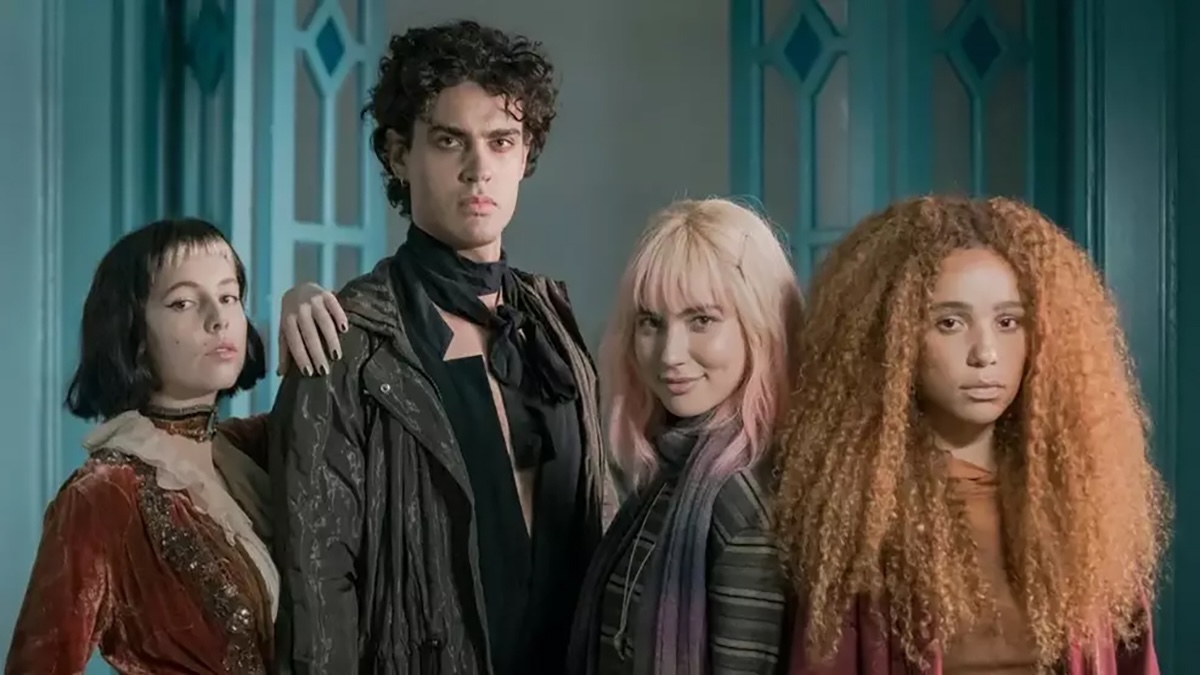
Combining vampires, romance, werewolves and Brazilian folklore, Blood Red: Under the Moonlight is preparing to introduce British audiences to a supernatural world that’s already attracting attention in Brazil.
Vampires have traveled just about everywhere on film and television, from the castles of Transylvania to the streets of New Orleans and the small towns of America. Now a Brazilian supernatural drama is preparing to bring its own variation on the mythology to international audiences, combining bloodsuckers, romance, genetic experimentation and a creature drawn from the wildlife and folklore of Brazil.
The series is Blood Red: Under the Moonlight, known in its native country as Vermelho Sangue, and on October 11, Brazilian entertainment giant Globo announced that the BBC had acquired its first season for broadcast on BBC Three and streaming through BBC iPlayer. The agreement, unveiled during the MIPCOM television market in Cannes, France, represents the first time an original production from Globo’s streaming platform, Globoplay, has been licensed to the BBC.
Created by Rosane Svartman and Claudia Sardinha, the Portuguese-language series premiered in Brazil in October 2025 and has already returned for a second season. Its international sale comes as Globo looks to introduce more of its original productions to audiences beyond Brazil, with Blood Red offering something familiar to fans of supernatural romance while incorporating distinctly Brazilian elements.
Vampires, Werewolves and a Very Different Kind of Transformation
Set in the fictional town of Guarambá, in the Brazilian state of Minas Gerais, Blood Red centers on Luna (Letícia Vieira), a young woman whose life is complicated by a supernatural inheritance. Her father is a werewolf, and since puberty she has undergone a transformation whenever the full moon appears. But rather than becoming the conventional wolf associated with European werewolf legends, Luna transforms into a maned wolf, a long-legged, foxlike animal native to South America.
Luna has spent much of her life moving from place to place with her mother, Carol (Heloísa Jorge), a geneticist determined to discover a way to reverse her daughter’s condition. Their arrival in Guarambá brings Luna into contact with Flora (Alanis Guillen), a young woman fascinated by magic, legends and the mysteries of the natural world. Flora dreams of escaping the limitations of her small hometown, but her encounter with Luna draws her into a supernatural world far stranger than anything she imagined.
And then there are the vampires.
Among them is Michel (Pedro Alves), a 230-year-old vampire originally from Paris who was transformed at the age of 20. Although he possesses the extraordinary strength, speed and agility associated with his kind, his youthful appearance conceals more than two centuries of existence. Accompanying him is Celina (Laura Dutra), a 290-year-old vampire born in Portugal who has grown bored with the routines of immortality.
The pair arrive in Brazil posing as siblings, although their real purpose involves a secret mission connected to VPTech, a scientific organization conducting research in Guarambá. Behind that operation is Elizabeta (Alli Willow), the powerful leader of a vampire clan who directs events from a distance.
As Luna, Flora and the vampires become entangled in one another’s lives, the series combines romantic relationships and coming-of-age conflicts with supernatural conspiracies, scientific experimentation and the question of whether the characters can escape the identities and destinies imposed upon them.
A Brazilian Spin on Familiar Vampire Mythology
What makes Blood Red particularly intriguing is the way it brings familiar vampire and werewolf traditions into a distinctly Brazilian setting. Although the vampires retain many of the characteristics audiences would recognize from international horror fiction, Luna’s condition introduces an animal rarely associated with traditional werewolf stories.
The maned wolf, or lobo-guará, is native to South America and is particularly associated with the grasslands and savannas of Brazil. Despite its name and appearance, it isn’t a true wolf, making its use as the basis for a supernatural transformation an unusual departure from the standard werewolf mythology.
The series also incorporates the Brazilian concept of the lobimoça, or wolf-girl, giving Luna’s transformation a cultural identity of its own. Rather than simply transplanting the familiar vampire-versus-werewolf formula into another country, Blood Red places that conflict within a landscape shaped by local wildlife, folklore and attitudes toward the supernatural.
At the same time, the series doesn’t abandon the romantic and melodramatic traditions that have made vampire stories popular with younger audiences. The relationships among Luna, Flora, Michel and Celina form a central part of the narrative, with the supernatural elements serving as both literal dangers and reflections of the characters’ struggles with identity, belonging and desire.
Season 2 Takes the Vampire Story Further
While British audiences will initially receive the first season, Brazilian viewers are already further along in the story. The second season premiered on Globoplay in September 2026, expanding the mythology and developing relationships established during the show’s first year.
One particularly significant development involves Flora, whose life has changed dramatically following her transformation into a vampire. Her new existence brings her closer to Celina, with the two developing a romantic relationship while Flora discovers both the attractions and dangers of immortality.
Meanwhile, Luna’s storyline becomes increasingly complicated by the reappearance of her father, Martín (Milhem Cortaz), and the discovery of her twin brother, Juan (Lucas Leto). Their arrival raises further questions about her supernatural inheritance and the larger forces surrounding her transformation.
The second season consists of 10 episodes, all of which are available in Brazil through Globoplay. Although the creators have discussed plans for a possible third season that would bring Luna’s story to a conclusion, Globoplay has not yet officially renewed the series.
The Significance of the BBC Acquisition
For Globo, the sale represents an important step in bringing Brazilian genre programming to a broader international audience. While the country’s television industry is widely associated with telenovelas, Blood Red demonstrates its growing interest in supernatural fantasy and serialized storytelling designed to appeal to younger viewers. At the Cannes announcement, Angela Colla, Globo’s Head of International Business, emphasized the significance of introducing the series to British audiences, while company executives pointed to its strong performance among younger Globoplay subscribers during its initial release.
The BBC acquisition could also provide Blood Red with an opportunity to reach viewers who might never otherwise encounter a Brazilian vampire series. International audiences have become increasingly accustomed to watching non-English-language dramas, and a supernatural story combining familiar genre conventions with a different cultural background offers an accessible introduction to Brazilian fantasy television. For now, the BBC has not announced a specific premiere date, and there has been no confirmation of an English-language dubbed version. The series was produced in Portuguese, and the announced agreement covers the first season rather than the complete two-season run.
Still, for vampire enthusiasts interested in something beyond the familiar American and European settings, Blood Red: Under the Moonlight offers an intriguing prospect: a world where centuries-old vampires pursue their own agendas, a young woman transforms into an animal unique to South America, and the mysteries of Brazilian folklore become part of an increasingly complicated supernatural drama. And with two seasons already produced, there’s considerably more of that world waiting to be discovered.