
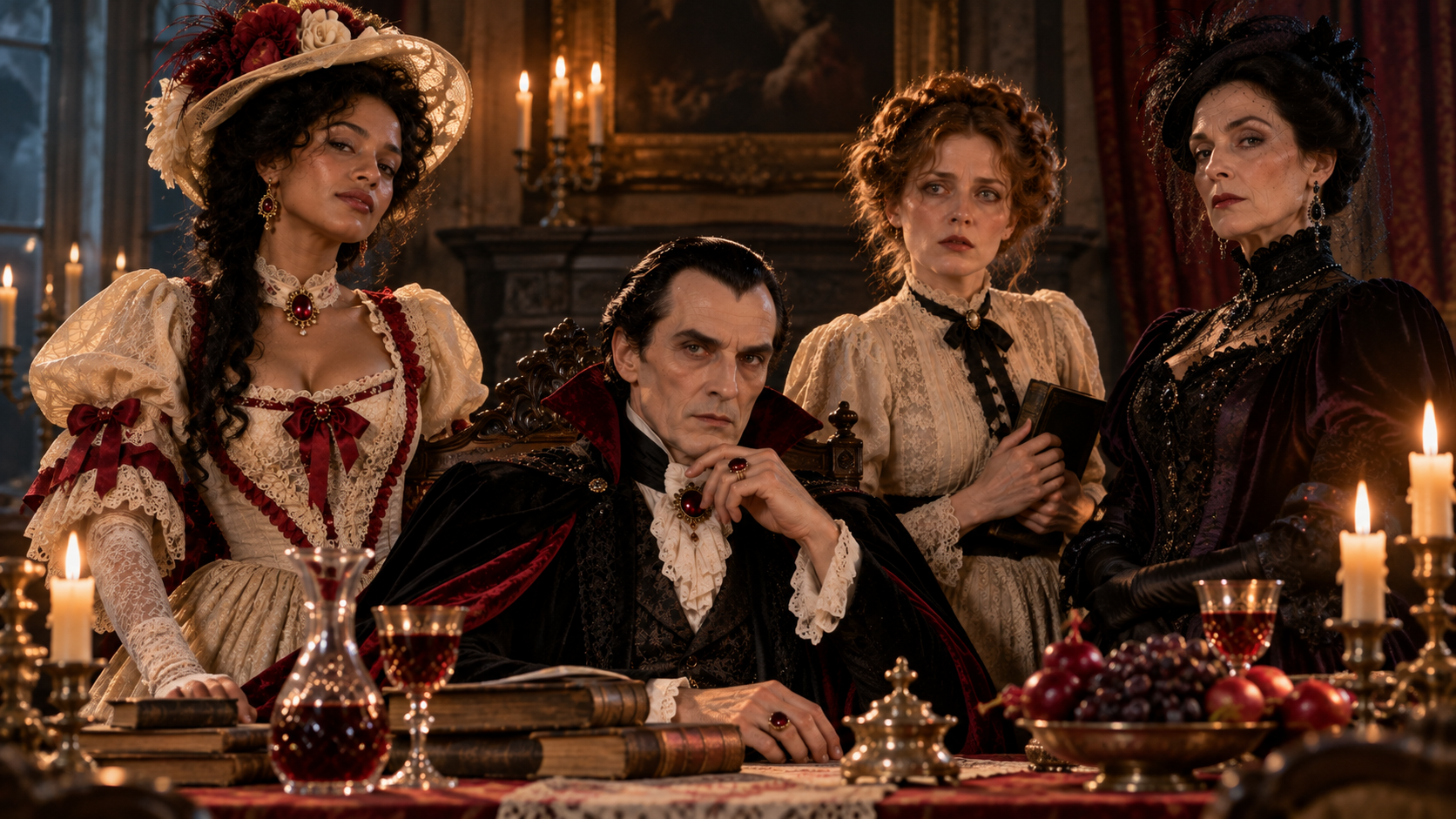
Bram Stoker didn’t invent the vampire, the aristocratic vampire, the seductive vampire, the female vampire, the sympathetic vampire or even the idea of an undead lover returning from the grave. In truth, by the time Dracula was published in 1897, writers had spent the better part of a century — and arguably longer — experimenting with vampires and steadily transforming them into something modern readers would recognize.
For our purposes, the literary trail begins with poetry such as Johann Wolfgang von Goethe’s “The Bride of Borinth’ in 1797 and Robert Southey’s Thalaba the Destroyer in 1801. But as vampire historian Matthew Beresford observes, one particular work would help change the literary vampire “from the folkloric Undead corpse into the Gothic figure so easily recognised today.” For the record, that work was published nearly 80 years before Dracula.
The Vampyre (1819) by John Polidori

If Dracula had a literary great-grandfather, Lord Ruthven would have a strong claim to the title.
Polidori’s The Vampyre grew out of the famous 1816 Villa Diodati gathering involving Lord Byron, Percy Bysshe Shelley, Mary Shelley and Polidori, Byron’s personal physician. The gathering produced the ghost-story challenge that led Mary Shelley toward Frankenstein, while Byron began a vampire fragment that would eventually provide the groundwork for Polidori’s own story.
The scholarly collection The Legacy of John Polidori: The Romantic Vampire and Its Progeny, edited by Sam George and Bill Hughes, describes Polidori’s transformation of the folkloric creature into “a sophisticated, seductive aristocrat,” with Ruthven becoming “the ancestor of the vampire as we know it.”
In other words, the vampire had moved indoors. Rather than lurking in a graveyard or existing only as a revenant from folklore, Ruthven could move through respectable society. He was wealthy, mysterious, attractive and socially accepted, which made his predatory nature considerably more dangerous.
Scholar Kaja Franck has explored that distinction as well, emphasizing Ruthven’s ability to pass within polite society. The vampire could now hide not simply in darkness, but in plain sight. And Beresford sees Polidori’s contribution as a genuine turning point in the evolution of the creature, arguing that The Vampyre helped transform the undead corpse of folklore into the recognizable Gothic vampire.
Long before Count Dracula welcomed Jonathan Harker into his castle, Lord Ruthven had demonstrated that the most dangerous vampire might be the gentleman standing beside you.
“Wake Not the Dead” (1822–23) by Ernst Raupach

The history of “Wake Not the Dead” is almost as Gothic as the story itself. For generations the tale was attributed to German Romantic writer Ludwig Tieck, and that attribution found its way into influential vampire anthologies and histories. Later research established that Laßt die Todten ruhen was actually the work of German dramatist Ernst Benjamin Salomo Raupach, appearing under his name in an annual dated 1823 but published in late 1822. An anonymous English translation followed in Popular Tales and Romances of the Northern Nations in 1823.
Scholar Heide Crawford has done some of the most important work untangling that history. Her study, “Ernst Benjamin Salomo Raupach’s Vampire Story ‘Wake Not the Dead!’,” goes back to Raupach’s German publication and the anonymous English version, helping restore his authorship to a story that English-language readers had associated with Tieck for generations.
The story itself introduces another ingredient that would become inseparable from vampire fiction: love.
Walter remains obsessed with his dead first wife, Brunhilda, despite having remarried. Unable to accept her loss, he discovers a means of restoring Brunhilda to life. Which turns out to be a spectacularly bad idea as the resurrected Brunhilda is no longer simply Walter’s beloved. She’s a vampire, and Walter’s refusal to accept death has unleashed something terrible upon his household.
There’s also an intriguing possible literary afterlife. Scholars have compared “Wake Not the Dead” with Edgar Allan Poe’s 1838 “Ligeia,” another story involving a man’s obsessive love for a dead woman and her apparent return. There is no evidence proving Poe read Raupach’s story, so the connection has to remain a possibility rather than a fact. Crawford, however, considers influence likely and notes that anonymous English versions had appeared before Poe wrote “Ligeia.”
Even more important for the evolution of the vampire is Brunhilda herself. She isn’t simply a corpse wandering out of a grave. She’s beautiful, sexually compelling and able to move among the living, bringing together resurrection, erotic attraction and predation decades before Carmilla and Dracula.
Long before vampire fiction became filled with tragic romances and lovers who refused to stay dead, Raupach was already exploring the seductive fantasy — and terrible consequences — of defeating death for love.
“Clarimonde” (1836) by Theophile Gautier

Then the vampire became irresistible. French writer Théophile Gautier’s La Morte amoureuse, generally known to English-language readers as “Clarimonde,” centers on Romuald, a priest whose encounter with an extraordinarily beautiful woman throws his spiritual and emotional existence into chaos. Clarimonde is alluring, sensual and dangerous, and Romuald finds himself divided between his religious vocation and a seemingly different existence as her lover.
Scholar Jordi Luengo López, writing about eroticism and the vampire, places Clarimonde at the forefront of the new kind of vampire emerging in 19th-century literature: no longer merely a frightening corpse, but a creature whose attraction is inseparable from the threat it represents.
Other scholarship on the story has focused on the way Gautier intertwines Clarimonde’s sexuality and vampirism. The very qualities that make her desirable are the ones that religious authority within the story identifies as dangerous, and it’s a significant step toward the vampire we know today. Blood, sex, religion, temptation and death are becoming increasingly difficult to separate. And there is another important development: the vampire at the center of all this erotic power is a woman.
Decades before Carmilla entered Laura’s bedroom — and long before Dracula’s brides encountered Jonathan Harker — Clarimonde had already demonstrated that the female vampire could be every bit as compelling as her male counterpart.
Varney the Vampire; or, The Feast of Blood (1845–47) — Attributed to James Malcolm Rymer

If Polidori made the vampire fashionable, Varney the Vampire made him popular.
Published in inexpensive serialized installments, the enormous Victorian penny dreadful eventually stretched across more than 200 chapters. Sir Francis Varney initially appears to be a straightforward monster terrorizing the Bannerworth family, but something happens as his adventures continue: He becomes human. Not literally, but emotionally.
Varney is capable of regret, loneliness and self-loathing. He wants human companionship even while his vampiric nature prevents him from fully belonging among human beings. That increasing humanization helped establish something that would become enormously important to vampire fiction: the sympathetic vampire, a monster readers could pity as well as fear. That’s an extraordinary development when you consider where the genre would eventually go.
Katzir points toward a lineage extending through later vampire fiction in which the vampire can become protagonist rather than monster — the tormented immortal who hates or questions what he is. Varney begins looking less like simply an ancestor of Dracula and more like an ancestor of Louis and Lestat, Angel, Bill Compton, Stefan Salvatore and countless other conflicted vampires.
Scholar Sara Hackenberg has noted another contradiction at Varney’s core: how can someone who appears to be an attractive, educated and courtly gentleman simultaneously be violent and vampiric?
Nina Auerbach similarly emphasizes Varney’s ambiguity. He can occupy seemingly contradictory identities at once: gentleman and fiend, human and creature, predator and friend. Those contradictions would become enormously important to the future of vampire fiction.
Katzir offers a particularly effective way of summing up the relationship between this sprawling penny dreadful and the novel that would follow half a century later: “If Rymer wrote the vampire rulebook, Stoker canonized it.”
Carmilla (1871–72) by J. Sheridan Le Fanu

Twenty-five years before Dracula arrived in England, Carmilla arrived at Laura’s home in Styria. Sheridan Le Fanu’s novella was serialized in The Dark Blue beginning in 1871 and collected in In a Glass Darkly in 1872. Of all the works that preceded Dracula, Carmilla may be the one whose shadow falls most visibly across Stoker’s novel.
Simon Cooke, senior editor of The Victorian Web, calls Carmilla “one of the masterworks of Victorian Gothic” and notes that it established many of the conventions of the literary vampire. More strikingly, he argues that Dracula was “largely a response to Carmilla,” and it’s not difficult to understand why.
There is the Central European setting, the aristocratic vampire, the mysterious illness afflicting the victim, the investigation of supernatural attacks and, eventually, the opening of the vampire’s tomb. But Carmilla brought something else to vampire literature in the form of intimacy.
Carmilla doesn’t simply attack Laura. She becomes emotionally and physically close to her, and the sexual implications of their relationship have generated more than a century of discussion. Scholar Amy Leal argues that Le Fanu “encodes forbidden passions” within the story, while other researchers have examined Carmilla as an expression of female sexual power and same-sex desire that challenged Victorian expectations.
That makes Carmilla more than a prototype for Dracula. She’s one of the great branches on the vampire family tree in her own right — the ancestor of generations of female vampires whose sexuality, independence and appetite make them threatening precisely because they refuse to behave as women are expected to behave.
“The Fate of Madame Cabanel” (1872) by Eliza Lynn Linton

And then somebody asked an entirely different question: What if there isn’t a vampire?
Eliza Lynn Linton’s “The Fate of Madame Cabanel” first appeared in All the Year Round in December 1872. Its frequent 1880 dating comes from its later appearance in Linton’s collection With a Silken Thread, and Other Stories.
The story takes place in an isolated Breton community where superstition and suspicion turn against Fanny Cabanel, an Englishwoman who has married a local man. Illness strikes the community, Fanny is foreign and she’s different, which seems to prove enough.
Rather than presenting readers with a supernatural predator, Linton turns vampire belief itself into the source of horror. Researcher Lauren Owen describes what unfolds as “a false and unauthorized vampire narrative gaining sway, with tragic consequences.”
That’s precisely what makes the story stand apart from the others on the road to Dracula. The people hunting the supposed vampire believe themselves to be heroes protecting their community. The reader can see something else happening: fear, jealousy, xenophobia and superstition are creating the monster.
There is no convincing evidence that Madame Cabanel is a vampire, but it doesn’t matter, because people believe she is one. And vampire literature had reached the point where it could question not merely what a vampire was, but why human beings needed to believe in one.
The Blood of the Vampire (1897) by Florence Marryat

And then came 1897, the year of Dracula. Except Bram Stoker wasn’t the only British novelist publishing a vampire novel that year. Florence Marryat’s The Blood of the Vampire centers on Harriet Brandt, a young woman who leaves Jamaica for Europe and gradually discovers something horrifying about herself: people who become emotionally close to her weaken and sometimes die.
Harriet doesn’t behave like Dracula. She doesn’t climb castle walls, command wolves or deliberately sink her teeth into victims. Her vampirism is closer to the unconscious draining of another person’s vitality.
Helena Ifill, whose scholarly study examines Marryat’s novel, describes Harriet as “an energy sucker and a formidable predator.” But there’s a crucial difference in that Ifill also describes her as “a tragic figure.”
Harriet gradually discovers that she has killed people she loves, which changes everything. The vampire is no longer simply an outsider that ordinary people must identify and destroy. She can be a victim of her own nature — someone the reader is invited to fear and pity simultaneously.
Modern scholars have also returned to Harriet because Marryat used her to explore late-Victorian anxieties surrounding women, sexuality, heredity, race and the emerging figure of the “New Woman.” Ifill argues that Harriet reflects the comparatively liberated but still precarious position occupied by women at the end of the 19th century.
Other scholars have pushed that reading further. Somi Ahn’s recent study places Harriet within the debate over the New Woman and marriage, building upon earlier scholarship that has described Harriet as a “radical New Woman” and as “modern” and “liberated.”
Which makes the timing remarkable. In 1897, readers could encounter two radically different visions of the vampire. Bram Stoker gave them Count Dracula, an ancient Transylvanian aristocrat who knowingly feeds on blood and spreads his curse. While Florence Marryat gave them Harriet Brandt, a young woman who may destroy the people she loves without understanding what she’s doing.
History made one of them immortal, but the other reminds us that even at the moment Dracula appeared, there was no single definition of what a vampire had to be.
Then Came Dracula

None of this diminishes Bram Stoker’s achievement. If anything, it makes Dracula more fascinating.
Stoker arrived at the end of a century in which writers had been continually dismantling and rebuilding the vampire. Polidori helped transform the folkloric revenant into a sophisticated aristocrat who could enter polite society. Raupach joined vampirism with obsessive love and resurrection. Gautier made desire itself dangerous. Varney showed that readers could pity a vampire as well as fear one. Le Fanu gave vampire fiction one of its most enduring female predators and made intimacy central to the attack. Linton demonstrated that belief in vampires could destroy innocent people. And in the same year Stoker published Dracula, Florence Marryat showed that the vampire could be tragic, unconscious of her own power and worthy of sympathy.
Stoker’s great achievement wasn’t creating the vampire from nothing, but rather bringing together a remarkable collection of ideas that had been evolving for generations and giving them a form so powerful that it threatened to obscure everything that came before.
Once Dracula entered popular culture — and particularly once stage and screen adaptations transformed the Count into an international icon — it became increasingly easy to imagine that the history of the vampire began with him, but it really didn’t. By the time Jonathan Harker arrived at Castle Dracula in 1897, the literary vampire had already spent nearly a century learning how to seduce us. Dracula simply became the one we couldn’t forget.