
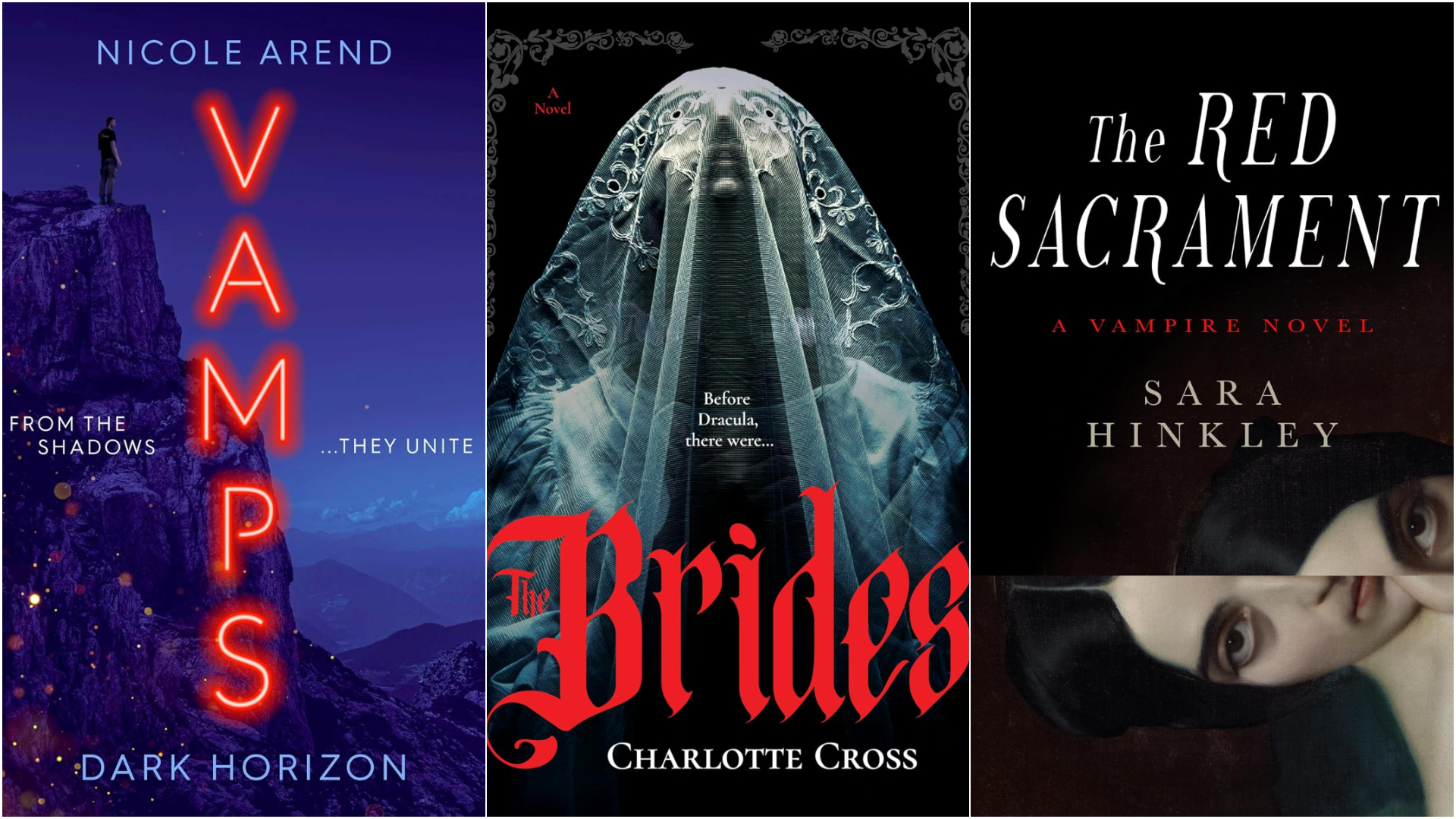
There was a time when you pretty much knew what you were getting when you picked up a vampire novel. There would be blood, darkness, probably a cape or two and, depending on the era, either a terrifying monster or an impossibly attractive immortal yearning for someone he probably shouldn’t be. Not anymore.
If the vampire books published over the summer of 2026 prove anything, it’s that writers are still finding remarkably different things to do with the undead. Vampires are being dropped into historical fiction, romantasy, dark academia, body horror and even economic satire. They’re inhabiting revolutionary Paris, confronting the legacy of slavery in colonial America, attending elite academies and discovering that immortality doesn’t necessarily help when you’re broke.
Some writers are also looking backward. Charlotte Cross returns to Bram Stoker’s Dracula to imagine the lives of the mysterious women in his castle, while Lore creator Aaron Mahnke leaves fiction behind entirely with Exhumed, exploring the very real New England vampire panic and the people who once believed the dead were feeding upon their families.
The vampire, in other words, remains remarkably difficult to kill. Here are eight recent books demonstrating just how much life remains in the undead.
Dhampira (June 16, 2026)

Author: Amy Pennza
Publisher: Ace
What it’s about: Corinthe has spent her life hiding the fact that she is a dhampir, born to a human mother and vampire father. Her unusual strength and appetite for blood would make her valuable to the supernatural beings living beyond the Feyline, the boundary separating the human world from a magical realm trapped in perpetual twilight. When Corinthe accidentally reveals what she is, she’s captured and put up for sale, only to be rescued by Vander, a vampire knight who takes her across the Feyline and into the court of King Rasimir. There she discovers not only that the vampire king is her father, but that her future may involve Prince Lorcan — and that her attraction to both Lorcan and Vander could complicate matters considerably.
Amy Pennza says: “[The elevator pitch is]: “A seemingly powerless halfling is thrust into a cruel and gangerous vampire court where she meets two wildly different men who claim they can help her een as they’re both interested in her… and each other… I based the world on the kinds of big, splashy [and mildly terrifying] worlds in the fantasy movies I watched as a kid. Movies like Labyrinth and The Neverending Story.” (blog.freshfiction.com)
The Red Sacrament (July 7, 2026)

Author: Sara Hinkley
Publisher: Titan Books
What it’s about: Paris, 1869. The Théâtre Saint-Siméon has become one of the city’s most sought-after attractions, although admission is restricted to those fortunate enough to receive one of its mysterious black invitations. Its performers are magnetic, seemingly ageless and never seen during daylight hours — for good reason. Arnault and his fellow actors are vampires who have survived by following strict rules, performing at midnight and taking only enough victims from their audiences to feed themselves without attracting unwanted attention. Their carefully constructed existence begins falling apart with the arrival of Béatrice, a witch who forms an unexpected bond with Arnault, and Victor and Françoise de Rouvray, vampires whose attitudes are very different from those of Arnault’s clan. All of it unfolds as Paris moves toward political upheaval and, ultimately, the Paris Commune.
Sara Hinkley says: “When I set out to write The Red Sacrament I knew I wanted to explore the spectacle of revolution, the relationship between political turmoil and the stage—how in some moments the glamour that mystifies our social relations can fall away and reveal the true workings of the world. So like a theatrical performance, I wanted to create a sense of creeping dread that builds and builds to an explosive, spectacular conclusion.
“How I did this is another question. I tried everything under the sun to try to get a handle on pacing: Scrivener organization tools, spreadsheets, big pieces of butcher paper taped to the wall. At one point I had a fat stack of index cards held together with a rubber band, and I kept it on my nightstand. Do I recommend any of this? I don’t know! It was the hardest part by far. I’m sure I left blood on the page.” (gnofhorror.com)
The Brides (July 7, 2026)

Author: Charlotte Cross
Publisher: Hanover Square Press
What it’s about: Bram Stoker told us very little about the three vampire women living in Castle Dracula. Charlotte Cross gives them their stories. Beginning in 1884, The Brides follows Mafalda, who travels to Budapest to care for her grieving aunt. Her secret love, Lucy, follows from London accompanied by chaperone Eliza and Alice, a lady’s maid plagued by supernatural visions. When Eliza develops a mysterious wasting illness, the women travel toward Transylvania in search of its supposedly healing waters. An invitation from a nobleman eventually brings them to Castle Dracula — and the fate readers of Stoker’s novel already know awaits three women there. Cross adds a fourth woman to the equation: the one who escaped. The result is a feminist, sapphic Gothic story that deliberately enters into conversation with Dracula while giving identities and histories to characters Stoker largely left unexplored.
Charlotte Cross says: “My debut novel The Brides was partly inspired by my time living next door to the Littlemore Asylum, in the Oxford suburb of the same name. The Brides is a Gothic horror about the three women who would become the ‘brides’ of Dracula, and the fourth who managed to escape. I started out with character sheets at the very beginning, listing out the minutiae of my characters’ likes and dislikes, where they came from, what they looked like…but I ended up throwing those out. What helped most was thinking about what each character really wants, really yearns for. I got to know the characters as I wrote them, through the framework of that yearning.
“I don’t know that we ever really move on from vampires. They’re endlessly fascinating – like us and not like us, our predators but also vulnerable in ways we’re not. They’re also often written to be very sexy (all that neck-biting, all those nightgowns, all that barely-controlled desire). Dracula himself is a very compelling character, partly because Bram Stoker doesn’t give us all the information that we as modern readers want to know about him. That leaves a lot of questions, and a lot of space to create new Dracula-focused stories.” (thenerddaily.com)
Brokeula (July 7, 2026)

Author: Michael J. Seidlinger
Publisher: CLASH Books
What it’s about: Immortality sounds considerably less appealing when you can’t pay the bills. James Sugre has been alive for centuries, but bad investments, missed opportunities and an inability to catch the latest financial craze have left the vampire virtually penniless. His attempt to cash in on the booming video-game business introduces him to Lauren, a developer and vampire enthusiast, and eventually inspires an even more questionable business venture: why not charge people to become vampires? Before long, immortality has become a commodity and vampirism the basis for something resembling a supernatural multilevel-marketing scheme. At only 120 pages, Brokeula uses an ancient monster to take aim at capitalism, financial desperation and the absurdity of trying to monetize virtually everything.
Michael J. Seidlinger says: “It does seem like everything I write comes from a sociological perspective, with more than a few splashes of the absurd too. It has everything to do with my natural interest in society and the people that inhabit it. Brokeula is no different. I’ve always found it so very fascinating, the intersection of personal and public, with regards to society’s norms. Seeing how the individual shifts and changes when in a social setting, the ‘whole actor and the stage’ analogy in effect, it gets the mind racing, thinking about the nuances of society itself.
“We all see those darker shades poking through the pristine veneer of a brand, an organization, a community, and that tends to be where I draw a lot of influence. Much of what I write starts out with a spark, an idea of some sort. From there, the idea is fueled by these sociological fascinations. It’s kind of like a puzzle where the only way to solve it is by imbedding those observations, using the narrative as a combination of seeing the story through its natural conclusion while also doubling as a sociological study. So yeah, it goes hand-in-hand, but I need a hefty dose of the sociological and the hyperactive imagination to see any story through.”
Vamps: Dark Horizon (July 21, 2026)

Author: Nicole Arend
Publisher: Simon & Schuster UK
What it’s about: The sequel to VAMPS: Fresh Blood sends Dillon and his classmates back to VAMPS Academy, where being a teenager is complicated by the fact that the students happen to be vampires. Dillon now knows considerably more about his heritage, including the identity of his powerful vampire father, but his troubles are escalating as rebels threaten both his mother and the established vampire order. The story eventually takes Dillon and his fellow students away from the academy and into the Carpathian Mountains, where they train with the Vampire Secret Service. Dark Horizon continues Arend’s combination of vampire mythology, dark academia and coming-of-age adventure, aimed particularly at readers who grew up on series such as Twilight, Crave and Vampire Academy.
Nicole Arend says: “VAMPS is a mix of Twilight Saga romance, bloodlust, desire and edginess from The Southern Vampire Chronicles and it is set in a ‘finishing school’ setting similar to Vampire Academy. Dillon, the main protagonist in VAMPS also has a tortured conscience like Louis in Interview with a Vampire and Edward Cullen in Twilight.
“It’s great fun to research and choose vampire powers, myths and rules. Many of the powers I selected such as flying, acute senses, echolocation and infrared radiation detection match real-life vampiric creatures like the vampire bat. Others suited the narrative or the plot best. One of the trickiest parts was working out the Vampire hierarchy in VAMPS and how it would work. I can’t give too much away about Dillon’s special blood but the inspiration for that came from finding out about the world’s rarest bloods – A blood called ‘Golden blood’ exists for real and less than fifty people in the entire world have it. Daringly(!), I also broke one of the cardinal vampire rules that states that a female vampire cannot have babies but the reason for that will become more apparent in books two and three.”
Exhumed: Unearthing the History of the American Vampire (August 4, 2026)

Author: Aaron Mahnke
Publisher: Running Press
What it’s about: Long before vampires became romantic antiheroes or pop-culture icons, some New England communities genuinely feared that the dead could return to drain the life from the living. Exhumed explores the so-called New England Vampire Panic, when tuberculosis — then commonly called consumption — devastated families and communities during the 18th and 19th centuries. With medicine unable to explain why one family member after another might waste away, frightened survivors sometimes blamed relatives who had already died, exhuming their bodies and performing rituals intended to prevent them from preying upon the living. Mahnke explores the history, folklore and social conditions behind these incidents, culminating in the famous 1892 case of Mercy Brown of Exeter, Rhode Island, whose body was exhumed after members of her family died from tuberculosis. Drawing upon historical records and modern scholarship, Exhumed examines how America’s own vampire tradition developed independently of the aristocratic European vampire popularized by fiction such as Bram Stoker’s Dracula.
Aaron Mahnke says: “Mercy Brown’s story stands out to me for a couple of reasons, but primarily because of its recency. In the grand scheme of things, her death and exhumation wasn’t that long ago. It took place nearly 120 years after the founding of the United States, and an entire generation after the Civil War. There, in the middle of the Modern era—and just a few miles from the gilded mansions of Newport, Rhode Island—something happened that feels ancient and occult. What’s not to love about that? In addition (and this is my other, smaller reason), Mercy’s story took place after the Industrial Revolution supercharged the speed and reach of all sorts of news stories. She might have been the last exhumation of her kind that we know of, but she was also the most reported on. Similar exhumations from a century earlier simply didn’t have the viral potential that Mercy’s did, and because of that, we’re still fascinated with her today.
“Surprisingly, very little of our modern notion of vampires, the Hollywood bloodsuckers that everyone grew up on, is rooted in the oldest vampire folktales from history. Traits that you might assume were always there—for example, transforming into a bat, avoiding sunlight, long fangs, and a hatred of garlic—are all missing in early European tales. The tropes that do seem to have a deeper historical continuity are things like the method of killing a vampire (being pierced by a stake) and a general thirst for blood. When most people close their eyes and picture a vampire today, though, they are conjuring up some variation on Bram Stoker’s work and just assuming it’s always been that way.” (audible.com)
Tapeworm: A Vampire Novel (August 18, 2026)

Author: A.P. Thayer
Publisher: Evil Twin
What it’s about: Recently separated from his wife, Victor joins his longtime friends for their annual getaway to Superstition, an isolated California desert community. The friendships are already showing cracks, and Victor is struggling with desires he has spent years repressing. Then the town’s unusually welcoming residents begin taking an interest in the visitors. What initially appears to be a vampire infestation turns out to be something considerably stranger: Thayer’s vampires aren’t elegant aristocrats or beautiful immortals but parasitic organisms capable of forming themselves into human shapes. Mixing the vampire story with body horror, Tapeworm uses its monsters to explore identity, aging, sexuality, repression and what happens when buried desires finally force themselves to the surface. The publisher rather accurately pitches the combination as From Dusk Till Dawn meets The Thing.
A.P. Thayer says: “Vampiric lore, to me, isn’t unified by the Transylvanian myth and gothic literary scene. It is unified, instead, by the parasitic nature of vampires and how they feed on their hosts. When I wrote Tapeworm, I wanted to focus on this unifying element. I wasn’t interested in exploring tired tropes but in forging my own vampiric creature. And when given the opportunity, I looked to nature, not just mythology. We live in a world filled with 300,000 different species of parasites, 300 of which can affect humans. From the micropredation of a tick growing fat on our blood to the single-celled protozoa of malaria, we are surrounded by tiny creatures bent on feeding on us, and there’s something brutally insidious about a diminutive organism trying to burrow into me. As terrifying as the attack of a xenomorph is, it is the being dragged back to be used as a host by a face hugger that I find far more horrific. Give me the quick death of forejaws punching through the back of my skull over a chest burster any day.”
Blood Rising (August 25, 2026)

Author: Markus Redmond
Publisher: Dafina/Kensington
What it’s about: The second volume of Markus Redmond’s Blood Saga, following Blood Slaves, picks up after Kwadzo Okoro and his fellow Ramanga vampires have destroyed the Barrow plantation and liberated its enslaved Africans. The former plantation has become the Crimson Plantation, providing a home for both the freed Africans and Native people who fought alongside the Ramangans. Freedom, however, doesn’t mean safety. Powerful slaveholders Bartholomew and Constance Crabtree are organizing a violent response, while Kwadzo and his people confront a different question: what happens when people who were once powerless suddenly possess extraordinary power? Redmond combines alternate history, supernatural horror and the vampire revenge story to revisit the brutality of slavery in colonial America while imagining its victims possessing the means to fight back.
Markus Redmond says: “Identity is everything. It’s who you are. I don’t think most folks could imagine having it snatched away from them and being powerless to do anything about it. So, when those who were enslaved do so, it’s something of a rebirth. Reclaiming a name may seem simple on the surface, but it really is a way to return to your roots and reclaim your humanity, which becomes all the more important if you’ve made the choice to become a Ramangan.”