
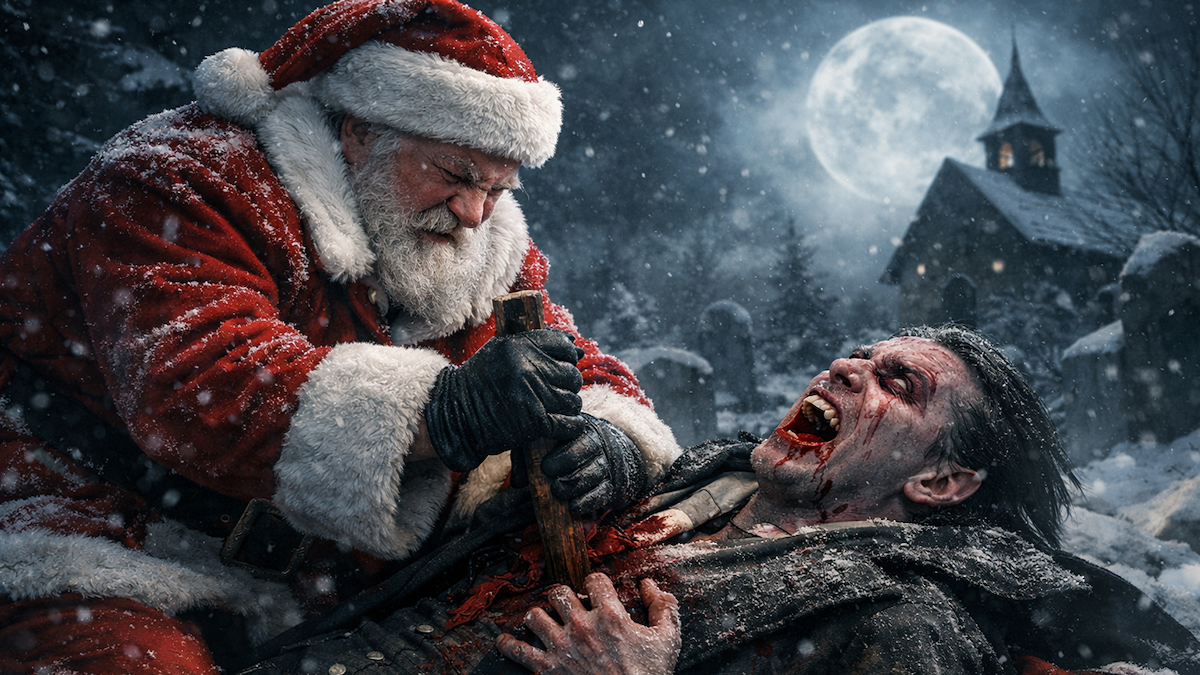
The modern image of Santa Claus is one of the most stable figures in popular culture. He appears once a year, behaves exactly as expected, and leaves no unanswered questions behind. Dressed in red, bearded, benevolent and predictable, Santa rewards good behavior and disappears without consequence. He is not a mystery to be examined, but a seasonal constant designed to reassure rather than provoke curiosity. That familiarity, however, comes at a cost.

According to the YouTube channel Tales of Mythology — which explores folklore in all its glory — the version of Santa Claus most people recognize is not an ancient tradition preserved intact, but a carefully smoothed legend—one that omits the harsher realities of the world that produced it. Behind Santa stands Saint Nicholas of Myra, a real historical figure: a fourth-century Christian bishop operating in the Eastern Mediterranean, known for charity, protection of the vulnerable and moral authority. His reputation was built on generosity, particularly toward children and the poor, and his cult spread widely throughout Europe. But Nicholas did not emerge from a safe or symbolic world.
As Christianity expanded into regions with long-established pre-Christian belief systems, saints were often adapted to meet local fears rather than replace them. Winter, especially in agrarian societies, was not a cozy season. It was a time of scarcity, disease, isolation and death. Communities believed boundaries weakened during the cold months. Night was dangerous and the dead did not always stay buried. In this environment, protection was not metaphorical.

Saint Nicholas’ feast day fell deep in winter, and his role gradually absorbed functions that went beyond moral instruction. Folklore surrounding him portrayed a figure who moved unseen, observed behavior without announcement and intervened suddenly when harm occurred. These traits survive in modern Santa mythology, but stripped of their original urgency. Surveillance becomes a list, judgment reward or mild correction. Movement becomes magic and what disappears is the reason these traits mattered.
In Eastern Europe and Slavic regions, winter folklore is filled with accounts of revenants—the returning dead believed to prey on families, livestock and entire villages. These were not romantic vampires. They were sources of panic, blamed for illness, unexplained death and social collapse. Responses were grim and sanctioned: exhumations, containment rituals and defensive practices often overseen by local authorities and clergy. In such a worldview, saints were not distant intercessors, but rather active defenders.

Tales of Mythology argues that Nicholas’ popularity in these regions was no accident. Saints associated with winter were expected to patrol liminal spaces, move at night and confront threats that avoided direct confrontation. Protection required discretion. A guardian who announced himself would fail. The ability to see unseen dangers was not symbolic—it was functional.
Over time, as centralized religious authority and later modern sensibilities favored uniformity and comfort, these harsher aspects were deemphasized. Nicholas was revised, not rejected. His severity softened and his purpose reframed with gift-giving overshadowing inspection. Punishment became symbolic. The threat itself went unnamed, yet the structure remained.

Santa still arrives at night, watches unseen, still judges behavior and departs before dawn. These elements persist not because they were invented for whimsy, but because they were inherited. The logic that once bound them together—winter vigilance against unseen danger—was simply no longer spoken aloud.
The video stops short of claiming a literal “vampire war,” and so should we. What emerges instead is something subtler: evidence of sustained cultural anxiety managed through transformation rather than erasure. As belief in revenants receded from official doctrine, the behaviors designed to contain them became ritual. Fires lit for protection became symbols of warmth. Threshold vigilance became tradition. Fear was domesticated. Nicholas survived this transition because he could be inverted rather than destroyed.
He became a symbol, but symbols retain traces of what they replace. The cost of that transformation is ambiguity. Modern audiences inherit customs without context and reassurance without stakes. The story works because it discourages inquiry. When the question is asked—why does this figure behave this way?—the legend destabilizes.
This does not mean Santa Claus is secretly hunting vampires. It means the world that created Saint Nicholas required guardianship, not reassurance. The modern version functions precisely because it denies that necessity. Whether that represents progress or selective forgetting is left unresolved.
Santa smiles. He watches. He arrives at night. He leaves before dawn. The structure of protection remains intact—even if the threat it once confronted no longer needs to be named.
This article is adapted from and inspired by the YouTube video “Was Santa Claus a Real Vampire Hunter?” by the channel Tales of Mythology, and is presented here as a folkloric and historical analysis rather than a literal claim.
Tags: Vampire Folklore