
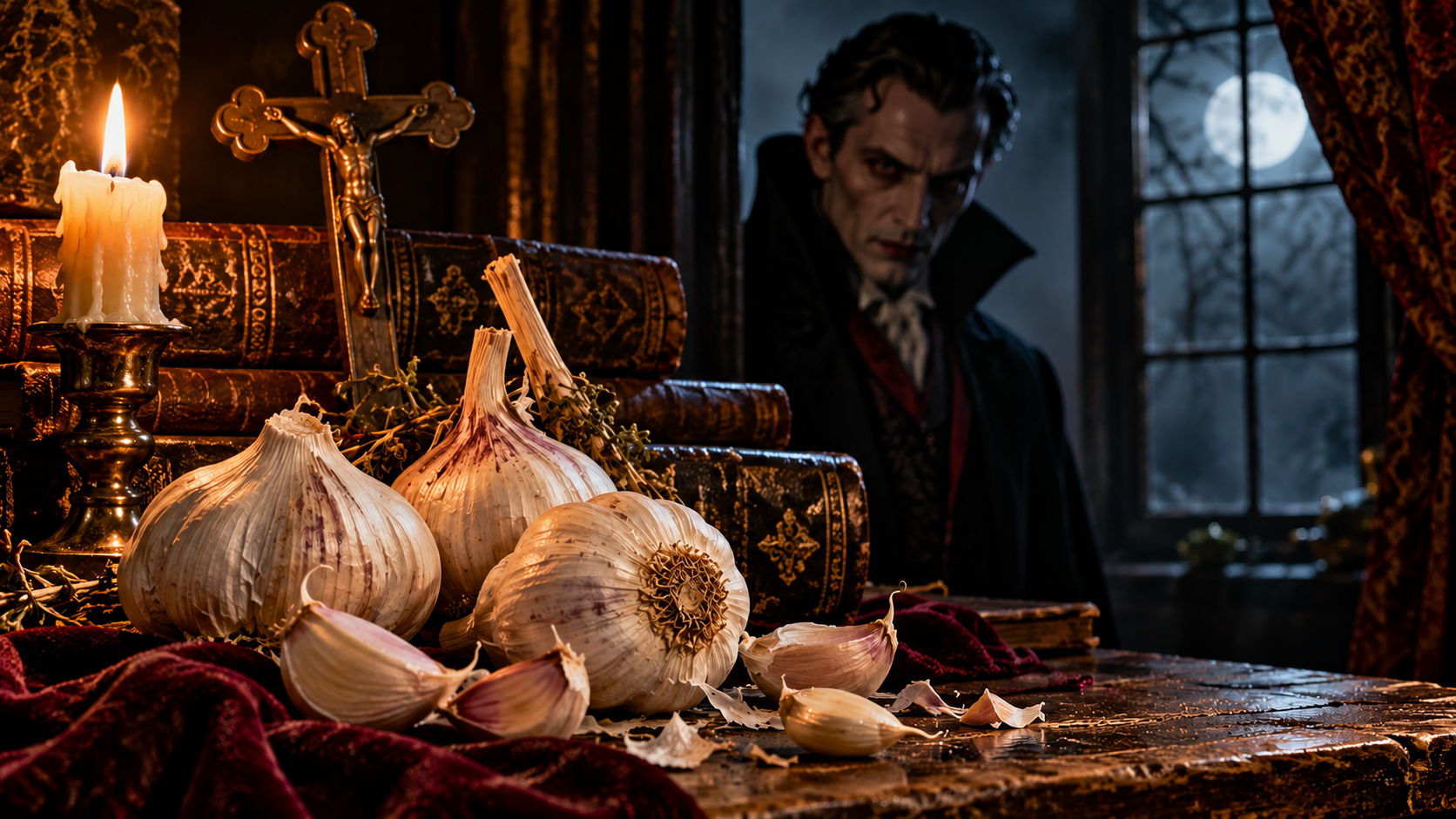
Garlic has been one of humanity’s favorite weapons against vampires for generations. Hang it around your neck, place it near a window or scatter it around a doorway, and supposedly even the most determined bloodsucker will think twice about coming inside (assuming they’re not just waiting to be invited inside). It’s a wonderfully simple defense against the undead, although it does raise an obvious question: Why should a creature capable of transforming into a bat, commanding wolves and rising from the grave be frightened of something you can buy in the produce aisle as vampire folklore says it is?
The answer takes us considerably further back than Bram Stoker’s Dracula. In fact, garlic was believed to possess protective powers long before the fictional Count made his appearance in 1897. And while Stoker helped establish garlic as an essential part of vampire mythology, he was drawing on a much older tradition of using plants to ward off evil.
Throughout history, garlic has been considerably more than a cooking ingredient. It has been used medicinally, incorporated into religious and folk practices, and credited with the ability to protect people from supernatural dangers. In his 2016 study, Seldom Just Food: Garlic in Magic and Medicine in European and Mediterranean Traditions, researcher Frank M. Dugan examines garlic’s longstanding place in protective rituals across different cultures.
Such practices are known as apotropaic, a term describing objects, symbols or rituals intended to turn away evil or misfortune, and garlic’s reputation extended well beyond vampires. Dugan documents traditions associating the plant with protection against malevolent spirits and other supernatural threats, including beliefs found in the ancient Mediterranean world and later Persian folklore. In other words, garlic wasn’t originally invented as a specialized vampire repellent, belonging instead to a much broader collection of protective customs.
It’s an important distinction, because the familiar explanation that vampires simply cannot tolerate garlic’s strong odor doesn’t adequately account for its place in folklore. Its smell may have contributed to its reputation, but the historical evidence doesn’t establish one universal reason for its supposed supernatural powers.
How garlic became a weapon against vampires

In parts of Eastern and Southeastern Europe, fears of the returning dead developed into elaborate traditions concerning how bodies should be buried, how suspected vampires could be identified and how communities might protect themselves.
These beliefs varied considerably by region. The vampires of traditional folklore were not necessarily aristocratic, seductive or even recognizable as the elegant creatures of modern entertainment. Some were feared as dangerous corpses capable of returning to trouble the living and garlic became one of the substances associated with protection against such threats, alongside other plants, religious objects and burial practices.
Research into Slavic protective customs also reveals how plants could serve different purposes. A 2018 archaeological and folkloristic study by Tomasz Kurasiński, Kalina Skóra and Viktor Gayduchik, for example, examines the use of poppy and mustard seeds in traditions intended to prevent harm from the dead. Those seeds were associated with protective qualities partly because their enormous numbers made them difficult to count, illustrating how supernatural defenses could depend on symbolic beliefs rather than physical force. Garlic belonged to this wider world of supernatural protection, but it probably wouldn’t be wise to think of every custom as universally practiced or assume that all vampire traditions shared the same rules.
Bram Stoker gives garlic its most famous assignment

When Bram Stoker published Dracula in 1897, he helped transform an assortment of supernatural beliefs into something resembling a recognizable set of vampire rules. Garlic plays a particularly memorable role in Chapter 10, when Professor Abraham Van Helsing attempts to protect Lucy Westenra, who has been suffering from mysterious nighttime attacks. Van Helsing arrives with a parcel containing garlic flowers, which Lucy initially mistakes for an ordinary and rather unpleasant medicinal treatment.
When she realizes what they are, she exclaims: “Oh, Professor, I believe you are only putting up a joke on me. Why, these flowers are only common garlic.”
Van Helsing is anything but amused. “No trifling with me! I never jest!”
He proceeds to arrange the garlic around Lucy’s bedroom, rubbing it against the window frames, doorways and fireplace. He also makes a wreath for Lucy to wear around her neck. When Dr. Seward observes that Van Helsing appears to be performing a spell against an evil spirit, the professor quietly acknowledges that he might be doing precisely that.

It’s a wonderful scene because it captures the collision between 19th century scientific thinking and ancient supernatural belief. Van Helsing is a physician, yet his attempt to save Lucy depends upon something medicine cannot explain. And the garlic isn’t merely an unpleasant smell intended to discourage Dracula, but part of a carefully arranged protective barrier. Unfortunately for Lucy, those precautions ultimately prove insufficient.
The episode nevertheless helped cement garlic’s association with vampire hunting in one of the most influential works of horror literature ever published.
There is an amusing scientific footnote to all of this. In 1994, Norwegian researchers H. Sandvik and A. Baerheim published a study investigating whether garlic could discourage blood-feeding creatures. Since vampires were unavailable for testing, the researchers substituted leeches. Their findings were rather unfortunate for aspiring vampire hunters.
In the experiment, leeches preferred a garlic-smeared hand over an untreated hand in approximately two-thirds of trials. They also attached themselves more quickly when choosing the garlic-covered hand. The researchers humorously suggested that garlic might attract vampires rather than repel them. Of course, leeches are not vampires, and the study tells us nothing about supernatural creatures. But it provides a delightful reminder that the supposed effectiveness of garlic belongs to folklore, not established science.
The enduring power of an ordinary plant

Perhaps the most fascinating thing about garlic’s place in vampire mythology is how ordinary it is. Wooden stakes, holy water and crucifixes all have their own histories, but garlic brings the supernatural directly into everyday life. You don’t need to be a trained vampire hunter to obtain it, you don’t need a special weapon or an ancient spellbook. The same plant that flavors dinner can supposedly keep a monster from entering your home. That accessibility may help explain why the idea has remained so appealing.
More than a century after Stoker published Dracula, garlic continues to be instantly recognizable as a vampire deterrent. Its popularity reflects a larger tradition in which ordinary objects are credited with extraordinary protective powers. And that may be the real secret of garlic’s enduring reputation. It offers the comforting possibility that even when the darkness is filled with monsters, something familiar and close at hand might be enough to keep them away.
Or maybe not.