
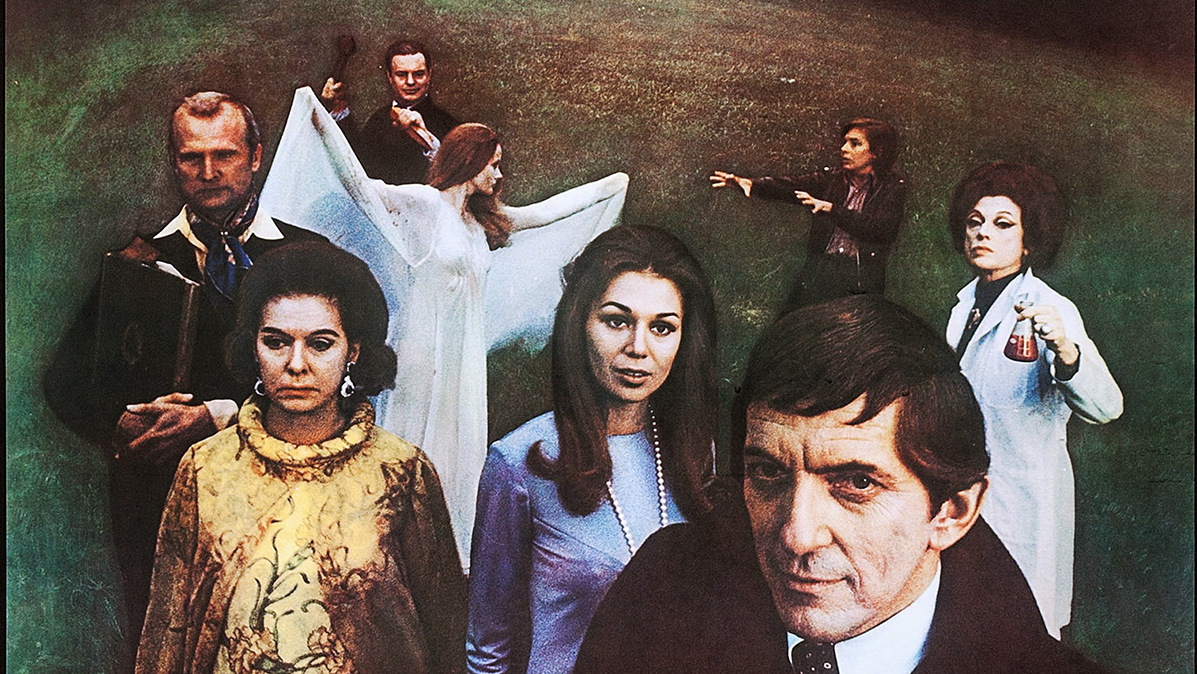
Quentin Tarantino was only six years old when he saw House of Dark Shadows in 1970, but the experience made an impression that has stayed with him for more than half a century. And considering the filmmaker’s own fascination with cinematic violence, it’s perhaps not surprising that one of his most vivid memories involves the spectacularly bloody demise of Jonathan Frid’s Barnabas Collins.
In comments featured on the James Whale Bake Sale YouTube channel, Tarantino looks back on director Dan Curtis‘ theatrical adaptation of the enormously popular ABC daytime series Dark Shadows, recalling the makeup effects of Dick Smith, the startling violence and the film’s very different approach to vampire mythology.
Tarantino remembers being struck by the film’s bloodshed, particularly its climactic destruction of Barnabas. He even compares its imagery to Sam Peckinpah’s The Wild Bunch, which he wouldn’t see until several years later. When he finally watched the Western, Tarantino found the violence surprisingly familiar.
“I mean, when Barnabas Collins gets eviscerated at the end, I mean, it’s like blood straight into the camera,” Tarantino recalls, laughing at the memory. He then points out something that might surprise modern audiences: “No, it was PG.”
But the violence wasn’t the only thing that distinguished House of Dark Shadows from other vampire films of the period. Tarantino is particularly fascinated by the way Curtis presents vampirism as something resembling a contagious illness, spreading through the characters and transforming familiar people into dangerous strangers.
“It’s not a disease movie, but vampirism is treated as if it is a disease,” Tarantino explains.
He points to the storyline involving Dr. Julia Hoffman, played by Grayson Hall, who attempts to cure Barnabas of his vampirism through medical treatments. Rather than presenting the vampire curse as something that can only end with the monster’s destruction, the film introduces the possibility that the condition might actually be reversed.
Tarantino doesn’t believe Curtis was necessarily using vampirism as a metaphor for disease. Instead, he sees the film as introducing a different, more contemporary approach to the mythology, one that anticipated the infection-driven horror that would become increasingly familiar in subsequent decades. That contemporary sensibility also informs Tarantino’s comparison between House of Dark Shadows and the vampire films being produced by Britain’s Hammer Films, particularly its popular Dracula series starring Christopher Lee.
“It seemed like Dan Curtis went out to just completely blow Hammer out of the water,” Tarantino says. “And I kind of think they did.”
He isn’t suggesting that Curtis’ film was superior to every Hammer production. In fact, Tarantino readily acknowledges that he prefers many of the British studio’s movies and believes House of Dark Shadows becomes somewhat cheesy toward its conclusion. Nevertheless, he argues that Curtis brought something fresh and exciting to the genre. “It was hip in the way that the Hammer films weren’t hip,” Tarantino observes.
He even suggests that Hammer’s Dracula A.D. 1972, which brought Christopher Lee’s Dracula into contemporary London, may have been an attempt to capture some of the modern appeal of House of Dark Shadows. Whether Hammer was directly responding to Curtis’ film is open to debate, but Tarantino clearly sees the 1970 production as part of a significant shift in vampire cinema.
Another aspect of House of Dark Shadows that impresses Tarantino is the remarkable challenge Curtis faced in adapting his own television series. Barnabas Collins had been introduced on Dark Shadows in 1967, and his story had unfolded over hundreds of episodes. Rather than inventing an entirely new adventure, Curtis essentially retold that mythology in a theatrical feature running approximately 97 minutes.
“He does a pretty amazing job of taking the mythology that he spent three years doing and boiling it down into one movie while the show is still on the air,” Tarantino says.
The contrast in pacing particularly amuses him. Events that might have taken several weeks to unfold on the daytime serial occur within the first 15 minutes of the feature film. The theatrical format also allowed Curtis to take the characters in directions that would have been impossible on television, including violent deaths and a definitive conclusion to Barnabas’ story.
Tarantino’s memories extend beyond the movie itself to the extraordinary cultural popularity of Dark Shadows during the late 1960s. Although it aired in the afternoon, the series attracted a devoted following among children and teenagers, and Jonathan Frid’s Barnabas Collins became a recognizable figure far beyond the show’s regular audience.
“It was crazy the pop cultural significance that Barnabas Collins had in ’69 and ’70,” Tarantino recalls.
He remembers seeing Barnabas Collins posters displayed in head shops alongside images of Peter Fonda and Dennis Hopper from Easy Rider and Steve McQueen from The Great Escape. For a generation of young viewers, the vampire from an afternoon soap opera had become as recognizable as some of the biggest screen icons of the era.
More than five decades later, House of Dark Shadows remains an unusual entry in vampire cinema, a theatrical adaptation of an ongoing television phenomenon that was simultaneously a retelling of familiar material and a considerably more violent reinterpretation of it.
For Tarantino, the film’s bloodshed, contemporary attitude and unusual treatment of vampirism helped distinguish it from the horror movies of its time. And while he readily acknowledges its imperfections, his memories offer a fascinating reminder of the impact Dan Curtis and Jonathan Frid had on a generation of viewers, including a six-year-old boy who would grow up to become one of Hollywood’s most distinctive filmmakers.
One thought on “Quentin Tarantino Recalls the Bloody Shock of ‘House of Dark Shadows’ and How It Challenged Hammer Horror”