
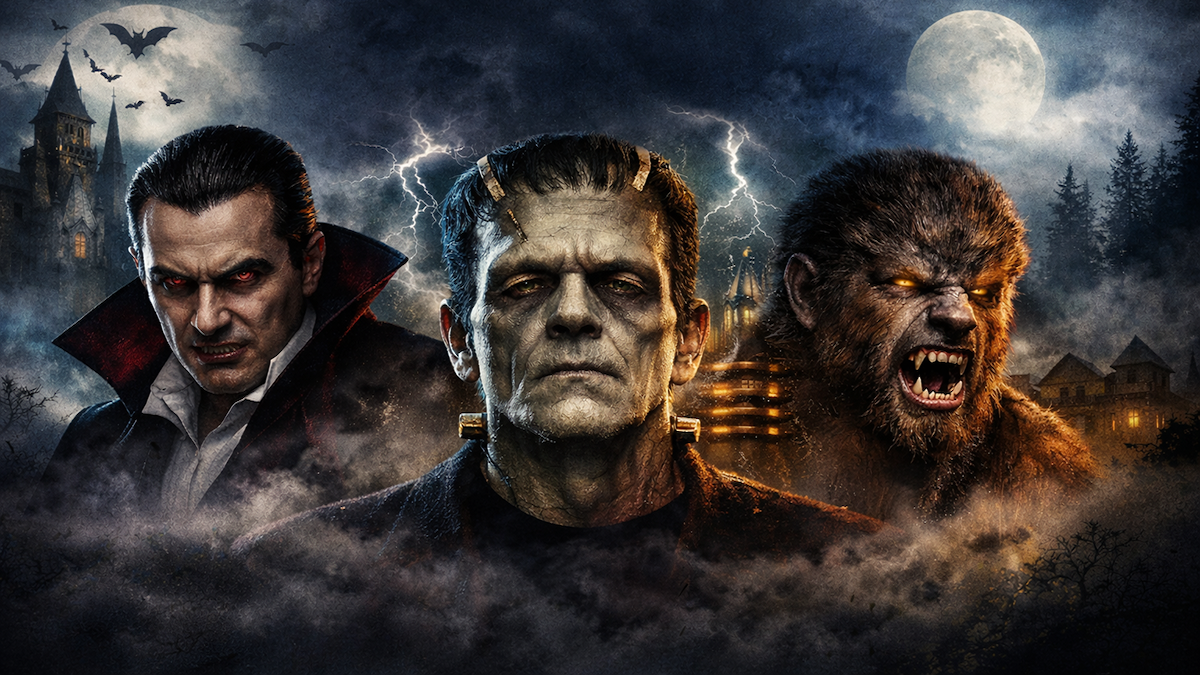
Universal’s legendary monsters may be returning to television — and this time, they may be entering the kind of serialized supernatural drama that defined early 2010s genre television.
Writer-producer Kevin Williamson, co-creator of The Vampire Diaries and the architect behind the Scream franchise, recently revealed that he is developing a new series set within the world of Universal’s classic monsters. Speaking with Esquire, Williamson described the project as something of an “adult Vampire Diaries,” one that will allow him to play with some of horror’s most iconic characters.
“The one I’m writing right now is a show,” Williamson said. “You might call it an adult Vampire Diaries. It’s based in the Universal monster land. I get to play with some of those characters like Dracula and Frankenstein and the Wolf Man and have fun there.”

The series is reportedly in development for Netflix with Universal Television behind the project.
While details remain scarce, the concept immediately raises intriguing possibilities: a serialized supernatural drama populated by Universal’s most famous creatures — Dracula, Frankenstein’s Monster, the Wolf Man and potentially others — all reimagined for modern audiences.
A Natural Fit for Kevin Williamson
Williamson’s involvement makes sense. His résumé includes several genre-defining television projects that blend horror mythology with character-driven storytelling.
He co-created The Vampire Diaries, the CW supernatural drama that ran for eight seasons from 2009 to 2017 and spawned two successful spinoffs, The Originals and Legacies. The series helped usher in a new era of vampire television where romance, mythology and long-form storytelling were intertwined.
Earlier in his career, Williamson created the teen drama Dawson’s Creek and later developed the serial-killer thriller The Following. Of course, his name remains synonymous with the Scream franchise, which he created in 1996 and recently returned to direct with Scream 7.
Given that background, a sweeping supernatural ensemble series built around classic monsters seems very much in his creative wheelhouse.
Universal’s Long Quest to Revive Its Monsters
For Universal, however, this new project represents the latest chapter in a decades-long effort to reintroduce its most famous horror icons to modern audiences.
The studio built its reputation in the 1930s and 1940s with films like Dracula (1931), Frankenstein (1931), The Wolf Man (1941), The Mummy (1932) and The Invisible Man (1933). These movies helped establish the template for cinematic horror and turned actors like Bela Lugosi, Boris Karloff and Lon Chaney Jr. into genre legends.
Universal has periodically attempted to revive those characters over the decades, with mixed success.
In the late 1990s and early 2000s, the studio found major box-office success with Stephen Sommers’ The Mummy (1999) and its sequels starring Brendan Fraser. That franchise leaned more toward action-adventure than pure horror, but it demonstrated the enduring appeal of the Universal monster brand.
The next major attempt came in 2014 with Dracula Untold, starring Luke Evans. The film was originally positioned as the launch of a shared cinematic universe of monsters, though those plans soon changed.
Universal formally announced its ambitious “Dark Universe” in 2017 with The Mummy starring Tom Cruise. The studio even unveiled a publicity photo featuring Cruise alongside actors Johnny Depp, Javier Bardem and Russell Crowe, all of whom were expected to headline future monster films.
But when The Mummy underperformed critically and commercially, the Dark Universe experiment quickly collapsed.
Since then, Universal has taken a different approach — allowing filmmakers to reinterpret individual monsters rather than forcing them into a shared universe. Leigh Whannell’s The Invisible Man (2020) proved the strategy could work, earning strong reviews and becoming a hit despite its relatively modest budget.
Other reinterpretations have followed or are in development, including films like Renfield (2023), which offered a darkly comic take on Dracula’s long-suffering servant.
Monsters Move to Television
Williamson’s proposed series may represent yet another reinvention — bringing Universal’s creatures into the realm of serialized television storytelling.
That format could allow for something earlier monster films never had the time to explore: the complex relationships between these characters and the worlds they inhabit. The CW’s The Vampire Diaries demonstrated how supernatural mythology can unfold across multiple seasons, with shifting alliances, romances, betrayals and evolving lore.
Applying that same approach to Universal’s monsters could create a narrative ecosystem where Dracula, the Wolf Man and Frankenstein’s creation exist side by side — not merely as isolated horror icons but as characters within a larger supernatural society.
At the moment, the project remains in development and no casting or production timeline has been announced.
Still, the idea of Universal’s legendary creatures returning in a serialized supernatural drama — especially under the guidance of someone with Williamson’s genre pedigree — is already enough to make horror fans curious.
After all, these monsters have been haunting audiences for nearly a century and finding new ways to tell their stories may prove that they’re still very much alive.