
Based on reporting from Playbill and New York Theatre Guide
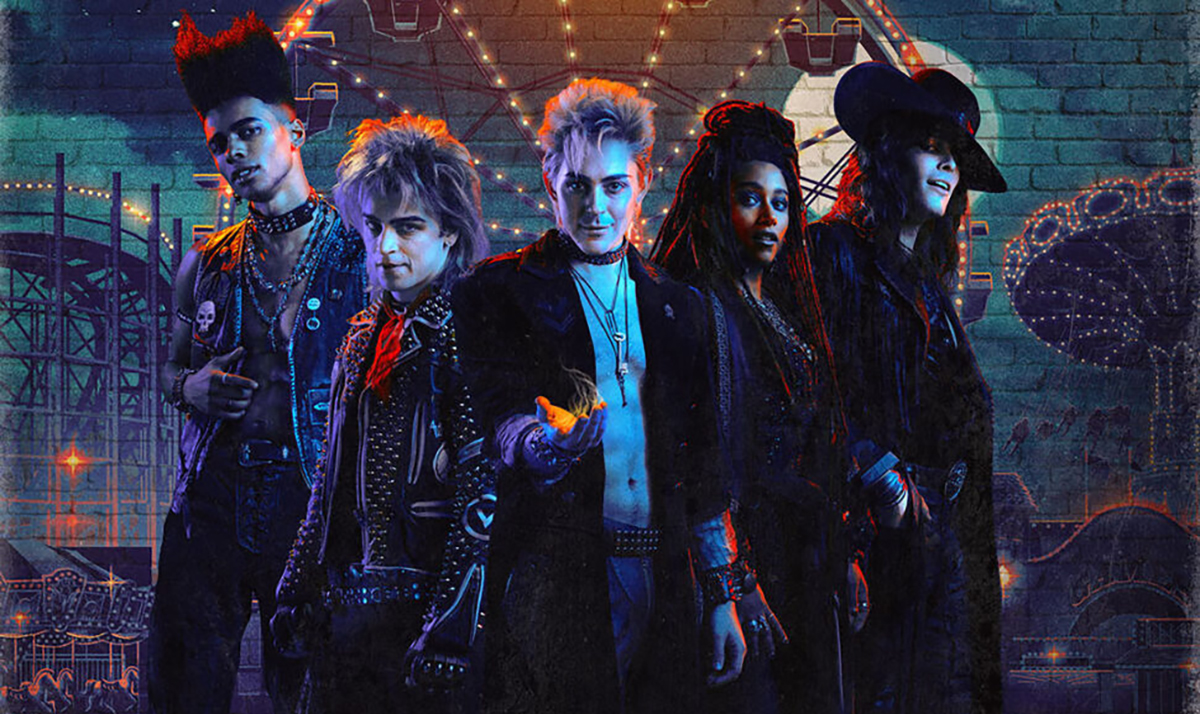
More than three decades after Joel Schumacher’s 1987 cult classic helped redefine youth-oriented vampire mythology, The Lost Boys are riding their motorcycles straight onto Broadway. The long-awaited musical adaptation begins previews March 27 at the Palace Theatre, with an official opening set for April 26 — and early looks at the production suggest a show determined to lean into both its gothic bite and its emotional heart.
As reported by Playbill and New York Theatre Guide, the Broadway incarnation of The Lost Boys is being staged under the direction of Michael Arden, with a book by David Hornsby and Chris Hoch and music by the indie rock band The Rescues. Rather than simply recreating the film’s surface thrills, the musical uses vampirism as a metaphor for adolescence itself — physical transformation, sexual awakening, and the often dangerous pull of belonging.
The story remains rooted in familiar territory. When single mother Lucy Emerson relocates with her sons Michael and Sam to the coastal California town of Santa Carla, Michael is quickly drawn into the orbit of a charismatic teenage rock band — a group that turns out to be something far more dangerous than it first appears. Vampires may be eternal, but in this version, they are also frozen in youth, grappling with identity and connection in ways that feel distinctly contemporary.
A Cast Blending Broadway Power and New Blood
The cast reflects that duality of experience and discovery. Tony and Grammy nominee Shoshana Bean leads the company as Lucy Emerson, grounding the story as a mother attempting to rebuild her life while remaining unaware of the supernatural forces surrounding her. Bean has noted that while she missed the film during its original run, she now sees its enduring nostalgia reflected in the musical.
At the center of the story are LJ Benet as Michael Emerson and Benjamin Pajak as his younger brother Sam. Benet describes Michael as a teenager searching for identity and independence in a brand-new environment — a struggle that mirrors the vampire transformation itself. Pajak’s Sam, by contrast, embraces his wit, his family, and his love of comic books, serving as both observer and unlikely hero.
Opposite them is Ali Louis Bourzgui as David, the magnetic leader of the Lost Boys. Bourzgui portrays David not simply as a predator, but as an immortal figure exhausted by time, searching for meaning and connection. His performance positions the character less as a monster and more as a tragic figure — a thematic throughline that aligns The Lost Boys with decades of romantic and existential vampire storytelling.
Maria Wirries plays Star, a member of the Lost Boys caught between worlds. As with the film, Star’s journey is one of self-discovery and escape, and Wirries has emphasized the show’s heightened theatricality — including moments of literal flight.
The supporting cast includes Paul Alexander Nolan as Max, the seemingly benign video store owner; Jennifer Duka and Miguel Gil as the Frog siblings, self-appointed vampire hunters; and Sean Grandillo, Brian Flores, and Dean Maupin as members of the Lost Boys’ undead inner circle. Together, they form a company that treats the show not just as a musical, but as a rock concert infused with gothic horror.
Vampires, Then and Now
Both Playbill and New York Theatre Guide note that The Lost Boys arrives at a moment when vampires are once again thriving across popular culture. The original film helped launch the careers of Kiefer Sutherland, Jason Patric, Corey Feldman, and Corey Haim, and its DNA can be traced through later youth-oriented vampire narratives including Buffy the Vampire Slayer, The Vampire Diaries, and Twilight.
The Broadway adaptation appears keenly aware of that legacy. Rather than shying away from the long-standing skepticism surrounding vampire musicals, the creative team embraces the challenge. As Nolan puts it, the trick is making vampires work on stage without tipping into parody — a balance the production aims to strike by leaning into character, atmosphere, and emotional stakes.
In the end, The Lost Boys musical positions vampirism not simply as a supernatural threat, but as a metaphor for time itself: the allure of eternal youth, the fear of stagnation, and the cost of never growing up. It’s a theme as old as Dracula — and one that, like vampires themselves, refuses to fade away.
Sources:
This article is based on reporting by Playbill and New York Theatre Guide.