
Listen to this Article:
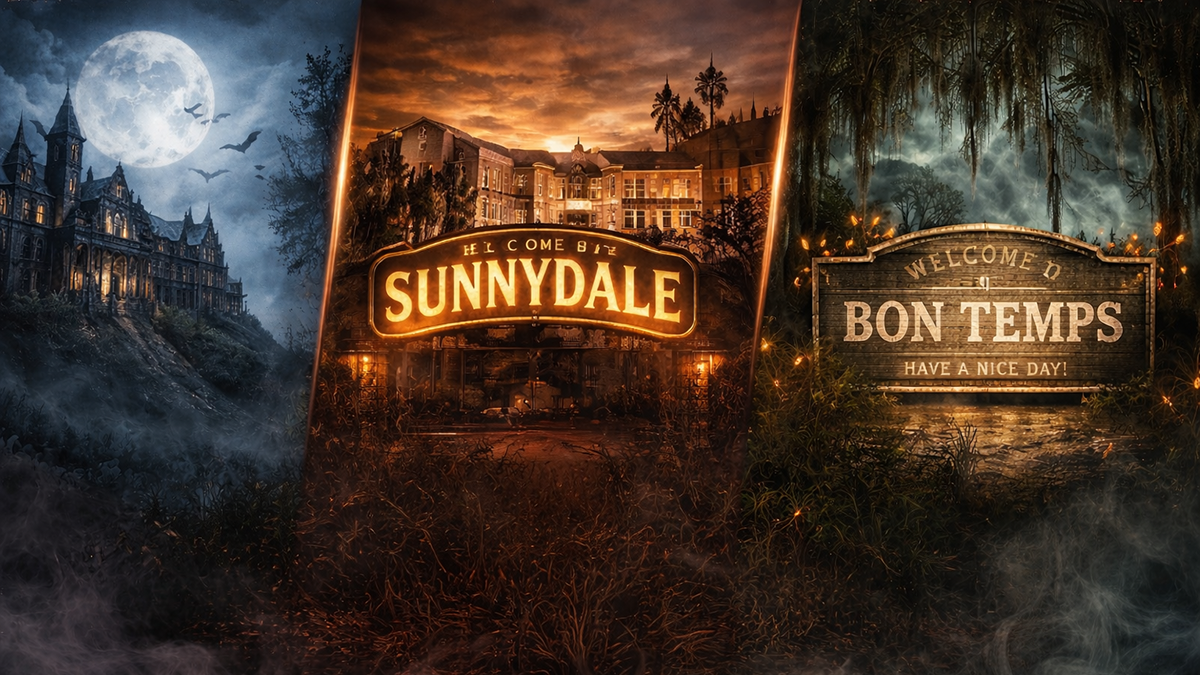
From the outside, Collinwood —home base to the horror soap opera Dark Shadows — just looks like another grand New England estate. Sunnydale of Buffy the Vampire Slayers, appears to be an ordinary California town with a decent high school and an alarming mortality rate. True Blood‘s Bon Temps is a sleepy Louisiana community where people gossip, drink, and quietly coexist with vampires. Midnight, Texas (from the show of the same name) barely registers on a map. Yet all of them share one defining trait: they are places where the supernatural doesn’t merely visit — it congregates.
Across decades of television, genre storytelling has repeatedly returned to the idea of the supernatural hub: a fixed location where monsters, magic and moral crises converge with alarming regularity. These are not random settings. They are narrative engines — places where horror is not an intrusion, but a constant pressure.
Collinwood: The Accidental Epicenter

When Dark Shadows premiered in 1966, Collinwood was not designed to be a supernatural nexus. It was a Gothic mansion weighed down by secrets, family guilt and generational decay. Ghosts, curses and past sins emerged organically, as if the house itself were remembering what its occupants wanted to forget.
The arrival of vampire Barnabas Collins changed everything. What began as a single supernatural storyline quickly expanded outward, transforming Collinwood into a magnet for witches, werewolves, time travelers, parallel timelines and creatures stitched together from science and hubris. The show did not reset or relocate its horrors. Instead, it allowed them to accumulate. As such, Collinwood became a place where the past never stayed buried — a living archive of supernatural consequence.
Sunnydale: Built on the Problem

By contrast, Buffy the Vampire Slayer begins with its thesis fully formed. Sunnydale is built atop the Hellmouth, a literal gateway to evil that explains, upfront, why vampires, demons and apocalyptic threats show up like clockwork.
The Hellmouth is a structural device — a narrative permission slip. It allows the show to explore adolescence, trauma and morality through escalating supernatural metaphors while maintaining internal logic. The horror is not symbolic alone; it is geographical. Unlike Collinwood’s haunted inheritance, Sunnydale’s danger is civic. The town survives by ignoring the truth beneath it — a metaphor for denial, repression and the social blindness that allows evil to flourish.
Why TV Needs Fixed Supernatural Geography
Television thrives on the concept of return. Characters return to the same spaces week after week, and audiences build emotional familiarity with those environments. The supernatural hub allows genre television to maintain continuity without exhausting plausibility.
If monsters appeared randomly across the globe, the emotional stakes would scatter. By anchoring horror to a specific place, shows create a sense of inevitability, a community shaped by unseen forces and a moral landscape where choices accumulate consequences.
The hub, in essence, becomes a character itself — wounded, complicit or cursed.
Beyond Collinwood and Sunnydale

Later series adopted and refined this model. In True Blood, Bon Temps functions as a cultural fault line where vampires, humans and supernatural beings collide under the illusion of Southern hospitality. The town absorbs conflict rather than exploding from it, allowing social anxieties around race, sexuality and power to surface.
The Vampire Diaries presents Mystic Falls as a town repeatedly rebuilt atop its own destruction, layering vampire history, witchcraft, and war into a cyclical mythology. And in Midnight, Texas, the hub becomes overtly communal: a town where everyone knows the truth, because survival depends on collective acknowledgment of the supernatural.
Each version reflects its era’s relationship with fear. Some towns deny it. Some manage it. Some weaponize it. But what unites these locations is not just monsters — it’s containment. Supernatural hubs allow television to explore chaos without letting it dissolve the world. They localize terror so that stories can focus on responsibility versus avoidance, community complicity, trauma passed through generations and the cost of staying versus leaving. Characters who remain in these towns are not simply unlucky. They are choosing to confront — or endure — what others flee.
Why This Structure Endures
Ultimately, the supernatural hub is less about monsters than about containment. Television doesn’t scatter horror randomly because fear, like memory, tends to settle in familiar places. Collinwood, Sunnydale, Bon Temps, and Mystic Falls are not cursed by accident — they are shaped by history, denial and repetition. Evil returns because it is unresolved. These towns become laboratories for morality, where characters must decide whether to confront what haunts them, manage it or pretend it isn’t there at all. By anchoring the supernatural to place, genre television gives its monsters meaning and its heroes responsibility. Once the hub is established, the question is no longer why evil keeps appearing — it’s who is willing to stay and what that choice costs them in the end.