
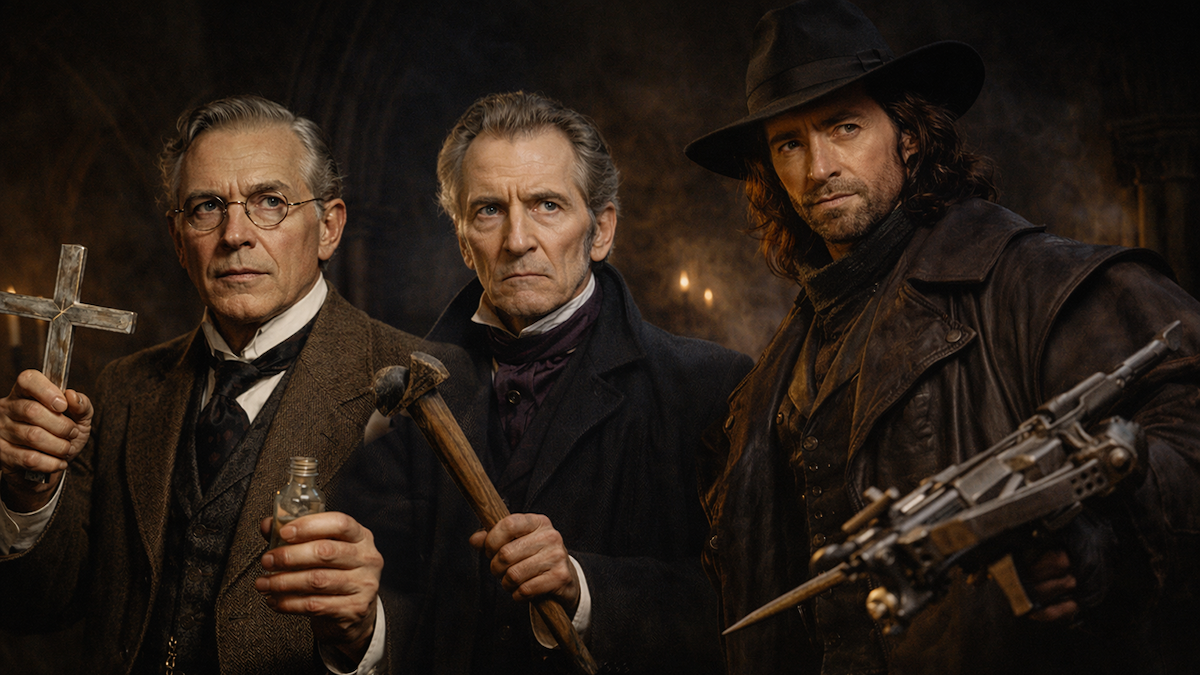
Before leather-clad Daywalkers and teenage Slayers wielded stakes and sarcasm, there was a vampire hunter who fought with holy water, ancient knowledge and an unshakable moral compass. His name was Abraham Van Helsing, and for more than a century he has stood as the archetypal vampire slayer—part scientist, part mystic and relentless adversary of the undead.
Created by Bram Stoker for his 1897 novel Dracula, Van Helsing’s cultural shadow has grown far beyond the page. Over time, he has evolved from an eccentric Dutch doctor into an action hero, mentor figure, zealot and enduring icon. Each reinvention reflects changing fears about vampires—and changing ideas about the people who hunt them.
The Literary Origins: Bram Stoker’s Van Helsing

Van Helsing first appears in Chapter 9 of Dracula, introduced as a Dutch professor of medicine, philosophy and folklore. He is summoned by his former student, Dr. John Seward, to help diagnose the mysterious illness afflicting Lucy Westenra. What initially presents itself as a baffling medical case gradually reveals something far more dangerous, pulling Van Helsing into a battle against an ancient supernatural threat.
In Stoker’s novel, Van Helsing is not a professional vampire hunter. He is a polymath—a man fluent in science, history, theology and superstition—who understands that reason alone is insufficient when confronting the undead. His methods range from garlic and crucifixes to communion wafers and precise medical procedures. While he occasionally struggles with the English language, he never wavers in conviction or resolve.
Stoker conceived Van Helsing as a bridge between modernity and mysticism. He champions empirical observation, but he also insists that open-mindedness is essential when confronting forces that defy conventional explanation. Throughout the novel, he serves as both strategist and spiritual guide, articulating Stoker’s larger themes of duty, sacrifice, faith and the fragile boundary between life and death.
On Stage and Screen: From Gentleman Doctor to Monster Fighter

Van Helsing made his first major leap beyond the page in the 1924 stage adaptation of Dracula, written by Hamilton Deane and later revised by John L. Balderston for American audiences. Actor Edward Van Sloan originated the role in the American stage production and went on to reprise it in the 1931 film Dracula, starring Bela Lugosi as the Count.
Van Sloan’s Van Helsing was dignified, authoritative, and unflappable—a figure of calm intelligence standing in opposition to Dracula’s seductive menace. His portrayal cemented the character as a rationalist who recognizes the supernatural without surrendering to hysteria.
Hammer Horror and the Physical Slayer

Between the late 1950s and the 1970s, Van Helsing underwent a dramatic transformation through Hammer Films. Beginning with Horror of Dracula, Peter Cushing redefined the role as younger, more athletic, and far more physically engaged. This Van Helsing was not content to direct others from the sidelines—he leapt across tables, wielded stakes with urgency, and confronted vampires face-to-face.
Cushing’s interpretation gave Van Helsing a sense of urgency and moral force that reshaped the character for modern audiences. Scholars and historians have frequently noted that his portrayal balanced intellectual rigor with physical courage, presenting Van Helsing as both a man of faith and an active warrior against evil. In many ways, this version laid the groundwork for the modern vampire slayer.
Later Film Interpretations
As vampire cinema evolved, so too did Van Helsing. Laurence Olivier portrayed the character in the 1979 film Dracula, opposite Frank Langella, emphasizing intellectual restraint and classical gravitas.
In Bram Stoker’s Dracula (1992), Anthony Hopkins delivered a wildly energetic and eccentric interpretation under the direction of Francis Ford Coppola. Hopkins’ Van Helsing was unpredictable, theatrical and often unsettling—a man driven as much by obsession as by righteousness. He treated superstition with the precision of a surgeon, deploying ritual and doctrine as clinical tools. This version emphasized Van Helsing as a man consumed by his mission, armed with encyclopedic knowledge of vampire lore.
Reinventing the Slayer: Van Helsing (2004)
In 2004, writer-director Stephen Sommers radically reimagined the character in Van Helsing, casting Hugh Jackman as a globe-trotting monster hunter employed by a secret Vatican-affiliated organization. This version abandoned academia almost entirely, transforming Van Helsing into a high-octane action hero armed with crossbows, experimental weapons and steampunk-style gadgets. The film introduced a mythological twist, revealing Van Helsing to be the reincarnation of the angel Gabriel, cursed to battle evil across centuries.
Though critically divisive, the film embraced spectacle and expanded the Van Helsing mythos to include werewolves, Frankenstein’s monster and Dracula’s brides in a sprawling monster mash. Sommers has explained that his intent was to create a universal defender—someone called upon when both science and sorcery fail.
Television and Alternate Takes
Television offered still more reinvention. Syfy’s Van Helsing (2016–2021) gender-flipped the concept, focusing on Vanessa Van Helsing, a descendant of Abraham who awakens in a post-apocalyptic world overrun by vampires. Her blood possesses the ability to reverse vampirism, positioning her as both weapon and symbol in humanity’s fight for survival. Running five seasons, the series expanded the Van Helsing legacy into dystopian territory.
Meanwhile, Penny Dreadful offered a darker, subversive take. David Warner appeared briefly as Abraham Van Helsing before the character is swiftly killed—an intentional narrative move underscoring how intellect and confidence can falter against the seductive power of darkness.
Legacy and Influence

Van Helsing’s influence extends far beyond direct adaptations. He established the blueprint for the scholarly monster-hunter mentor: eccentric, deeply knowledgeable, morally driven, and often burdened by sacrifice. Characters such as Rupert Giles (Buffy the Vampire Slayer), Whistler (Blade), and Dr. Sam Loomis (Halloween) echo aspects of his DNA.
At his core, Van Helsing embodies the tension between faith and reason. He uses science to understand vampires, yet relies on ancient ritual to destroy them. That contradiction—modern man versus ancient evil—has made him endlessly adaptable. Today, the phrase “a Van Helsing figure” has become shorthand for any character who straddles intellect and action in the fight against the supernatural. He is no longer just a man. He is an archetype.
More than a century after his creation, Van Helsing remains the prototype for all vampire slayers. He has been portrayed as teacher, crusader, fanatic, martyr, and hired hunter. Whether depicted with scholarly restraint or cinematic bravado, he continues to reflect humanity’s enduring need to confront the dark with both knowledge and conviction.