
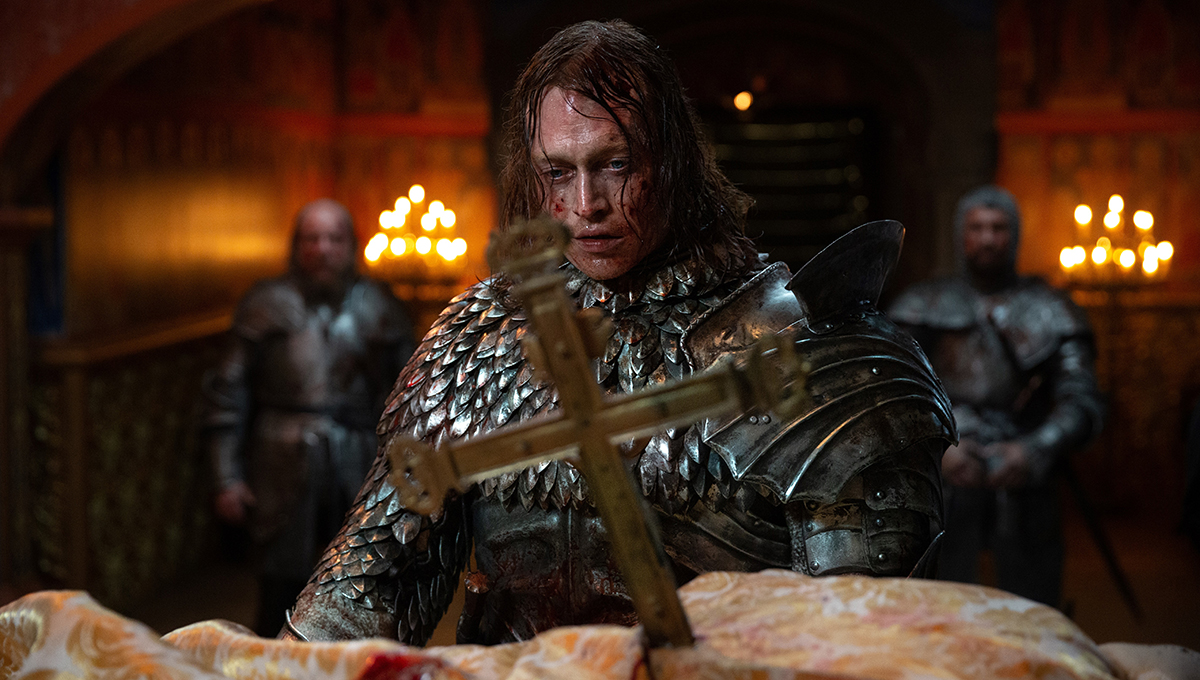
For Luc Besson, making a Dracula film was never about embracing horror. In fact, he openly admits he isn’t a fan of the genre at all. What pulled him toward the story — and ultimately into directing his 20th feature — was something far more personal and, in his mind, far more tragic: love stretched across centuries. “I feel there’s one element in the book that’s missing all the time,” Besson explains. “It’s the love. For me, it’s the ultimate love story — a man who will wait 400 years to see the return of his wife.”
That idea became the emotional foundation of the film. Yes, there is blood. Yes, there are monsters. But those elements, Besson insists, are secondary. “The main thing is the love. It’s the love story.”
The project itself grew organically from Besson’s ongoing creative relationship with Caleb Landry Jones, whom he previously directed in Dogman. While the two were discussing potential collaborations — historical figures, iconic characters — the name Dracula surfaced almost accidentally. “Dracula,” Besson recalls. “And we kind of stopped for a minute.”
Curious, he returned to Bram Stoker’s novel, reading it again not as genre material, but as a human story. What struck him wasn’t fear, but grief. Dracula, as Besson sees him, is a man condemned to immortality not as a gift, but instead as punishment — forced to endure centuries simply to say goodbye to the woman he loves. “He doesn’t make a deal with the devil,” Besson clarifies. “He banishes God from his life. And God gives life, but God can also forbid you to die. That’s his punishment.”
In Besson’s interpretation, immortality is unbearable. “Everybody wants to be eternal,” he says. “But after 400 years, you want to die.”
That paradox — hope followed by despair, repeated across centuries — shaped the structure of the film. Rather than anchoring the story solely in the familiar 19th-century setting, Besson moves freely through time, showing Dracula in the 14th, 15th, 16th, 17th and 18th centuries. “There’s not one Dracula in the film,” he says. “There’s like 21.”
That approach demanded an actor capable of radical transformation. Besson found that in Jones, whom he describes as a chameleon — emotionally open, technically fearless, and entirely committed. Jones spent weeks developing the character’s voice, working with a Romanian dialect coach and adjusting cadence and depth depending on the century being portrayed.
“The voice is not the same in the 14th century as in the 19th,” Besson explains. “There’s a moment when he finds it, and then he keeps it.”
Jones maintained the accent even off camera, worried that losing it would break continuity. Before every take, he performed brief vocal exercises to drop into character. Besson says Jones rarely stepped out of the role at all. “He never really leaves his character.”
Their collaboration was unusually immersive. Months of preparation, weeks of rehearsal away from the set and constant exchange of ideas meant that by the time cameras rolled, little needed to be discussed. “When we come, boom — we shoot,” Besson says.
Visually, Dracula occupies a deliberate middle ground between realism and fantasy. “I love when you’re at the border,” Besson says. “It looks real, and it’s totally fake.” He avoids exaggerated supernatural imagery — no flying capes, no excessive transformations — grounding the film instead in tangible locations, textured sets and believable physical rules.
Even the iconic lore of Dracula is treated selectively. Coffins and the traditional method of killing the vampire remain, but other elements are used sparingly. “I only use what serves the storytelling,” Besson explains. “The movie is very emotional, in fact.”
That philosophy extends to the film’s color palette. Where many Dracula adaptations lean heavily into darkness, Besson wanted light, movement and adventure. “I want this dimension of an adventure,” he says. “Light and colors.”
Dracula’s journey takes him through royal courts across Europe — Versailles, Germany, Spain — reflecting both the passage of time and his search for meaning. To achieve the right visual language, Besson sent his cinematographer and lighting team into museums, studying German and Dutch paintings from the 15th and 16th centuries. “We ate paintings for weeks,” he says. Not to replicate them directly, but to understand how light was constructed in that era.
The historical grounding also informs the film’s action. In one major sequence, Dracula — portrayed as Prince of Wallachia — leads forces against the invading Ottomans in the 14th century, a battle Besson notes is rooted in the novel itself. Armor was designed with authenticity in mind, drawing inspiration from real medieval pieces while incorporating symbolic flourishes. Dracula’s helmet, shaped like a dragon’s head, plays on the Romanian meaning of “Dracul,” reinforcing the myth that he could breathe fire.
Opposing Dracula is a priest played by Christoph Waltz, a character Besson describes as anything but conventional. Part investigator, part philosopher, he has been tracking rumors of vampirism, navigating between church and state. When the two finally meet, Besson refuses to take sides. “I love them both,” he says. “Good luck.” Their dialogue, he explains, isn’t about moral victory, but mutual persuasion — two men trying to understand each other’s truth.
Despite its scale, Besson says the greatest challenge of the production isn’t technical, but emotional continuity. With scenes shot months apart and centuries apart within the story, maintaining a coherent emotional arc requires constant vigilance. “That’s the hardest thing,” he says — remembering exactly how a character feels at any given moment in time.
For Jones, portraying a man across 400 years meant trusting Besson to track that internal journey. “He told me, ‘I’m getting lost between the periods,’” Besson recalls. “So I stay very focused to never let him down.”
In the end, Dracula isn’t designed to shock audiences with gore or fright. It’s meant to linger. “It’s not a gory film,” Besson says. “That’s not the main thing.” What he hopes viewers take away is something quieter — the tragedy of endless life, the ache of devotion, and the terrible patience of love that refuses to die.
Tags: Dracula